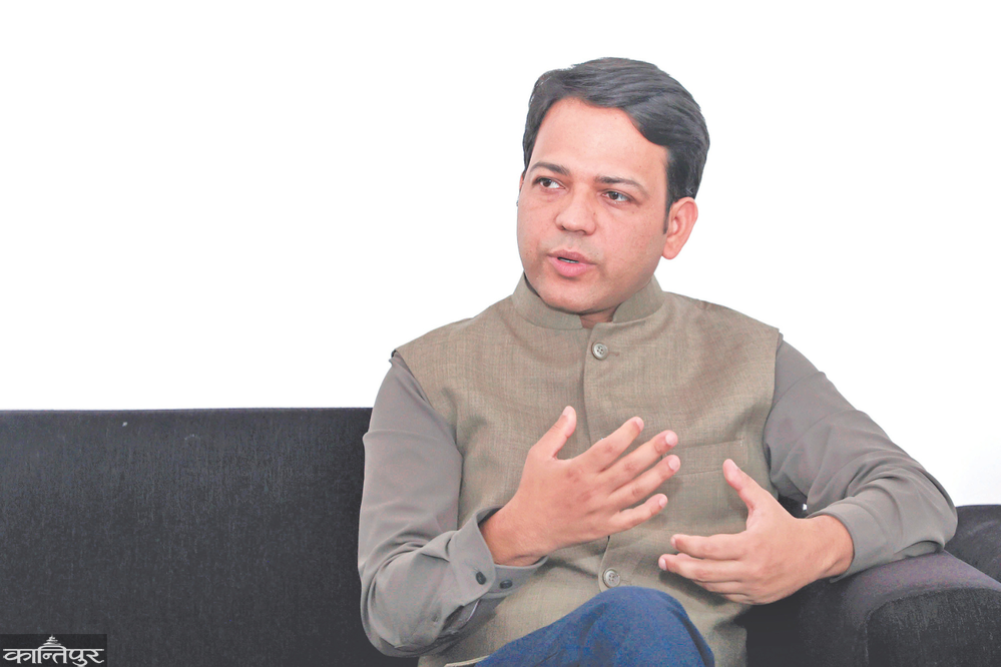
In an interview with Kantipur, RSVP Joint General Secretary Bipin Kumar Acharya says, ”RSVP does not have a foreign policy. The country has a foreign policy. Whatever the government says on foreign affairs, that is it.”
We use Google Cloud Translation Services. Google requires we provide the following disclaimer relating to use of this service:
This service may contain translations powered by Google. Google disclaims all warranties related to the translations, expressed or implied, including any warranties of accuracy, reliability, and any implied warranties of merchantability, fitness for a particular purpose, and noninfringement.
Prime Minister Balendra Shah has not shown interest in foreign visits. He has not even met foreign representatives by showing 'protocol'. At the same time, the ruling Rashtriya Swayamsevak Sangh (RSS) President Ravi Lamichhane has visited India. This visit was made at the invitation of India's ruling Bharatiya Janata Party. During this visit, he has met with high-ranking government officials including Indian Prime Minister Narendra Modi. On the same day of his return, Foreign Minister Shishir Khanal has reached Delhi. In this context, RSP Joint General Secretary Bipin Kumar Acharya, who went to India with President Lamichhane, was interviewed by Rupesh Shrestha for Kantipur Television's Fireside program: It was said that Ravi Lamichhane's visit to India was at the invitation of the ruling Bharatiya Janata Party there. It was found that he met with officials from Prime Minister Narendra Modi, Home Minister Amit Shah, Foreign Minister S. Jaishankar to National Security Advisor Ajit Doval. Did the visit go beyond just 'party to party'? The National Independent Party team went to India at the invitation of the Bharatiya Janata Party. However, as soon as it is called a ruling party, people within that party are playing the role of running the government. When the very high-level leadership of the ruling party of a neighboring country goes to a meeting, the process of meeting the Prime Minister, Home Minister, and Foreign Minister of that country should be taken as a natural one. It should be seen as a meeting with people related to the government of that country in order to advance the relations between the parties in a multidimensional manner. The welcome from the BJP was on the one hand, the red carpet of the Indian government was also ready for you. This has also been discussed with importance in the Indian media. This is not just 'party to party'. It is 'beyond' that. That discussion is also happening in India. How do you view this? The path that is being drawn for a new Nepal. I understand it as the natural understanding, full support, understanding of the neighboring country towards that path, and the desired desire to become partners in each other's new journey. Because after the 21 Falgun elections, when the Rashtriya Swayamsevak Sangh (RSS) entered the government with almost a two-thirds mandate, the level of expectations that the citizens of this country have for the government or party was approved by the party and government of the neighboring country. I have taken the visit in that sense. There is no historical record of BJP giving such a welcome or importance to other political parties in Nepal. Was it because the Rashtriya Swayamsevak Sangh (RSS) was not taken so seriously earlier, but after coming to power, it was not able to be ignored?
No, the Rashtriya Swayamsevak Sangh (RSS) was not taken so seriously even within the country before. I do not consider it so wrong that it was not taken so seriously at any one point. The way the shape of the Rashtriya Swayamsevak Sangh (RSS) has changed since 21 Falgun. Since then, the fact that it has emerged as a reliable, long-lasting political force has been accepted within the country, and its influence has also spread to its neighbors. I am clear that a party that has formed a government in a neighboring country by securing a two-thirds majority, its president and delegation should be given that level of 'respect'. I am 'clear and loud' that every 'political element' should be given that level of 'respect', not just in the case of the Rashtriya Swayamsevak Sangh (RSS).
The issue of how India took the visit of the leader of the ruling party, not the head of the government, has been interpreted from many angles. You have seen that interpretation and commentary. What do you say?
I have taken it naturally. The natural welcome of India or the Bharatiya Janata Party is a 'respectful' welcome with an eye on the future. The meeting itself is not a project. How does the result of the meeting go further. How does it facilitate the journey ahead? Will this meeting remain only in the form of a 'cordial relationship' or will it facilitate Nepal's 'economic journey'? Only from that can we know what that 'warmth' was like.
I met many of you in India. What was discussed in the meeting with Prime Minister Narendra Modi?
How the RSP and its top leadership ‘treated’ this visit is very important. We made a breakthrough. That is, we took this visit beyond a ‘one to one’ or secret meeting. It was not just that we were from the ‘side’ of the party. The acting ambassador representing the country was also part of our meetings. We were not obliged to have ‘one to one’ talks. It was not our idea either. The first major breakthrough is that we have maintained transparency in our meetings as much as possible. We got ‘reciprocal’ from the other side as well. The ‘framework’ was formed that way. When the ‘framework’ is correct, the talks that take place are also correct. There was a self-respecting, mutual and respectful relationship. We can complement each other, and its realization was also in the journey ahead. In the past few years, there has been a great development in infrastructure in India. Nepal could not benefit from that. The Chairman raised the issue with the Indian Prime Minister regarding the benefits Nepal wants to reap in the ‘Economic Contest’. He said that the neighborhood is the first priority for India. Along with that, we got his understanding that Nepal wants to prosper and stability is maintained in Nepal due to the continuity and multidimensional aspects of the relationship between India and Nepal. That is a point of convenience.
During the meeting between the two, other people representing both sides were also present. What topics went through in the dialogue between Chairman Ravi Lamichhane and Indian Prime Minister Narendra Modi, what did Modi bring?
The Chairman discussed the multidimensional aspects of the special relationship between the countries. Second, the starting point of the journey now should be development diplomacy, the Chairman also raised the issue that Nepal wants to reap benefits from India’s prosperity. He raised that issue clearly. Similarly, he said that we want to see the economic strength of Nepalis to be strong, we want to take Nepal to the status of a peaceful, secure and economically prosperous country, we need the support of neighboring countries to properly implement the ‘mandate’ of the citizens. He also made it clear that there should be no ‘negativity’ in the support.
The Indian Prime Minister also mentioned that the resources of Nepal have not been utilized. He raised the issues of tourism, pilgrimage or Nepal’s immense water resources. He said that India is ready to support all of them without any conditions. We have considered that positively. Now the work of preparing the ‘framework’ to implement it will be done at the government level. The Indian Prime Minister had also read the article written by the Chairman in the Hindustan Times. He said that there was agreement on many issues mentioned in the article. He said that he saw the possibility of working together on many issues. The relationship between the political leaderships also ‘decides’ the relations of the two countries. He also proposed why we should not increase interaction in that.
Did the Indian Prime Minister express any interest in the changing politics in Nepal, the rise of the Rashtriya Swayamsevak Sangh (RSS) in power and the stability of Nepal in the future?
Naturally, a neighbor talks about the political stability of another neighboring country. They did too. The issue of improving the living standards of Nepali citizens. May your political journey be permanent was raised during the conversation. We have considered the issue that India wants political stability and prosperity in Nepal to be very positive.
There was no discussion anywhere about the border dispute between Nepal and India during the meeting, right? Is that right?
This is a very ‘sensitive topic’. Every word spoken on this subject, whether it is about diplomacy or borders, is like a border. I personally feel that this is not a normal topic. As a responsible representative of the party, I am not in favor of ‘quoting and unquoting’ the ‘sensitive topic’ related to borders. In the multifaceted aspect of diplomacy, the country will always take ‘forward’. The country will ‘govern’ it. The country is the government of the country. The multifaceted aspects of diplomacy will not be resolved by interviews between you and me. Nor will what I say on a public platform. This ‘decision’ is made through bilateral talks. As a party, whatever problems or disputes we have between the two countries, all of them should be resolved by India and Nepal themselves. Be it border issues or any other issue. That ‘resolution’ will not be achieved in a day through ‘initial’ meetings of the ‘delegation’ of the RSPB President. If there are problems, they should be resolved based on ‘dialogue’, ‘discord’ and ‘facts’. The path forward for that will be taken by the government, not the party. The responsibility of resolving ‘sensitive’ issues like the border lies with the government. The RSPB stands behind the government. There has been a lively discussion on the need to ‘resolve’ the problems between the two countries through the ‘right approach’.
When Rashtriya Swayamsevak Sangh (RSS) President Ravi Lamichhane is going on a visit to India, many expect him to insist on resolving the issues of Limpiyadhura, Lipulekh and Kalapani or other disputed issues with Indian Prime Minister Narendra Modi. Some also expect him to come after finding a way to resolve them. Some even expect him to raise his issues in a loud and clear manner. How will he address this?
 The issues raised regarding border issues are as sensitive as the border itself, as I said earlier. Ravi Lamichhane is no longer just a ‘host’ of ‘Sidha Kura’. He is not just an ‘activist’. Today, he is also the president of a party that represents two-thirds of the country’s ‘mandate’. We should all expect maturity from such presidents. Especially, on ‘sensitive topics’. His responsibilities go far beyond the headlines on ‘social media’ or online. The seriousness of the words he speaks is very high. For that reason, time should be given. More time should be given to diplomacy. More time should be given to a complex issue like the border. The Rashtriya Swayamsevak Sangh (RSS) is determined to resolve these problems. The government is determined. How long it will take, it cannot be said. But it is our top priority. After saying
, you gave such a large vote to the RSS, are you saying to give time now?
In the initial days, we should give our signals and signs to the citizens. Is it on the right track or not? If there was a possibility of resolving the 36-year-old dispute in three months, there would have been no rebellion. That is why we should give time. Do you have any 'comments' on the Prime Minister's statement on the border in Parliament?
Leadership should be the most responsible. After becoming a public figure, everything we wear, say, and do has a meaning. After becoming a public asset, the meaning of things that are considered normal becomes multifaceted. In that context, what we are saying has a great meaning. Today, the highest expectations are placed on the RSS and its leadership. The words we speak and the 'narration' we give have multiple effects. Therefore, our preparation and study on every issue should be thorough. The history of the country is worth examining. The same applies to all Prime Ministers and party presidents. It applies to all ministers and MPs.
Is Nepal trying to adopt two types of diplomacy with India? Is the ruling party trying to increase its 'approach' with India when the head of government is not visiting? Secondly, does India also want to establish relations with Nepal through the RSVP President?
There are multifaceted levels of 'diplomacy' between the two countries. Trade, citizen, government or party-to-party 'diplomacy' is taking place. The RSVP as a party has no interest in 'shadow diplomacy'.
India has always said 'neighborhood first'. In saying that, Nepal and other neighboring countries in the vicinity are also included. On what basis does the RSVP 'maintain' its foreign policy? 'India first' or 'China first'?
The RSVP does not have a foreign policy. The country has a foreign policy. Whatever the government says on foreign affairs, that is what it says. The policy of advancing its diplomacy without compromising its scope is also the party's policy. Whoever the government is, the RSP stands behind it. The RSP is not in favor of having 10 foreign policies for 10 parties in this country. We were neither yesterday nor today.
The day you returned, Foreign Minister Shishir Khanal reached Delhi. Is there any 'connection' in both visits?
The RSP's 'delegation' went at the invitation of the BJP. And, just because a minister from the same party's government is going on an official visit, it does not mean that there is no 'connection' between the party and the government.
During your visit, party president Ravi Lamichhane also met the US ambassador to India, who is also considered Trump's special envoy. During the last visit to India, he also met an American. Why?
America is a big country. That meeting was just a coincidence. There is no need to consider it unnatural when an official representing a country tries to meet. There were talks on multifaceted aspects of Nepal and America. America is also a big partner of Nepal. It is a coincidental meeting with the person representing that country with the supreme leader of Nepal's party. It is a 'cordial meeting'. You say that the government is supposed to 'lead' diplomacy. And will the American envoy meet with your president here and there? When the meetings of the head of government are not taking place, the party president's meetings and talks are going on. Isn't this a 'conflicting' scene?
While we are chatting here, the Foreign Minister of the Nepalese government is in various meetings in Delhi. It is not that the government is not holding them. It was an 'official' meeting when the American representative was coming to Nepal. It was coincidental. We were in Delhi. He tried to meet. We did not consider it unnatural.
Among your meetings, the meeting with Home Minister Amit Shah was also in the news. He usually says that he does not meet foreign guests. That meeting was taken as meaningful. Was it his 'choice' or yours? The meeting took place as a 'respect' given to the President of the Nepali People's Party (RPP) when he was going to India, which was given power by the Nepali citizens through elections. The meeting will be held with the desire to meet both of them.
There are problems that the Nepali side is facing at the border checkpoint. There are issues of pressure and influence from the security forces. Was that subject raised?
The conversation was lively. An open border is both a special feature of the relationship and a complicated aspect. How to make the special and complicated aspects easier, in a 'global contest'. Today, 'crime' has also become 'global'. What issues should be taken into account to make the lives of the people of the two countries easier, those are natural topics of discussion. When two prominent people are chatting, it is not just 'hello hi'. 'hello hi' can be over in 10 seconds. After that, it will be about the country and society.
Let's change the context, the district convention of the RRP is currently being held. The first general convention is being prepared. You are also the coordinator of the committee formed to amend the statute. What are the preparations for the general convention? What is being tried to transform the party from it?
This is the first general convention for us. That is why we are wondering what to do. In terms of experience, it is the first historical general convention. It is a party with a 'concept' of becoming a 'modern' party that is different from others. That is why we are focusing on how to make the general convention effective and not traditional. The general convention amends the statute. The draft is being prepared. It makes the party's journey and 'framework' easier. It brings more clarity to the party's 'ideology'. Along with the statute, what kind of party the RSVP wants to become as a party is also decided. Similarly, the leadership at all levels is elected for five years.
Should the party president or other central office bearers be elected? Or not?
If you ask me, my personal opinion is that it should be a democratic practice. However, as the party founder, I am also aware. Various parties have joined hands before the elections. They should not be treated unfairly in any way. After Asad 20, 21 and 22, there should be no party left within the RSP. Those who will take the leadership after the next general convention will be from the RSP. It does not mean that they came from this party or that party. All the parties have come to the RSP. Those who have the ability to integrate them should take the leadership forward.
Should Ravi Lamichhane continue to lead the RSP?
If you are looking for my personal answer, then unconditionally. Personally, I want to see Ravi Lamichhane as the president. I am 'loud and clear' about it.
Is there a situation where an election will be held?
The party's constitution envisages an election.
What will be the role and participation of Prime Minister and senior RSP leader Balendra Shah in this general convention?
That is more for him to say than for me. I can tell you what my role will be.
There is talk that your aspiration is to be the general secretary of the party, right?
You and I also talked about being a minister when we were talking a while ago. Whenever something happens in the party, my name comes up. I take that as a sign that I am starting to become a matter of concern for the citizens. As the founder of the party, my only concern and concern is that the party should go on for ages. Today, since I have direct relations with the Rashtriya Swayamsevak Sangh (RSS), the bell, and the blue color, my concern is that the party should go up. Wherever the party sees me suitable, I will be happy there. This time, even if they ask me not to become a central member, but to show my ability as an MP for 5 years, I will be happy.
The general convention of the RSSSP is being held in Chitwan. Will Prime Minister Balendra Shah be participating there?
This is the first historic general convention of the RSSSP. This is a moment that every member of the party should be proud of. The party is an important point in the journey of life for people from ordinary members to high-ranking officials. For me, it is a moment of ‘celebration’. I want every person in my party, inside and outside the hall, to be a participant. However, I cannot guarantee who will come here and who will not. However, the question of whether the party president, senior leader, or general secretary will not come is a difficult question.
So, you are not confident that senior leader Balendra Shah will participate in the party’s first national convention or not. Are you not sure?
The convention is underway. It is not appropriate to talk about whether the party leaders will come or not. I believe that everyone will come, he will also come.
Senior leader Balendra Shah is there. Will the post of senior leader remain while the statute is being amended?
The draft of the statute will be out by the middle of this week. It is not right for me, as the statute amendment coordinator, to say everything that is in it now.
In the past, there used to be turmoil in power after leaders visited India and returned. There are many examples of government changes. Is there any possibility of that after your visit?
The key to Nepal's politics lies with the Nepali citizens. It lies within the structure within the borders. The Rashtriya Swayamsevak Sangh (RSS) is putting a lot of effort into three areas – we want to be predictable, credible and capable. We have no interest in allowing a few individuals to bake the bread of politics by putting this country in the same turmoil of instability. The leadership of the RSSS does not need to cross the border to discuss the power equation within the country. Rest assured about that.