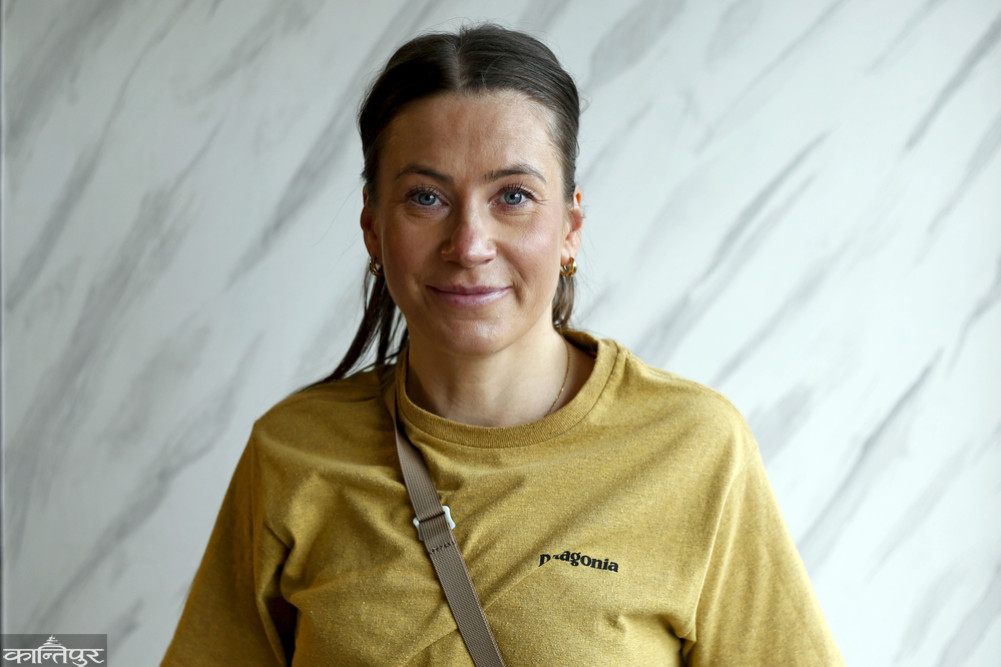
Christine Harila, who has climbed mountains over 8,000 meters 31 times in 6 years, says: Now I spend time with my family
We use Google Cloud Translation Services. Google requires we provide the following disclaimer relating to use of this service:
This service may contain translations powered by Google. Google disclaims all warranties related to the translations, expressed or implied, including any warranties of accuracy, reliability, and any implied warranties of merchantability, fitness for a particular purpose, and noninfringement.
Norwegian mountaineer Kristin Harila, who set a record by climbing all 14 of the world's 8,000-meter peaks in just 92 days, talks about her rapid success, the controversies surrounding climbing, the need for the safety of the Sherpa community, and the pain anyone who wants to climb Everest should be prepared to endure.
In 2022-23, Norwegian mountaineer Kristin Harila, along with climbing partner Tengen Lama Sherpa, set several records by climbing all 14 of the world's 8,000-meter peaks in just 92 days. Now 40, Harila seems to be preparing to end her mountaineering career. She has climbed 8,000-meter peaks 31 times in the last 6 years. This season, she climbed the 'Himalayan Triple Crown' - Everest, Lhotse and Nupse.
Recently, at The Ascent Summit, jointly organized by the US Embassy and Seven Summit Treks in Kathmandu, Christine Harila spoke to Kantipur's Suraj Kunwar and Biken Dawadi about his journey to success, criticism, the safety of the Sherpa community, and his decision to take a break from professional mountaineering:
Let's start with the most basic question. How did you get attracted to mountaineering?
I first climbed Kilimanjaro in 2015. That experience left a deep impression on me. Eventually, in 2019, I quit my job. And, after that, I started coming to Nepal. Kilimanjaro was a very high mountain for me at that time. Before that, I mainly used to cross-country ski. There are no really high mountains in Norway, only small ones. So I used to run a lot in the mountains near my house to prepare.
How old were you at the time?
29 years old.
What was the main factor in achieving such great success in such a short time?
I skied cross-country for many years. I ran a lot in the mountains. That gave me good stamina. I had climbed many mountains before coming to the Himalayas. Although they were small. That experience was the basis of my success.
I am very interested in the relationship between you and your guide Tengen. How did you first meet?
I had already heard about him. We had met briefly a few times through the company. In March 2023, we climbed Manaslu together for the first time. Then we went to Shishapangma and Cho Oyu. The experience there was very good. Then we decided to climb all the remaining peaks together.
I heard that this is your last professional mountaineering season. Is this true?
Yes. But my career is not that short. I have been coming to Nepal for 6 consecutive years. During this time, I have spent a lot of time in Nepal. I have climbed mountains higher than 8,000 meters 31 times. So now it feels like this chapter is over.
Is it time to hang up the crampons for mountain climbing forever?
Now I want to spend more time with my family. I will come to Nepal in the future to trek and visit friends, but I will not participate in long climbing expeditions for a while. The main reason is that I am away from home for a long time. I need a long break. Being away from home for years not only affects my body, but also my relationships. I have a mother, father, brother and sister. My sister has two children. Now I want to spend time with them.
Critics say that you have made climbing easier by using helicopters and setting up camps in unusual places ?
That is wrong. Not everything the critics say is true. Many do not understand the reality of high-altitude mountaineering. Many of their accusations are completely wrong.
What is your view of the Sherpa community ?
There is no doubt that the Sherpas are taking too many risks. The weather is harsh and the terrain is dangerous. Changes are needed to reduce the risks and make climbers more prepared. I have always been a vocal advocate for reducing the risks of the Sherpas . Climbers need to be made more self-reliant .
But if climbers become self-reliant, won’t the employment of the Sherpas be affected ?
I think the way of working in the future will be different. The Sherpa community will remain, but they will have to take much less risks than they do now .
Is overcrowding a big problem on Everest?
It is largely related to the time available for climbing. The ‘summit window’ of Everest is a very short period of time. Expedition companies generally manage crowds well. But a certain level of experience and qualification should be made a requirement for those who want to go to Everest.
New technology and easy access will attract many. Everest will always be special as it is the highest mountain in the world. But it is important to ensure that those who get permits are adequately prepared.
Have you felt the effects of climate change in the last 6 years?
Yes. The changes are particularly evident in the Khumbu Icefall. It is changing a lot. The glaciers look very different than before. The snow in the Himalayas is gradually melting and the old snow cover has not been restored. But even if the snow melts, people will not stop coming here.
You seem very optimistic?
I think people will always be attracted to the big mountains. Seeing the mountains through social media makes more people want to come here. That's why the number of climbers is increasing every year. This trend will continue in the future too. But some restrictions or qualification criteria are needed .
When did the goal of climbing 14 8,000-meter peaks in the fastest time become ?
I decided to try to set this record after climbing Everest and Lhotse in 2021 .
After just two peaks ?
Yes . It wasn't for the fame . I wanted to show that women can also set such records and achieve the same achievements as men .
What is your message to women who want to take on new challenges ?
Go out, climb and try everything you want. You can do it .
Which was the hardest mountain for you ?
It's hard to say. It depends on the weather and conditions. I've climbed 8,000 I have climbed mountains higher than 31000 meters 31 times. Manaslu in 2022 and K2 in 2023 were among the most difficult for me.
What did you do before mountaineering?
I was in a leadership position in a large company. I was responsible for about 900 employees. The salary was good. But I wanted to make a difference in my life, so I quit my job.
That decision was not because of money, was it?
No, not at all. It was not for money.
This season you climbed Everest, Lhotse and Nuptse. Why were you drawn to Nuptse?
I had already climbed Everest and Lhotse three times. But Nuptse had been my dream since I first saw it. It seemed extremely steep and almost impossible. So I wanted to reach its summit one day.
Wasn't it a tribute to your friend, guide Tenjen?
Yes. When I reach the top of the mountain, I feel like he is always with me. I feel closer to him as we go up.
What are you working on with the foundation established in Tenjen's name?
The main objective is to increase the safety of people working in the mountains. It has two aspects. First, to make climbers more prepared. Second, to ensure a good working environment for those working in the mountains. They need proper equipment, training and remuneration.
When climbers arrive without adequate preparation, the people working there are at great risk. That is why the preparation of climbers is extremely important.
Where did you set up the foundation's office?
In Norway. Not in Nepal at the moment, but it may be in the future.
What do you say about the accusation that you stepped on a porter during the climb?
In reality, there was no dispute. After he fell, we tried to rescue him for hours. But many people spread misinformation despite knowing the truth. The accusation that I ignored the dying porter to set a record is completely false. That never happened. I was there for about an hour and a half. The report also mentions that we tried to rescue him. So this is just a misunderstanding.
What should a person who wants to climb Mount Everest mentally prepare for?
First of all, one should be ready to endure suffering. One should accept that the climb will be extremely difficult and challenging. One should feel comfortable with it. The highest peak in the world cannot be expected to be easy.
What advice do you have for those who want to climb Mount Everest regarding diet and preparation?
First, one should climb many mountains and gain experience. By doing so, one can understand one's body, stomach, necessary food and energy management. Experience is the greatest teacher.
Will foreign climbers be able to climb mountains without Sherpas in the future?
The work of Sherpas is very important. They have unique knowledge of the mountains. So it is good to work as a team by partnering with them. Safety is also in that.
Will drones and robots come to mountain climbing?
Yes. Technology cannot replace human connection. It is not just about carrying loads. It is also important to make decisions, solve problems and support each other. That is why we call them ‘climbing partners’. You need a friend to share the struggles and joys of climbing.
Apart from mountaineering, what attracts you to Nepal?
I will not stop coming here. Tenjen’s family is here. I will come to visit them, spend time with friends and do trekking. But a three-week visit and a nine-week expedition are different things.
What do you like about Nepal apart from nature?
The people. They are very welcoming to guests. I like the culture here, and in many ways it is similar to the culture of my country.
Favorite Nepali dish?
Pizza.
Nepali food?
In the Himalayas, we eat dalbhaat. That's why my choice is dalbhaat.