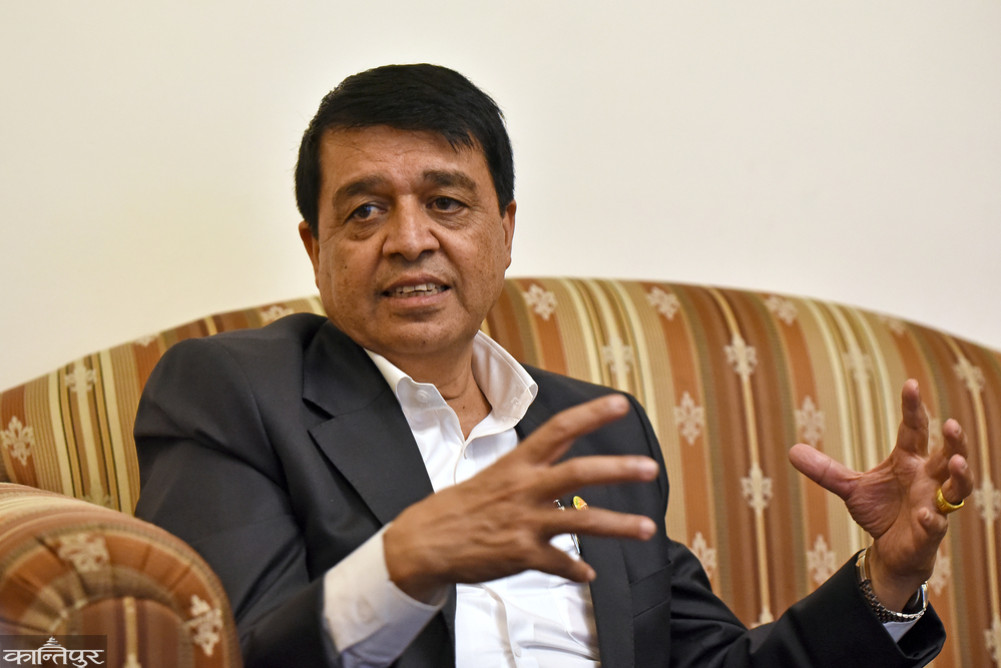
In a conversation with Kantipur, Federation of Nepalese Chambers of Commerce and Industry (FNCCI) President Chandra Prasad Dhakal said that despite progress in policy reforms, investment-friendly environment, and public-private partnerships, negative attitudes and lack of confidence towards the private sector still remain a challenge.
We use Google Cloud Translation Services. Google requires we provide the following disclaimer relating to use of this service:
This service may contain translations powered by Google. Google disclaims all warranties related to the translations, expressed or implied, including any warranties of accuracy, reliability, and any implied warranties of merchantability, fitness for a particular purpose, and noninfringement.
Chandra Prasad Dhakal, who is stepping down as the president of the Federation of Nepalese Chambers of Commerce and Industry after completing his three-year term, has faced many challenges and opportunities during his tenure as the leader of the private sector. Amidst the post-COVID economic slowdown, declining investment, high interest rates, and policy uncertainty, he tried to organize the voice of the private sector and increase dialogue with the government. He claims that the federation has been active in policy debates related to infrastructure, energy, tourism, and the financial sector. However, the morale of the private sector has not yet increased and the economy has not yet become dynamic. Kantipur's Yagya Banjade and Bimal Khatiwada talked to him about the review of his tenure, the state of the economy, the investment-friendly environment, and the role of the private sector while stepping down: After the formation of the new government, investigations are being conducted on some industrialists and businessmen. You call this 'arrest'. Since the government sees it as a problem, real investigations have been conducted on some entrepreneurs and businessmen. The government is saying that it is not its intention to hurt or intimidate the entire private sector. In this context, you have already held extensive discussions with the President of the Rashtriya Swayamsevak Sangh (RSS) Rabi Lamichhane and all three umbrella organizations of the private sector. Why was this discussion necessary? What happened in the discussion? The discussion was held with the President of the Rashtriya Swayamsevak Sangh (RSS) Rabi Lamichhane regarding the perception of the private sector, recent developments, and other issues. In the past, the private sector has always been a target after every movement. This trend was repeated in the Gen-G movement of 23 Bhadra and the protests of 24. In which the private sector also suffered a lot. But the private sector is not an opponent of the state, but a contributor. The private sector has a huge contribution to investment, production, revenue, infrastructure construction, employment creation, etc. The private sector is a driver of economic development. But the view of the state and the general public towards the private sector is negative, and the federation has been saying that it needs to be changed. The private sector contributes 81 percent of the total investment in Nepal and 85 percent to employment creation. Despite all this, we have been lobbying for the private sector to be targeted, suggesting amendments to unfavorable and inconvenient laws, etc. Since I became the president of the federation, we have been working on lobbying, suggesting amendments to unfavorable and inconvenient laws. The federation has also suggested the formation of a high-level commission to make suggestions for economic reforms.
The private sector has always wanted political stability, a stable government, and policy stability. This has not been possible for many years. After the elections on 21 Falgun, the RSVP government was formed with a near two-thirds majority. Even before this government came to power, the federation had prepared a draft of the 'Private Sector Protection and Promotion Plan Strategy' (PSPP) and submitted it to various government bodies. The issue was also included in the 100-point agenda passed by the cabinet of this government. This is positive. Meanwhile, private industrialists and businessmen have been arrested in recent days for investigation. Due to these reasons, the confidence of the private sector has decreased, and there was a fear that it will be targeted again. In this context, we had requested the President of the Nepali Congress, Ravi Lamichhane, to clarify his views on the private sector. Accordingly, a discussion was held. In the discussion, along with the Federation, the officials and members of the Confederation of Nepalese Industries and the Chamber of Commerce held a discussion on Sunday. In the discussion, President Lamichhane has clarified his views on the private sector again. President Lamichhane has clarified that the government's objective is not to discourage the private sector, but to encourage and facilitate it. President Lamichhane has given clear answers to the questions of industrialists. The President urged them not to have any doubts about whether the government is against the private sector and to do business with full confidence. In the first meeting with you after the formation of the new government, Finance Minister Swarnim Wagle had said that industrialists would not be detained, but would be heard first, and that if they made a mistake, they would be fined. But another minister in the government seemed to have instructed industrialists to use the language of the private sector to 'catch up'. How has the private sector taken this? There was no discussion on why this or that industrialist was arrested. There was a discussion on the whole. He clarified that the government is working to maintain good governance in the country and even though industrialists have been taken under control as per the suggestions/recommendations of some regulatory bodies, this is not a situation that discourages the entire private sector. The Chairman has said that even if some individuals are affected in the course of controlling corruption and maintaining good governance, they should not be viewed as a whole.
As soon as a government body starts investigating industrialists on a specific issue, the private sector is immediately arrested and confidence is lost. Does that mean that industrialists should not be investigated at all?
The Federation has always encouraged industry and business with integrity. The Federation has not said that those who make mistakes should not be investigated. We have made the investigation process easy, when an entrepreneur is taken under control, all his industries and businesses are directly affected. To prevent that from happening, we have said that action should be taken only after they are found guilty in the investigation. If possible, we only said to impose financial penalties instead of control and imprisonment.
You led the federation when the economy was in a difficult situation due to the COVID-19 infection. There were ups and downs during your tenure. Now you are handing over the responsibility of the chairman. How do you evaluate your tenure?
When I took over the leadership of the federation, the country's economy was sluggish. The impact of the COVID-19 pandemic that spread around the world had also started to be seen in our economy. The country's economy was suffering from the impact of the Russia-Ukraine conflict, high interest rates, lack of liquidity, and investment disappointment. Frequent changes of government had added to the policy confusion. In such an unstable situation, the initial test was to maintain the morale of the private sector and create an environment that would keep economic activities moving.
In this context, I moved forward by prioritizing the creation of an investment-friendly environment, initiatives to remove policy obstacles, and state-private sector cooperation. I continued to strive to put the federation's initiatives into practice through institutional dialogue and coordination, rather than limiting them to announcements. The Federation, moving beyond its traditional role of making demands, tried to influence the policy-making process. The third executive committee meeting of the Federation held in Dhorpatan, Baglung, decided to organize a comprehensive national economic debate to solve the country's current problems. This brought the government, political parties, regulators and the private sector on one platform. As a result, the government formed a high-level economic reform suggestion commission as per the proposal of the Federation. As the chairman of the Federation, I myself served as a member of the commission. It has recommended more than 30 legal reforms to create an investment environment. It has brought long-standing legal complexities and procedural obstacles to the formal agenda of reform. It has prepared the basis for improving the investment environment.
During my tenure, the work of redefining the relationship between the private sector and the government has long been a task. I tried to shift the government-private sector relationship from a situation of confrontation and one side making demands and the other side addressing them to cooperation. Which is considered a major and important achievement of my tenure. I also consider it a great achievement to have the proposal to bring the private sector under the purview of the authority to be revised.
For this, we succeeded in amending the provision to bring the private sector under the purview of the authority by convincing various government bodies such as the Prime Minister, ministers, Chief Secretary, Secretary and other officials, constitutional bodies and Parliament with our arguments. Investment and economic growth could have been affected by having too many regulatory bodies. We not only opposed this, but we succeeded in bringing everyone to an agreement and suspending this provision for the time being, which helped protect the investment environment. There was a growing negative narrative that nothing happens in Nepal and nothing can be done with Nepal's internal capital. To dispel this narrative and collect small capital scattered inside and outside the country, Nepal Development Public Limited with a capital of 10 billion rupees has been established. Through this company, a new model has been proposed to invest in large infrastructure, productive industries and startups through internal capital mobilization. I also consider the efforts to attract foreign investment through investment forums and bilateral conferences in various countries to be a success.
The amendment of the statute of the federation is another important achievement during my tenure. We succeeded in unanimously amending the statute of the federation, which has been a subject of controversy and debate for a long time. In the past, the statute used to be amended to bring or prevent someone from taking office. This is not the case this time. Through the amendment of the statute, the system of automatically becoming the president was ended and a system of selecting the president through direct elections was implemented. This has made the leadership selection process more competitive, accountable and timely. This change has created a new structure of balance of power within the federation. In this way, since it comes through a competitive method through the then representatives, the new statute will make the president more accountable, responsible and result-oriented towards the members. Overall, the foundation has been laid during my tenure to transform the private sector from a 'pressure group' to a 'development partner'. It is clear that if the efforts of collaboration, policy reforms and institutional transformation that have been put forward during my tenure can be continued, it will have a long-term positive impact on Nepal's economic development and investment environment.
What do you feel could not be done during your three-year tenure?
I had prioritized five issues to take over the leadership of the federation. First, to prepare a strategy to resolve the then economic crisis, second, to create an investment environment, third, to strengthen the partnership between the state and the private sector, fourth, to produce skilled manpower and create employment, and fifth, to determine the place of the private sector in the hierarchy of the state to raise the morale of businessmen. All these tasks have been completed very successfully.
When I came to the leadership, there was a COVID-19 infection. There was a lack of liquidity in the financial system, high interest rates. There was political instability. That situation is not there now. Interest rates have come down significantly. There is more liquidity in the financial system. A stable government has come. Many policies and laws have been amended, some laws are in the process of being amended. Foreign exchange reserves, balance of payments position and current account are in surplus. Based on these indicators, the state of the economy is also very comfortable now.
The investment environment has improved. As an example, you can see the investment under the IME Group. During this period, we have established a paper industry in Mahottari with an investment of about 2 billion. We have established a cement board in Nijgadh for the first time in Nepal. Along with this, tourism infrastructure and hydropower projects are under construction in various places. Since I am at the helm of the federation, there has been no decrease in investment expansion. Work is ongoing. Some projects are being worked on to be operational soon. Not only mine, but other industrialists and businessmen are also investing without any hindrance. For example, the expansion and reconstruction of Bhatbhateni Supermarket can be taken. The environment here has not stopped investment in this way.
It has been easy to expand investment since you can reach all places, including the Prime Minister. It is said that not all industrialists and businessmen have such access, right?
I have been the chairman of the federation for only three years. But I used to do business even when I was not in the federation, and I continued to do business even when I was. I continue to do business even after leaving the presidency. Therefore, there is no difference in the expansion of industry and business when I am the chairman of the federation and when I am not. Many of my investments were made before I became the chairman of the federation. Bank interest rates are at an all-time low. Money has been piled up in banks.
And some private sector people have been saying that there is no investment environment, that confidence has been lost, right? What are the grounds for saying that it is the right time to invest?
No, now is the most appropriate time for investment. Many policies, including low interest rates and easy investment, are favorable. The average loan-to-deposit ratio (CD ratio) of banks and financial institutions is less than 74 percent. While banks are allowed to maintain a CD ratio of up to 90 percent. There is a new and close-to-majority government. There is policy stability. For these reasons, this is the right time for investment. However, some issues still need to be improved.
What needs to be improved in the place or area of investment?
We have an investment board. Previously, where private sector people were kept, now there are no private sector people. Only the private sector knows the pain of real investors. Otherwise, reality is on one side, policies and regulations are on the other. Such issues should be improved. The private sector should also be consulted on changes. The Federation had also discussed this with the Investment Summit by calling representatives (investors) from different countries and visiting their countries.
In which major countries did such activities take place? What was the response from them?
The government needs the support of the private sector to attract foreign investment. If the government tries to attract investors by making policy and procedural reforms, the private sector can provide practical advice. The private sector will provide case studies of success. The establishment of joint venture companies will also be initiated by the private sector. Embracing this philosophy, I took the initiative to activate the federation in this direction. The federation, in collaboration with organizations in the relevant countries, organized bilateral business summits in China, India, UAE, Spain, and Thailand. Two consecutive business summits were successfully held in China—in September 2023 and December 2024.
The first summit was addressed by Pushpa Kamal Dahal as Prime Minister and the second by KP Sharma Oli. In those summits, we informed Chinese investors about the progress made by Nepal in creating and improving the business environment. We tried to attract investment by informing them about the benefits and other attractions of doing business in Nepal.
At the summit, organized with the support of the China Council for the Promotion of International Trade (CCPIT) and the Nepali Embassy in Beijing, we discussed the possibility of expanding Nepali exports to China and exporting to other countries via China. Chinese investors and government representatives pledged to support and cooperate in that. At that time, Nepal had just completed its sovereign credit rating. The morale of both the government and the private sector was high due to the good rating after India in South Asia. At the summit, I urged the Chinese government to prioritize Nepal. Ministers and high-ranking officials of the Chinese government and big businessmen showed their commitment to support it. The Vice Minister of the Ministry of Commerce of China addressed the summit as a special guest. He also said that he would support Nepal in investment, tourism and trade. Not only trade and business, but China can become a good employment destination and a good source of tourists for Nepalis. However, we have not been able to benefit from it. Such issues are raised and discussed in discussions and negotiations at the government and private levels. Nepal has not benefited from the lack of a culture of continuous advocacy on issues that can have a special impact on the economy and employment. About 130 Chinese businessmen, Nepalis doing business in China, and a delegation from Nepal participated in the summit, including 200 businessmen. We also published a book in Chinese and Nepali titled ‘Why Invest in Nepal’. I do not remember a program of this level being organized in Beijing. Therefore, the Nepalese government has also included it in various statements and reports.
A bilateral business summit was organized in New Delhi, India in June 2080 and in Dubai in December of the same year. More than 60 Indian companies and representatives participated in the summit held in New Delhi. While speaking there, I had said, ‘Nepal is a proven destination for Indian investment. Out of the total approved foreign direct investment here, Indian investment accounts for more than 30 percent. Indian companies doing business in the manufacturing and service sectors in Nepal have been getting good returns on their investment. They have a pleasant experience of more than two decades.’ I had also told businessmen and investors present at the Nepal-India Business Summit, New Delhi, that Nepal is trying to attract global and regional FDI by making foreign investment and technology transfer, public-private partnerships and investment-related policies and laws more open and favorable.
India is Nepal’s largest trading partner. 70 percent of Nepal’s export trade is with India. Similarly, Nepal is the 11th largest export destination for India. If Nepal’s hydropower potential can be turned into a reality, we can balance trade by exporting energy. And such trade will benefit Nepal in the long run. For that, we need to strengthen investment from India and other countries. They need to be informed about the huge business potential here. Now, Nepal has adopted a policy of promoting hill stations close to the Indian border. You can reach those destinations in about two hours’ drive from any Indian border, where the maximum temperature remains below 30 degrees Celsius even in mid-summer. These hill stations are not yet fully developed. I had told Indian investors that there was a good potential for investment in tourism infrastructure and other sectors there. We were the only ones to hold such an investment promotion program at the KOP, which is considered one of the world's largest mega-events, which drew the world's attention to Nepal. In this way, the federation has succeeded in responsibly fulfilling the work that the government should do.
The federation has maintained its reputation at the regional level. The proposal we put forward at the 2023 BIMSTEC Business Summit to establish a BIMSTEC Chamber has been accepted by the 2024 summit. It is a matter of pride for us that all member countries have agreed to the federation's proposal to establish a BIMSTEC Chamber of Commerce. This has increased the prestige of the federation as well as the country.
What are your plans to increase investment and go into new areas after leaving the leadership of the federation?
To complete your work that has been done and is ongoing. Work is underway on some projects. Work is being done in the fields of hydropower projects and tourism. Therefore, the work of previously started projects should be completed.
The government is currently preparing a budget, what suggestions did you make on this?
The new working committee will come and give suggestions. Infrastructure construction should be prioritized in the upcoming budget. Infrastructure construction work that is currently underway should be completed. A budget that promotes domestic production and replaces imports should be brought in. Now, we need to create an environment for producing and exporting from Nepal. Right now, we are importing wood, and we need to create an environment for exporting it. Our rivers and canals have been clogged due to gravel and sand. But it is not allowed to be extracted. If we can complete the rules and sell it, the state will earn income. It can be extracted and sold without damaging the environment. For this, it is necessary to make laws accordingly. Due to the ongoing war in West Asia, construction work is currently affected due to shortage of construction materials.
There are also issues of industrial villages and SEZs, is it said that entrepreneurs did not go there due to obstacles from the private sector?
Although the tax levied for using Special Industrial Zones (SEZs) was asked to be reduced for years, it was not reduced. Now, it has finally been reduced. The revenue received by the state has been lost due to lack of timely decisions on this. Apart from cars and motorcycles, other goods entered through informal channels. This also posed a challenge to the state. Now many businessmen go there. It has become easier. Not only rent, but there are other minor problems as well. For example, an industry requires five bighas of land. But only one bighas is available. Due to this, businessmen are reluctant to go because there is not enough and required land.
The issue of dedicated trunk lines has not been resolved yet, what will happen to it?
When I was in the leadership, my job was to decide whether to cut the line or connect the cut line. At some point, it was decided that a commission should be formed to solve this problem sustainably. It was also successful.
The second generation of families doing business in the industry studied abroad, came to Nepal to see if they could do something, and started going out again because of the situation here, right?
My children have not said that they are going out because there is no working environment in Nepal. They are enjoying their business here. I have told not only my children, but all the young generation to do something here. When I meet you abroad, I have said that you should return to Nepal. I have said that the knowledge you have studied abroad should be applied in Nepal. There are many things in Nepal. We have not studied and researched them. The current generation is smart. It is accustomed to information technology. There is also a lot of potential in this area.
What impact can the West Asia war have on remittances, has it had, or not?
People have not started returning to West Asia due to the war. It is not yet time to assess this. When people return, they will provide employment and remittances will decrease. More than this, it seems that fuel will have a big impact on infrastructure construction.
Which group are you on in the federation election?
I am in favor of unanimously selecting the leadership. If there is a situation where an election is held, I will only vote. Therefore, when the election is held, the leadership should be selected through fair competition. If the new working committee can only implement the work we have done in the last three years, it will be much easier.
Can't we make the private sector umbrella organization a single organization? Didn't you take the initiative in this?
Not after I became the president of the federation, but when I was the vice-president of the Employers' Council, I brought together those who had returned from all over the world and made them work. We worked by connecting everyone and sitting in a high-level commission. Where a committee was formed under the leadership of former Finance Minister Rameshwor Khanal. Therefore, rather than merging, there should be an environment where everyone comes together after blowing the whistle once.