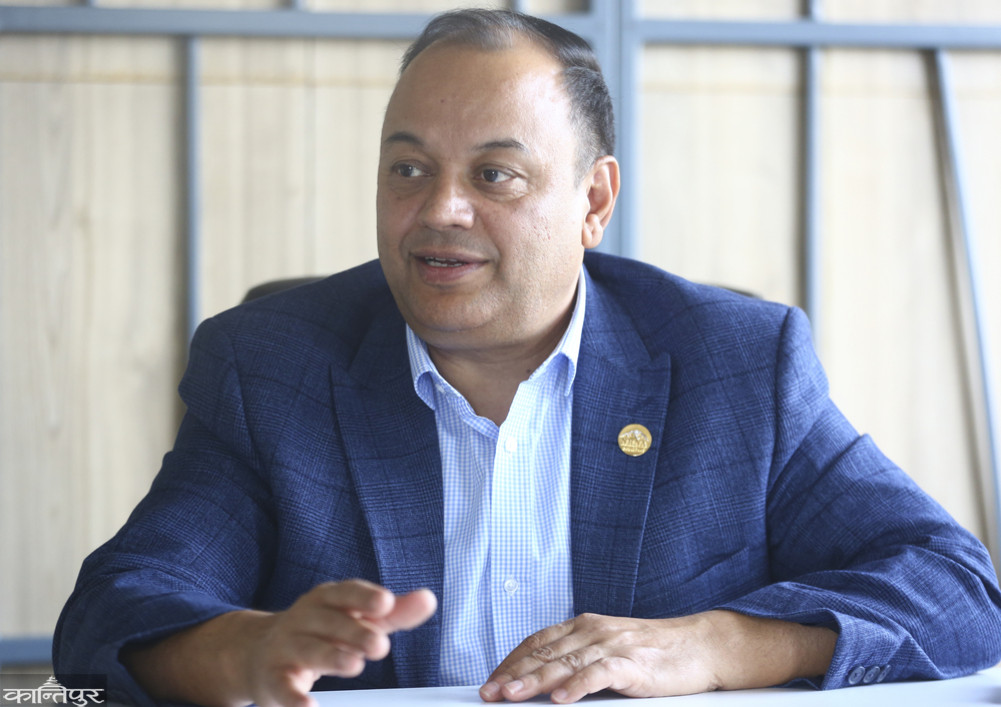
”Recently, those with money or political connections have used it in the elections, which has led to chaos in the NRNA.”
We use Google Cloud Translation Services. Google requires we provide the following disclaimer relating to use of this service:
This service may contain translations powered by Google. Google disclaims all warranties related to the translations, expressed or implied, including any warranties of accuracy, reliability, and any implied warranties of merchantability, fitness for a particular purpose, and noninfringement.
The Non-Resident Nepali Association (NRNA), established in 2003 with the motto of ‘Nepali for Nepalis’ to unite Nepalis scattered around the world and contribute to the prosperity of the motherland, has been mired in controversy since its ninth general convention. The NRNA, which was divided into three factions and headed for disintegration, has returned to harmony through the 12th World Conference and Unity Convention. Kantipur workers Krishna Acharya and Home Karki spoke to Hemraj Sharma, the president of the NRNA and ICC, who was unanimously given the responsibility of leadership from this convention, about the NRNA’s controversy, the crises seen in West Asia, and future plans: NRNA is an organization with a long history. However, in the last three/four terms, it has been embroiled in major controversies. It has been embroiled in lawsuits. Questions have been raised about the dignity, reputation, and credibility of the organization. This time, the elections have been held relatively peacefully. How was this possible? The issue of why the controversy arose should be understood with background. It seems that the elders did not envision the speed of its spread when establishing the NRNA. It seems that the structure of the organization could not handle it due to social media or other digital platforms. For example, we were stuck with what was there in 2003 regarding the organization's election system and other issues. On the other hand, the NRNA could not produce leadership. When it came to Upendra Mahato, Jiva Lamichhane, and Shesh Ghale, they were a legacy in themselves. It seems that the government expected more from us, it seems that we gave more assurances than necessary They did not have to involve many other parties to go to the elections and come to the leadership. That is how people used to unite. Lately, we have not been able to produce that kind of leadership. And, after going to the elections, people would use whatever they had. Those who had money or political connections used that. It seems that this is where the chaos started. Lately, there has also been a mismatch among the elders. Political parties took advantage of that. One by one, NRNA leaders started supporting one political party. The parties also needed a platform. That's why there was a split. I don't think there would have been a situation where we would still be united if it weren't for the Gen-G movement. The opportunity given by the organization's statute was used intensively and well in the past 6 months. Ever since Mahesh Shrestha was elected, we had been talking about moving forward as one. However, there was also an understanding that we should accept the court's decision. After the Gen-G movement, we didn't know when the court's decision would come. Whether we hid it or not, a team had the support of a political party. After they themselves became weak, there was pressure that there was probably no alternative to being united. After the division at the top level, the National Coordination Council (NCC) in each country was in great trouble. Everyone had a hard time deciding which NCC to call. This damaged public reputation. It seems that pressure from all sides brought us together.
What exactly was the dispute within the NRNA about among policies, methods and positions?
Others said that Nepalis outside Nepal have become big, if we want to 'connect' Nepalis, it is not possible to bring millions of people to vote, so they should give them the opportunity to vote outside. There was only a slight policy disagreement. Apart from that, there was no other ideological disagreement. If the elders had come together, there would have been no room to play. Therefore, the reason for the dispute is personal ego rather than policy. There is no dispute on the agenda. This is just a show of teeth. The ego of the leadership within the NRNA is the main issue. Another is the issue of external political influence. There was no question of differences of opinion on important issues such as citizenship, investment. It was not just because of the electoral system that it split. But some said that they should come to Kathmandu and hold elections.
The dispute has already caused great damage to the NRNA. You have now arrived at the leadership in a unanimous manner. How will you elevate the organization?
The approach to viewing the NRNA should also be slightly changed. What kind of ‘impression’ do we give, we will come here exactly in two years. In Kathmandu, such a dry-skinned person is seen in a ‘five-star’ hotel. The President, Prime Minister or cabinet minister goes there. When you look outside, it looks like a huge giant. The government and the country also expect that all NRNs are like that? Will they do something here? We gave the ‘impression’ that everyone is like Jiva Lamichhane, Upendra Mahato or Shesh Ghale.
It seems that the government has also set expectations a little higher for us. It seems that we have given a little more assurance than necessary. If we tell our reality, the pressure will ease a little on us. Not all of them are like this. The first generation is NRN. There are also people who left after 1990. However, if we look at this short-term progress, it has been faster in other ‘diasporas’. Recently, there are people who have established themselves economically and professionally in many countries. NRNs are not just a bunch of people coming to Kathmandu. We had to give the impression that its 'potential' was also outside.
Earlier, it was customary to seek the blessings of party leaders to become the president. After the party leader made him the president, it was no longer possible to sit with them and look them in the eye and say, 'Resolve the immigration issue.'
Now, Nepal outside Nepal has become big. We need to connect all the Nepalis there. If that happens, we can really bring in financial and intellectual investment as the government expects. We have not yet reached that area. Only 100-150 people who come to Kathmandu are permanent people. Some come and go. Now, in terms of membership, only two percent of the 8 million members are ours. I am saying voters rather than members. Rather than being formed from within, there are members who are 'encouraged' by someone to win elections.
We should make this clear. What is diaspora? Attention should be paid to how to connect them. The state should also not view NRNs only as a group that receives financial investment. There is a greater intellectual investment than financial investment. Such people do not want to join the NRNA. The government has not been able to prepare a platform for professional Nepalis like doctors and engineers. We have not been able to do so.
The second generation non-residents (our sons) have entered the market as skilled manpower. There is a need to attract them too. This is 'free of cost' for Nepal. The state has invested in us. Western countries have recruited the cream of the crop from all over the world and put them into production 'free of cost'. Nepal should now learn that idea. Our children want to come if there is an opportunity. Even if the income is not much, coming to Nepal has a different meaning.
A 'connection' is also needed to bring people from that region here. Now, in terms of how to move up with such a jumbo team in an institutional sense, it is easy for me to work. I have a kind of personal relationship with all the people in the committee. I know them. That should make management easier. Secondly, since I am not affiliated with any party, it is easier for people from all parties to work with me.
The recently concluded general convention has decided that all registered members will vote to elect a working committee. If we can implement that, there will be no jumbo team. So far, there are 130,000 members. If everyone votes, the number will increase. A person elected as president by the votes of nearly 300,000 members is a force in the diaspora. I did not go to the homes of any leaders. But earlier, it was customary to seek the blessings of party leaders to become president.
The big expectations from the NRNA come with the investment they make collectively. They have also repeatedly made various investment funds or investment commitments. Its implementation seems very weak. How do you work on this? After the party leader made him the president, there was no way to sit down with them and face them and say, "Solve the migration issue." If the power is in your own hands, your perspective on NRN will change. I agreed with a condition. That condition is to make the election system direct next time. There are many people who benefit from the current election system. This could lead to the emergence of the wrong kind of leadership. The condition for increasing the working committee is to allow directly registered members to vote in the next election. The rest is to do the work.
The electoral system I mentioned is a matter linked to investment. First, a trustworthy leadership is sought to instill confidence in the NRNA, to make ‘connections’ with each other, and to ask them to come with investments. What is the leadership like here? How does it behave? The issue of investment is linked to whether or not to trust them.
On the other hand, there is the matter of ‘connections’. How many people have we been able to reach to bring investments? Currently, there are limited people in the leadership as well. The NCC does not have many ‘connections’ down there either. They have their own problems. There are few people who have earned a lot of money by staying outside. But there are many people who have invested a little bit. It has become millions. To win the trust of those millions of people, the structure of the organization must be tight. They must have 'connections'. Then an environment of trust is created for investment. This will attract investment.
How will you do this work under your leadership?
Right now, an investment of 10 billion is like 'ready to go'. During this term, we can do a 'road show'. We are told to start with at least 1,000 dollars. People who can invest this much can be gathered in millions. We have a network in 60 countries. We move forward by creating that 'dedicated' team. Now that we are united, it is easier. After becoming united, we have no problem going to different countries to do 'road shows' to raise investment. Now, 'technology' is making it easier. We gather 'potential' investors. We immediately move forward as a pilot project. We find a large number of people who invest little by little.
There is a fear of war in West Asia, where there is a large population of Nepalis. Employment seems to be at risk. The humanitarian aspect also seems to be heading towards a crisis. What is the role of NRN in this situation?
Sometimes when the wrong person is in the leadership, it does not leave a good 'impression'. It seems that sometimes it is difficult to see that people who should work in favor of the workers have ended up causing trouble to the workers instead. A lot of work has been done by coordinating with the embassy. There is a record of helping two hundred thousand Nepalis during Covid. Some may have been fed food. Some may have bought plane tickets. We helped even in such difficult times. Moreover, embassies have their own problems. They have limited resources. There is a language problem among the employees. There is a cultural barrier. Our NCC friends do not have such a problem. On the other hand, the help of our friends is 'free of cost'. They have been mobilized and the work has been done so far. Friends are paying attention as much as possible.
If a situation arises where we have to go to rescue due to the war in West Asia, how does the NRN under your leadership facilitate with the government or the community there?
If our structure had been mobilized in times of difficulty like Covid, then there would have been no problem in this regard. As soon as the war started in West Asia, we identified the immediate work to be done, including our NCC, at the Ministry of Foreign Affairs. We will do it even if we have to set up shelters immediately. The NCC is helping those who are having difficulty finding food and shelter after the plane did not take off at the Kuwait airport. Keeping this in mind, the working committee has raised one crore rupees.
Like the Foreign Employment Welfare Fund, our fund has about three crore rupees. We need people and money to work. We deposit $1 from the fee received from each of our memberships into the fund. We already have five and a half crore rupees. If necessary, we will get additional help from friends. Even if we have to set up shelters like during Covid, we are ready. If the war escalates, we must be ready. The mechanism we have has already been tested. We are doing it. We are doing it. Even if there is a bigger problem, we are preparing how to work. We are making a work plan in ‘three phases’. समस्या बढ्दै गयो भने पहिलाको संयन्त्रलाई फेरि पुनःजागृत गरेर अगाडि बढ्छौं ।
यस सन्दर्भमा सरकारी तयारी कतिको प्रभाकारी देख्नुहुन्छ ?
हाम्रो सबै संयोजन परराष्ट्र मन्त्रालयमार्फत नै भएको छ । अहिलेसम्म त धानिएको जस्तो देखिन्छ । युद्ध बढ्यो भने पनि उद्धारमा सरकारले नै नेतृत्व लिने हो । अहिले रोजगार नै गुम्ने, तलब नै नपाएको स्थिति छैन । अहिले विमानस्थलमा यताउति परेका साथीहरूलाई व्यवस्थापन गर्ने हो । कम्पनी नै बन्द भएर रोजगारविहीन हुने अवस्था आएमा के गर्ने भनेरचाहिँ सरकार तयार हुनुपर्छ । तत्कालका समस्या र आउने समस्याहरूलाई पहिचान गर्न सरकारसँग अपिल गर्छौं ।
एनआरएनएले लामो समयदेखि गैरआवासीय नेपालीलाई नागरिकता र त्यससँग सम्बन्धित अन्य सेवा सुविधा हुनुपर्छ भन्ने नीतिगत विषय उठाइरहेको छ । अझै यसमा उपलब्धि भइसकेको छैन । खासमा यो विषय कहाँ र किन अड्किएको हो ?
नेपालको संविधानले आर्थिक, सामाजिक र सांस्कृतिक अधिकारसहितको नागरिकता दिनुपर्छ भन्ने व्यवस्था गर्यो । नागरिकता ऐनले त्यस्तो नागरिकता दियो । केही हजारले लिए पनि । तर त्यस्तो नागरिकताको आर्थिक, सामाजिक र सांस्कृतिक अधिकारको परिभाषा गैरआवासीय नेपालीसम्बन्धी ऐनले गर्छ । गैरआवासीय नेपालीसम्बन्धी ऐन र नागरिकता ऐन सँगसँगै संसद्मा जानुपर्थ्यो । त्यो भइदिएको भए नागरिकता प्राप्त भएको मान्छेले पाउने अधिकार स्पष्ट हुन्थ्यो ।
सरकारको प्राथमिकतामा गैरआवासीय नेपाली नागरिकता ऐनभन्दा नागरिकता ऐन पर्यो । गैरआवासीय नागरिकता ऐनलाई अगाडि लैजान सकेनौं । अहिले के स्थिति छ भने नागरिकता त पाइयो तर त्यसलाई न अध्यागमनले चिन्छ, न मालपोतले चिन्छ, न अड्डा अदालतले चिन्छ । यो खोस्टो भयो । अहिले परिस्थिति फरक छ ।
अबको नयाँ संसद् बाहिर बस्ने नेपालीको नीतिगत कुरामा अलिकति उदार हुन्छ भन्ने विश्वास लिएका छौं । राष्ट्रिय स्वतन्त्र पार्टीको घोषणापत्र हेर्दा पनि बाहिर भएका नेपालीको हकमा ‘लिबरल’ नै देखिन्छ । आर्थिक, सामाजिक र सांस्कृतिक अधिकारको परिभाषा दिने विधेयकलाई तत्काल संसद्मा पेस गर्नुपर्छ ।
गैरआवासीय नागरिकता दिएको सरकारले केचाहिँ दिएन त ?
नागरिकता त दियो । त्यो नागरिकतालाई यो सरकारको कुनै निकायले चिनेन । अध्यागमन, मालपोत, बैंक, कम्पनी रजिस्ट्रार कार्यालय जस्ता कुनै पनि सरकारी निकायले चिन्ने कानुन, नियम बनेन । नयाँ सरकारले सबैभन्दा सजिलोसँग पहिचान हुने छाता कानुन ल्याइदिनुपर्छ । गैरआवासीय नेपाली नागरिकता ‘कम्प्रोमाइज’ गरेर आएको हो ।
हाम्रो चाहना त जो साविकका नेपाली छन्, जोसँग वंशजको नेपाली नागरिकता छ, तिनीहरूले विदेशी नागरिकता लिँदा पनि यहाँको वंशजको नागरिकतालाई निरन्तरता दिनुपर्छ भन्ने हो । कमसेकम वंशज नागरिक भएकाले विदेशी नागरिकता लिँदा नागरिकता रद्द नहुने प्रावधान राखिदिनुपर्छ । अहिले समस्याचाहिँ दोस्रो पुस्ता अर्थात् जो विदेशमा जन्मिँदै त्यहाँको नागरिक भएर जन्मिन्छ । बरु तिनीहरूलाई चाहिँ गैरआवसीय नेपाली नागरिकता दिन सकिन्छ कि भनेर छलफल गर्न सकिने भयो । तत्काललाई गैरआवासीय नेपाली नागरीकता ऐन ल्याएर त्यससँग सम्बन्धित अरू प्रशासनिक समस्यालाई फुकाइदिनुपर्छ ।
यस पटकको एकता महाधिवेशनमा पिपल अफ नेपाली ओरिजिन (पीएनओ) को विषय जोडको साथ उठ्यो । खास यो के हो ? यसलाई कसरी राज्यले सम्बोधन गर्न सक्छ ?
हाम्रो संविधान, ऐन कानुनले चिन्ने तीन पुस्ताका नेपाली मात्र हो । मेरो नातिसम्मलाई चिन्छ । चौथो पुस्तादेखि उनीहरूको पहिचान यहाँको कानुनले चिन्दैन । बर्मा, मलेसियामा रहेकाहरू नेपालीभाषी नेपाली हुन् । उनीहरूको पुर्खौली नेपाली नै हो । उनीहरू चार/पाँच पुस्ता भइसके । जसलाई हामी पीएनओ भन्छौं । उनीहरू एनआरएनको संरचनाभित्रै हुनुहुन्छ । त्यो पाँच पुस्तामा पनि नेपाली भाषा र संस्कृतिलाई संरक्षण गरेर राखिएको छ ।
हामीभन्दा राम्रो नेपाली बोल्नु हुन्छ । उहाँहरूको माग धेरै ठूलो छैन । उहाँहरू नेपाललाई पितृभूमि भन्नुहुन्छ । यो पितृभूमिमा हाम्रा बालबच्चाहरूलाई पढाउन पाइयोस्, भिसा लगाउन नपरोस् भन्ने हो । नेपालसँग कुनै न कुनै खालको सांस्कृतिक सम्बन्ध होस् भन्ने हो । विदेशीसरहको व्यवहार गर्नुभएन भन्ने हो । कतिपय मान्छेको ‘इमोसन’ जोडिएको हुँदोरहेछ ।
एक जना ९२ वर्षकी वृद्धाले नेपालमै गएर मर्छु भन्ने चाहना राख्दा भिसा पाउनुभएन । के–के प्राविधिक समस्या देखियो । सामान्य ‘इमोसन’ सँग जोडिएका विषयलाई अब बन्ने ऐनमा जोडियोस् भन्ने छ । ‘वेस्टर्न’ मुलुकमा बस्ने मान्छेलाई तिमीहरू चार पुस्तापछिको हुनु र अहिले बर्माका नेपाली हुनुको हालत त्यही नै हो भनेर सम्झाइराखेका छौं ।
हरेक निर्वाचनमा विदेशमा रहेका नेपालीलाई मतदानको अधिकारको विषय उठ्छ । यस पटक पनि मताधिकारबाट वञ्चित हुनुपर्यो । बारम्बार किन यस्तो भइरहेको छ ?
हामीले सुरुदेखि नै विदेशमा रहेका नेपालीलाई मताधिकार दिने व्यवस्था हुनुपर्छ भन्ने विषयलाई प्रस्ट रूपमा उठाइरहेको हो । यहाँको निर्वाचन आयोगले एउटा अध्ययन टिम बनाएको थियो । त्यतिखेर यो विषय धेरैलाई असान्दर्भिक जस्तो लाग्थ्यो । हामीले संसारभरिको अभ्यासबारे सरकारलाई बुझायौं । सर्वोच्च अदालतले पनि दिनु भनेर भनिसकेको छ ।
तर यसलाई व्यवहारमा कसरी उतार्ने भन्ने विषयमा एकदम ‘रियालिस्टिक’ भएर सोच्नुपर्ने हुन्छ । ११० भन्दा बढी राष्ट्रमा नेपाली बसेका छन् । केही ठाउँमा धेरै र केही ठाउँमा थोरै होलान् । धेरै नेपालीहरू बस्ने खाडी तथा मलेसिया नै हो । अस्ट्रेलिया, अमेरिका बस्ने नेपालीले विदेशी नागरिकता लिएका होलान् । उनीहरूलाई मतदानको अधिकार हुने कुरै भएन । सकिहाल्यो ।
पश्चिम एसियामा युद्धको चपेटामा परेका नेपालीलाई कोभिडका बेलामा जस्तै गरेर ‘सेल्टर’ राख्नुपर्यो भने पनि हामी तयार नै छौं।
खाडी क्षेत्रमै फोकस भएर हेर्ने हो भने ‘लजिस्टिकली’ बुथै राखेर निर्वाचन गर्ने भन्ने कुरो त असम्भवै देख्छु । खाडीमा त्यत्रो मान्छे जम्मा हुन पनि दिँदैनन् । एम्बेसीको एउटा सानो ठाउँमा ल्याएर निर्वाचन गर्न कतिको सम्भव हुन्छ ? भौतिक रूपमा त असम्भव छ । अनलाइन भोटिङबाट मात्रै सम्भव छ । ‘फेसियल म्याचिङ’ गरेर ‘ब्यालेट पेपर’ मा छिर्न सक्ने खालको सिस्टम बनाउन सक्छौं ।
अब आउने एनआरएनएको चुनावमा तीन–चार लाख नेपालीलाई भोटिङमा सहभागी गराउँछौं । त्यो सफल भएको प्रमाणित गर्न सक्यौं भने सरकारलाई अर्को संसदीय चुनावमा दबाब पर्छ । एनआरएनएको चुनावमा अनलाइनमा नजान त्यतिखेरका ठूला दलले आफ्ना कार्यकर्तालाई दबाब दिएका थिए । त्यसको भित्री पाटो बुझ्दै जाँदा, अनलाइन मतदान सफल भयो भने दलहरूलाई संसदीय चुनावमा पनि बाहिरका नेपालीलाई सहभागी गराउन दबाब पुग्ने रहेछ । यो विषय सरकारी निकायकै मान्छेबाट सुनेको हो ।
जस्तो परिवर्तन भएर अब नयाँ सरकार आउने परिस्थिति बनेको छ, तुलनात्मक रूपमा एनआरएनलाई कतिको सहज हुन्छ ?
यसपालि हामीले सरकारसमक्ष कुनै ज्ञापनपत्र लिएर जानै नपर्ने स्थिति छ । रास्वपाले नै आफ्नो घोषणापत्रमा जे लेखेको छ, त्यसलाई नै ‘टिक’ लगाइदिए हामीलाई पुग्छ ।