There will be no failure of the policy introduced by the Ministry of Finance, every policy of Rashtra Bank will focus on the safety of savers, low interest loans and the environment to become entrepreneurs.
We use Google Cloud Translation Services. Google requires we provide the following disclaimer relating to use of this service:
This service may contain translations powered by Google. Google disclaims all warranties related to the translations, expressed or implied, including any warranties of accuracy, reliability, and any implied warranties of merchantability, fitness for a particular purpose, and noninfringement.
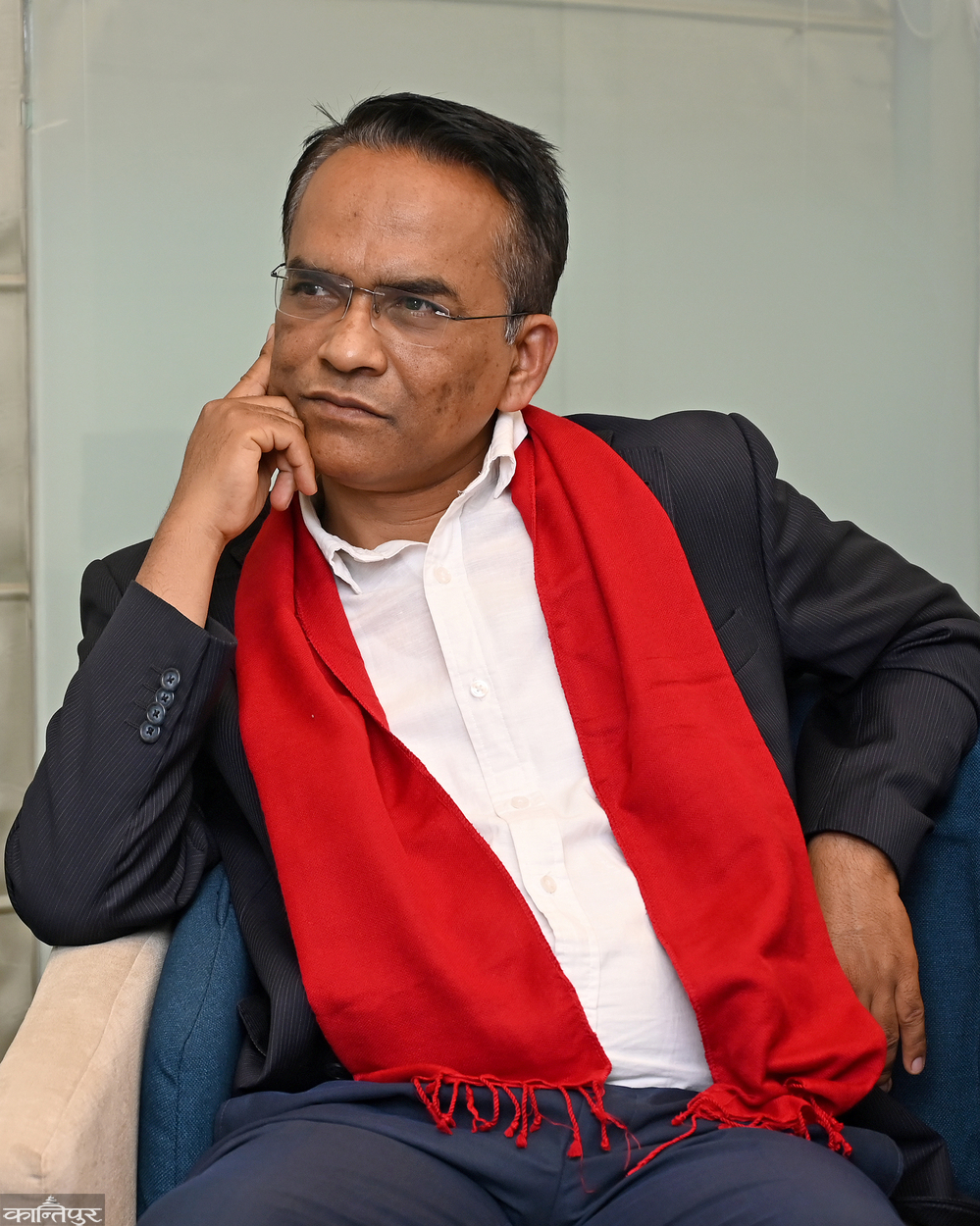
Economist Vishwanath Poudel has been appointed as the Governor of Nepal Rastra Bank after a month and a half long tug-of-war between the two main parties of the ruling coalition, Congress and UML. Although there is a legal provision to appoint one month before the vacancy, a position like the governor came up in the conflict of interest between the two parties to appoint the person who proposed them to the highest position of the National Bank.
Poudel, who graduated from the University of California, USA, is a professor of agricultural resources, resource management and labor economics and economic history in addition to economics.
Focusing on maintaining the autonomy of the National Bank, solving the existing problems of the economy, the policy towards the stock market, the strategy to get Nepal out of the 'grey list' kept by international bodies, and the plan and idea of giving justice to the victims of meterbaze from cooperatives Krishna Acharya of Kantipur and Seema Tamang conversation with Verner Poudel
:
This time, two major parties, Congress and UML, played extreme politics in the appointment of the governor. You yourself became the Governor with a political background of being a candidate for the House of Representatives from the Congress in the last election. How do you keep the National Bank free from political shadows?
The main role of Nepal Rastra Bank is to look into the problems encountered in the economy. In politics there are pros and cons. But the National Bank only has data. I will find the problems and solve them. Therefore, politics does not have much scope. Rashtra Bank is a technical space.
As an economist, my 'training', experience, judgment, data provided/brought by my colleagues will be influenced. But during my tenure, politics does not affect the policies taken by the National Bank or the economy as a whole. Sometimes there is more liquidity in the market and sometimes less, there are credit problems, to solve those problems I work from experience according to the principles of economics but I do not work from politics. Who did the bullying? What is its background? If my decision is influenced by that, it will be influenced by politics. But I won't let that happen.
Even when I worked as a vice-chairman in the National Planning Commission, no one accused me. My political background is not that long. Not even a person who joined a class organization and contested elections in the Congress. After the election, I resigned from the party and became a professor at Kathmandu University. Even after going to university, I did not engage in political activities. I won't even do it in Rashtra Bank.
You also have another moral question. You were a member of the Governor's Recommendation Committee formed on Chait 11, 2081. The committee did not hold a formal meeting even once. Soon you resigned and became governor yourself. Why didn't I morally refuse to go for that position in the selection committee?
does not seem to raise moral questions. While in the selection committee, the names of various candidates were discussed. But the problem was not resolved. Decisions had to be made from the selection committee to the cabinet. There was no consensus and the process stalled for weeks. Being a prisoner of indecision is not fun. I was offered to be the governor, I resigned from the governor's nominating committee. Resignation was not immoral. After I resigned, the solution came out immediately. Is it unethical to give a solution in terms of the country's citizens and economists?
Even though you have worked academically in the field of economy, you have no experience of working in the National Bank. So there is a question whether you can work effectively with the structure of the National Bank or not?
I am not the first person to get an appointment without working in Nepal Rastra Bank, and probably not the last person either. There are employees with long experience at various levels. In the first meeting of the Board of Directors of Rashtra Bank, I have already said that the employees have 'cumulatively' one and a half hundred years of experience.
My role is that of a decision maker. For that, it should be done with knowledge of economics, knowledge of economy and experience of bureaucracy. Rashtra Bank has employees with various experience including Deputy Governor, Executive Director, Board of Directors members who have experience in bureaucracy. There is a system. Finally I have the ability to make a decision, I hope everyone will help me in that decision.
It is alleged that the National Bank is the main responsible for the current problems of the economy. How do you address the problems of the economy?
The main sectors of the economy are banking and government. The government has its own problems. Revenue growth is not as encouraging as it was between 2064-74. The government is under pressure as the country's public debt has increased 4 times in the last 8 to 9 years. Due to lack of economic activity, the government's ability to collect revenue has weakened.
Banks, on the other hand, increased capital and aggressively expanded credit in between. There is a question as to whether the necessary monitoring, high diligence (due diligence) on the quality of the loan could be done or not when the loan was expanded aggressively. Bad loans to small and medium enterprises are on the rise. When credit goes aggressively to small-scale 'enterprises', do they have the potential to become entrepreneurs? Whether we can see it or not.
lending to small borrowers for business is also whether there are large projects. Overall, there is pressure on both government spending and bank investment. We need to create opportunities to drive the economy or increase investment. Even if the people spend by taking loans, there is no return? That will have to be seen. It should be seen whether it will be okay even if there is strictness in lending. I will study all these issues one step at a time and come up with a policy to address them.
6 and a half billion investable funds are now accumulated in banks. Will investable funds still accumulate or flow into the market? What is the role of the National Bank in this?
The inability of small borrowers to make a profit means that they have no investment opportunities. Banks and financial institutions would only go to collect loans if bad loans related to them increased. Where are the investment opportunities? What should you invest in? There is money, but due to lack of opportunities, I have not been able to invest. Earlier, there were investment opportunities in schools, hospitals and hydropower sectors. Now most of the government agencies have taken strict policies in many places, which has reduced the investment opportunities. For example, the power purchase and sale agreement (PPA) in the hydropower sector had been closed for a long time, it has just been revealed. We have to create opportunities in new areas for investment. It is not necessary to increase the investment by stricting the
investment area. People's money should not go to risky areas. Creating opportunities for investment and taking the lead is the responsibility of the Ministry of Finance or the government. According to the government's financial policy, the National Bank opens the way for priority investment. The National Bank will give suggestions. But the leadership will be done by the government or the Ministry of Finance.
Another problem in the financial sector right now is interest rates. Even if you take a loan at 7/8 percent interest rate, sometimes the interest rate reaches 15/16 percent within 6 months. What kind of plan do you plan to keep interest rates regularly within range? Have a smooth transaction rather than
stability. Common people wish that the interest rate which was 8 percent a month ago should not reach 14 percent after a month. Change gradually when interest rates change. Even if it happens, be predictable and expected. We think that it will be the same when growing. We will do something about it.
Other sectors and industries incur losses but banks and financial institutions never incur losses. There is an allegation that the National Bank protects banks and financial institutions in various matters including interest rates, service charges, etc.?
Primarily, the National Bank protects the savings of savers. It means that the savings should not go to risky places and whoever took the loan should return it. The National Bank is interested in the safety of the savers, not the profit of the bank. This should be understood by every saver as a protection of my savings and as a matter of course.
In recent years, there have been accusations that Rashtra Bank sometimes brings loose and sometimes very tight policies. Due to political instability, the trust of the stakeholders is lost. What kind of policy should the National Bank bring?
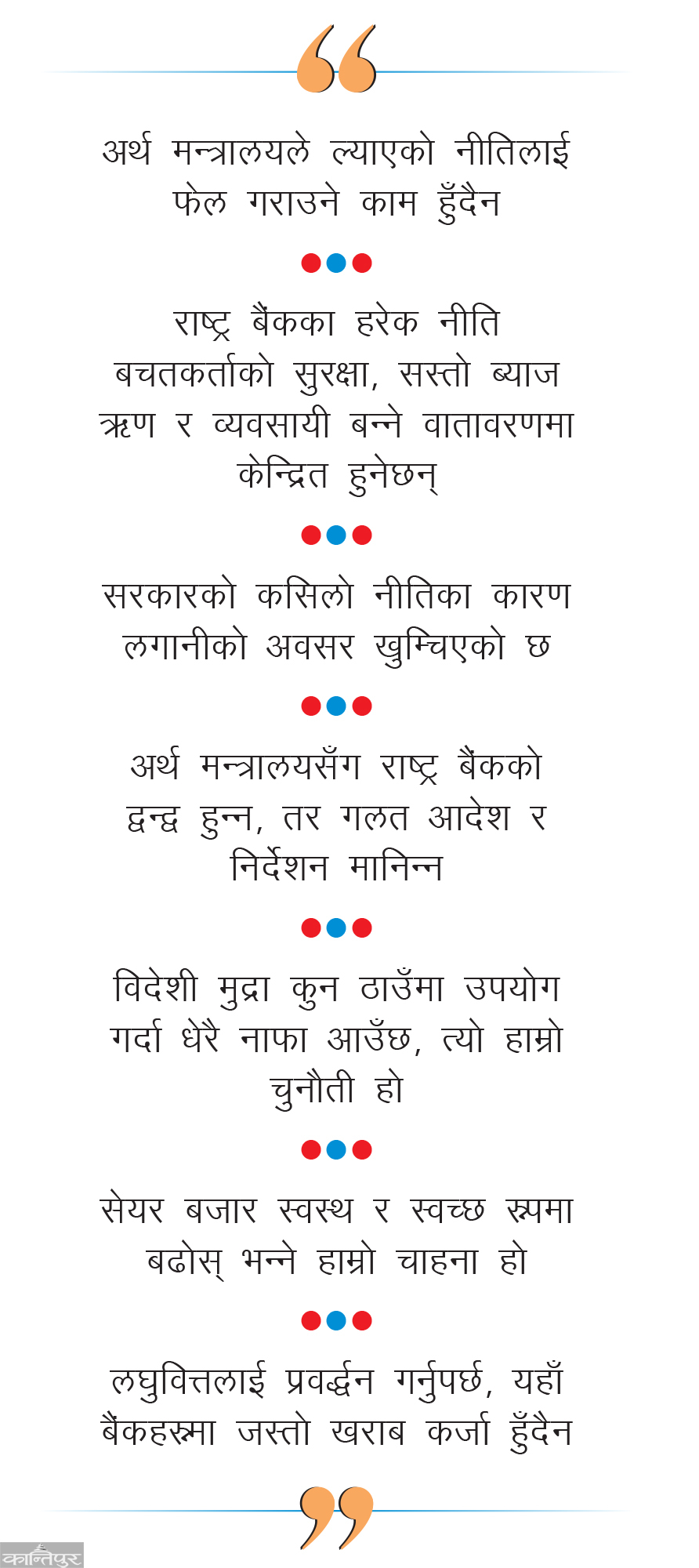
My effort is to reduce the 'frequency of change' of policy in the future. I emphasize on reducing the 'frequency of change' and policy stability.
You said that after the appointment of the governor, the National Bank will do less regulation and more supervision. Some problems cannot be solved by supervision alone. Sometimes the regulator is a silent spectator, sometimes it is strict. How do you balance these two?
Now there is an impression that we have made many rules. I had a brief discussion with the Chief Justice and the judges in the Supreme Court after the swearing in of the Governor of Rashtra Bank. I said that there will be a problem if the lawyers, courts, judges etc. do not have a common understanding about why we made the rules, what they are for, and the interpretation of the rules. Rules are made, but in the court, one judge understands one thing, another understands the other.
can be different decision according to the judge on the same issue. Various laws have such a problem. When making rules, I said let's make simple rules that everyone can understand. So that everyone can have the same understanding, in that sense regulation means less supervision. Less regulation does not mean lack of regulation. Rules should be few, clear and unambiguous. Let there be rules, but let's not make everyone a 'criminal'. Don't be in a situation where banks are unable to work.
Lately, there is no good coordination between the Ministry of Finance (Finance Minister) and Rashtra Bank (Governor). This is the reason why the financial policy seems to have turned to one side and the monetary policy to the other. How to improve this situation?
is to coordinate with the Ministry of Finance. Fiscal policy will lead. There is no benefit in fighting with the Ministry of Finance. The overall responsibility of the economy rests with the Ministry of Finance. The policy introduced by the Ministry of Finance will not fail.
However, in some cases, the finance minister gives unnecessary instructions. Such examples are not only in Nepal but also in other countries. Out of Jurisdiction Finance Minister instructed, 'Why fight?' Will you sit or face?
Non-conflict does not mean acting against the law. Wrongdoing is resisted. Wrong orders, instructions should not be obeyed. It has to be legally correct and in the right place, that is done, nothing else is done.
Currently, the main problem of the economy is 'current capital loan guidance 2079'. Due to this guidance, the industrialists have not been able to take more loans, there has been a demand for the postponement of this guidance. Will you amend, suspend or withdraw this guidance or proceed with it?
No one has said that the guidance on working capital loans is wrong. No matter what is said outside, banks have also affected us. We analyze which areas have been affected. We will evaluate if it really has an impact. In such cases there is always room for modification.
External indicators including foreign exchange reserves, remittance inflow, current account balance, and current account are strong recently. Foreign exchange reserves are in surplus by 24 billion rupees. Remittances contributed more to this record. There is a need for an effective policy of Rashtra Bank for the use of remittances, especially in the productive sector. Do you have any plans for this?
Until 058, when foreign exchange was low, we used to restrict imports. We used to take less money when we went abroad. Industrialization was also affected by it. For the first time in the year 061, the foreign exchange reserves were more than 1 trillion savings. Now we have enough foreign exchange reserves. We have seen many dreams since buying foreign goods.
Many cafes that have opened in Kathmandu have foreign machines. Our lifestyle has changed. Our challenge is where to use foreign currency to get more profit. Once upon a time investing in hydropower sector brought profit from it, the problem of energy was solved. Now we are selling energy. 048 years ago, private sector participation in hydropower construction was minimal. Now foreign currency in which area? For that, a suitable financial policy should come. If the government takes the lead in this and we will help, we will do that.
In August 2078, the stock market index reached close to 3200. But the National Bank intervened in it through various policy arrangements. And, there has been some improvement in the NEPSE which has been going down continuously and now it is around 2600. Now will your policy in the stock market be increased or decreased from 2600?
The problem with the stock market is whether some people manipulated it by reducing it, that should be seen. But that problem was also in land. The price of land also increased overnight and a few people got plantations of plantations. It seems that sometimes we have tried to solve the law and order issue of the country with economic tools. Overall, we want the stock market to grow in a healthy and clean manner. 100% increase overnight cannot be sustained. The stock market should not be 'manipulated' but should move in a disciplined manner. Let the stock market grow so that Nepal's economy is sustainable. No one's property should be destroyed.
Share loans have increased by 37.8 percent in 9 months of the current financial year. But NEPSE is around 2500 to 2700. The National Bank has imposed a limit of 15 crores on share loans for individual investors and has removed such a limit for institutional investors. It is said that large investors have had a negative impact on the stock market when they used the loan taken in the form of share mortgage elsewhere. Will the National Bank bring a mandatory arrangement to invest in shares, loans or not?
is regularly reviewed. But I will not increase or decrease the loan limit.
Now you don't get to sign many notes because now digital transactions are more than cash. There are wallet companies other than banks for digital transactions. What are your views and plans regarding the regulation and supervision of those companies?
It has been 79 years since the country's 2000-year history of currency notes. I'm not one to take offense at not being able to correct a note. Who would be as happy as I am if digital currencies work, even if there are no notes? In case of easy transactions, people should not have to take out notes and exchange them. New technology should always be encouraged. Risks should be looked at and opened. I am positive about digital payments. Decisions should be taken with confidence so that people don't suffer. It is to advance the digital currency.
The high-level reform suggestion commission formed under the leadership of former secretary Rameshwar Khanal of the Ministry of Finance has recommended to review the fixed exchange rate with the Indian rupee. The National Bank has said that it will conduct a study and research within one year in the action plan designed to implement it. What is the role of Rashtra Bank and your 'position' in this?
Revising the exchange rate with the Indian rupee should be seriously considered. Many economists are already calling for change. In 2017, we made 160 rupees of 100 bharu. We also made 100, 135, 170 in between. But now we are at 160 rupees. We are at the same place again. Which rate is appropriate? should study. There is also the question of whether the exchange rate is volatile. There is also the question of whether fixed exchange rates hindered industrialization. One should proceed only with good understanding. Must be continuously reviewed.
Recently, the role of the National Bank has been mentioned for the regulation and supervision of the cooperative sector according to the laws issued by the government's directives and ordinances. The problem of cooperatives is terrible. What kind of plan is there in the problem solving, regulation and supervision of this sector?
There is a 'narrative' that when the interest rate of the bank increased, the money of the cooperative came to the bank and there was a problem in the cooperative. In my opinion, the problem is with the legal system. It is being considered whether the existing rules have been violated by the people. So it should be understood well. Although it seems to facilitate small entrepreneurs in rural areas or increase agricultural productivity, cooperatives raise money and buy land in cities. Rather than empowering small farmers, it was seen as engaging in others. That is why we have to work hard in cooperatives. If the National Bank tries to regulate the issue which can be resolved by the Ministry of Home Affairs, it should also be seen how expected the results will be.
Nepal Rastra Bank is also showing reluctance to look at the cooperative sector. The National Bank should look at it or keep it outside the National Bank, what is your opinion?
I am studying whether Rashtra Bank has the capacity to look into small scattered loans. It is a question of whether there are sufficient staff for supervision. If the government is to give responsibility and look at it by creating a big institution, then it is the responsibility of Rashtra Bank to be ready to look at cooperatives as well.
The microfinanced have been in the movement for a long time. Is the problem of meter abuse victims still the same? Microfinance is under the regulation of the National Bank. How do you solve the problem in this area?
I am relatively positive towards microfinance. Non-performing loans are also high in microfinance. The microfinance sector was started with the objective of empowering women, providing easy loans, etc. Microfinance should not be evaluated on profit alone. My research has also shown that microfinance has reduced domestic violence and increased women's ownership of companies. It has played an important role in empowering marginalized communities. Get loans easily. Microfinance should be promoted. Microfinance does not have bad loans like banks.
When people need loans, banks and financial institutions do not give them. Due to not getting loans when needed, distortions have occurred through sectors like cooperatives, microfinance and metered loans. What kind of policy does the National Bank take to make it easy and accessible to the people when they need a loan?
We have opened cooperatives and microfinances for those who could not get loans through formal channels. The role of banks is also the same. If small farmers and poor people do not get capital, how will they go up? The aim of the bank is one, but if it gives a loan for buying a motorcycle or going to the city, it is strict. It should go to the target group. To supervise for that.
Overall, what kind of difference will a governor's plan, policy and strategy make in the lives of common people? What can you change, especially about income and employment?
Saver's money should not go to risky areas, create an environment where anyone can take a loan through formal means at cheap interest rates, and the responsibility of the Rashtra Bank and the Governor is to create this. Rashtra Bank's role is to secure the future and become businessmen. An industry gives after disbursement of credit even though it has no direct role in job creation. Jobs are created automatically.
How do you work to get Nepal out of the 'grey list' set by the General Assembly of the International Organization Financial Action Task Force (FATF) last February?
We work with the government on whatever terms they have. We will remove the country from the gray list. There are some requirements, for which we are working jointly with the government.
Citizens have not been able to get cheap loans for two and a half years because the government has not paid about 16 billion in interest subsidy. Therefore, the government's interest subsidized cheap loan program, which was brought to increase production and employment in the country, has failed. How do you make this program regular?