We use Google Cloud Translation Services. Google requires we provide the following disclaimer relating to use of this service:
This service may contain translations powered by Google. Google disclaims all warranties related to the translations, expressed or implied, including any warranties of accuracy, reliability, and any implied warranties of merchantability, fitness for a particular purpose, and noninfringement.
Gurung Sushant is active in writing reviews, criticism and essays. He has the ability to thoroughly study narratives and non-narratives. Gurung Sushant's new book 'Other Reviews' is coming soon.
Edited part of the conversation with him, who is also teaching at Tribhuvan University, for the column 'Five Questions' of Ekantipur:
What was the last book you read?
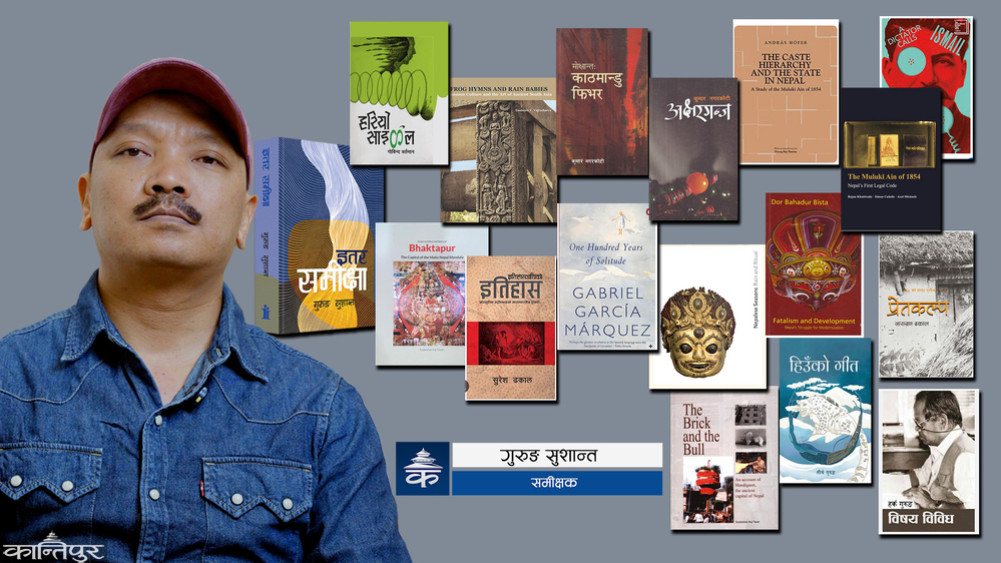
I recently read five books together . Read Sudarshanraj Tiwari's 'Essays on Culture and History of Bhaktapur'. He read the article 'The Brick and the Bull'. I was very impressed with his horizons of study and scope of research. Later I wrote a review of his translation 'Handi Village' in Kantipur. Although he is an architect, he has a great study in culture . I also read the second work as he is a good study especially about the culture of Kathmandu Valley. It has the story of how the palaces of Bhaktapur were being built from Jayasthiti Mall. It was written after deep research and I myself lived in Bhaktapur so I enjoyed reading that book. Another book along with
is Gautam Bajra Bajracharya's book 'Please Season Rain and Rituals'. Before that, I had read a book called 'Frog Hymns and Rain Babies: Monsoon Culture' by the same author. Gautam Bajra is considered by many scholars to be an authentic researcher of the art and culture of South Asia. In the beginning, he wrote from the schooling of the History Revision Board was . He wrote a book called 'The Palace of Hanumandhok' in Nepali. It's about rain . If it doesn't rain, we worship the frog. We will marry the frog. The book explains well how our myths and art are connected. It is said that we should study our art and culture by going ahead of the Buddhist scriptures and ancient Hindu scriptures. We have to go through oral history rather than written history. If we go through the history of architecture that we have, we can go through the history of our culture . It is written in the book about what our culture is about the monsoon.
Another Rajatarangini . It is in two volumes . It is not available in Nepal. This book is available in both Sanskrit and Hindi. This is the history of Kashmir from the 9th century to the 12th century. Whether the history of Kashmir is relevant to us or not, one episode of Nepal is important. Even though it is an epic, it is said that three parts of four parts are history. It is also being studied as an official history. We had rulers with war skills . Armudi is also known as Magar Raja . I was very interested in that question. Along with
, I read Suresh Dhakal's 'History Before History'. I think this book is useful to look at anthropology, Prague history and the roots of our culture in an anthropological way . How human culture has developed. There is a matter of how we can look at it from an archeological point of view. How did the development of letters, the development of the wheel happen? How did fire evolve? We can learn such things from this book.
The most recent read is 'Snow Song' by Tirtha Gurung. Before or around this seven and a half hundred years, we can symbolically understand the emergence of the Ghola Sothar state of the Gurungs and the interference of foreign culture, myths, cultural matters and the history of the Gurungs from the novel. I also thought that this is a must-read novel lately.
Your favorite fiction? There are many
s. Among them is Chinua Achiwe's 'Things Fall Apart'. It is well written about how the Christians dominated the Achiweko community in Africa, how they were culturally attacked . This novel can change the way of looking at Africa. Readers in a multicultural country like ours need to read this to write a new way of how society can be presented. Another is Gabriel García Márquez's 'One Hundred Years of Solitude'. The power struggle is presented through Marquez's magical realism. There are so many characters in history. It looks like the history of a city. It seems like the story of its birth, rise and fall. Or it seems like a story of seven generations of a community. But not only that, it is a story of friction and struggles between civilizations. It is said that the novel should be established as a national metaphor. This book is not a history book. But it is written in a stronger way than history. It is also a unique novel in terms of craft . I think this is a book that readers and writers should read.
Narayan Dhakal's novel 'Pretkalp' in Nepali, I liked Oodhi. What was the condition of education during Rana period? How was the condition of women? How was the untouchable ? What kind of problems did the people who said they would reform the society have to face? I consider 'Pretakalp' as a strong novel depicting Sangopango society.
After 'Pretakalp' I like 'Snow Song' . It brings the cultural history of the Gurungs well into the debate. There is also a magical reality in this . It explores our belief systems using various techniques - wild imagination, magic realism Prepared using . If this book is translated into English, Nepali society thinks it is a novel to be proud of.
The other one is Kumar Nagarkoti's 'Mokshant Kathmandu Fever'. This book seems to be a wonderful experiment in Nepali. No writer is meant to be overnight. A long study takes place . Nagarkoti may also have read various usages from world literature to Nepali literature and used them in his literature . Existentialism and anomalousism are at the center of 'Mokshant Kathmandu Fever'. The language he uses is amazing .
Like non-fiction ?
Sudarshanraj Tiwari's 'The Brick and the Bull'. After that, it was also translated into Nepali under the name of 'Handigaon'. We have different styles of cultural historiography . There are various uses . Among them we can also take the legend . We can also take it from oral history. The living documentation we have is the Jatras. Handigaon was such a capital. How that capital fell is discussed at length, so this book made me Absolutely loved it. His scope of study is also very strong and liked. Another one I like is Andre Hoofer's 'The Cast Hierarchy and the State in Nepal'. It violates the civil law . At that time, in the civil law, even for the same crime, there were different punishments according to caste . How was Nepali society? To know how the Nepalese society is today, we have to read the Civil Act of 1910. If you find the language of that civil law difficult, Andre Huffer has analyzed what happened there so well that the book is my favorite non-fiction.
Another one is Hark Gurung's 'Visahay Vidh' . He has written his travel memoirs in it. He has studied so deeply about geography, about mountaineering, about population, about politics, about nationality, about tribes in some respects. He also has a good study of the Gurungs.
The other one is Dor Bahadur Bista's 'Fate and Development'. How does Nepali society believe in fate? This book also teaches to understand Nepali society. The other is the current 'green bicycle' of Govinda. It contains travelogues, profiles, some books and movie reviews. I like his language very much. Strong language, strong ideology on top of that. He writes honestly. I think Govinda Prashant has the ability to make prose, ordinary memoirs taste as sweet as fiction. Another favorite non-fiction is Kumar Nagarkoti's Aksharganj . This is a memoir . Kumar Nagarkoti has prose that can be introspective in this book.
Book that came out recently but you haven't read it?
Smile Kadre's novel 'The Dictator Calls' . I haven't found this book in the bookstore . I heard that this novel is based on a phone call . I heard that the technique of writing this novel is also sweet .
Book recommendation for the new generation ?
The number one recommendation for the new generation is the 'Muluki Act of 1854'. This is the Civil Act of 1910 translated into English. Although the language of that time was difficult for us, when it comes to English, it is easy to read for the later generation who have been exposed to this language. In the introduction section of this book, there is a commentary on the civil law. How was our society and legal system yesterday? How was the economy? To understand how the hierarchy of Nepali society was, one should read the civil law. It shows us the mirror of today's society .
A must-read book for the new generation is Ahuti's 'Jatwarta'. In this simple language, one can understand what is untouchability in Nepali society, what is the caste system. Since Ahuti has worked in this field for a long time, his study seems very objective . The analysis also seems very scientific .
South Asia's caste system. We know Bhimrao Ambedkar as the scholar who has worked the most on the caste system. But Ambedkar's view on the caste system, the steps taken by him are strongly criticized in this book . It does not matter if you claim that Ahuti is number one in the world for being able to speak authoritatively on the caste system or Dalit problems.
'Jat Varta' is a good book written in simple language, in a question and answer style to understand the new generation. I recommend reading this book to the new generation . Another one is Sitaram Tamang's "Historical Materialist Narration of Nepalese Social Development". We have read a lot of things written in the praise of Raja Maharaj yesterday in history. But this book of his has done the job of explaining that history in a new way so that it should be read upside down. We must read this book. The tribal people call this book I think you should read .
The other is Sudhir Sharma's recent book 'Bhikshu: Business and Rebellion'. I recommend this book to read what was the state of Nepal yesterday with China, what was the religious relationship, what was the economic and political relationship, what was happening in Nepal and what political developments were going on around the time when the event was happening. This book is also very easy to read.
Another must read Hark Gurung's book, BP Koirala's autobiography, diary. Any book by Maheshchandra Regmi is worth reading . I suggest to read Kamal Prakash Malla's book, Baburam Acharya's history book. Parijat's memoirs and some novels are great books to read. Another one is Govind Sanghar, Narayan Dhakal, Kumar Nagarkoti, Nayanraj Pandey, Upendra Subba, Swapnil Smriti, Vinod Vikram Keshi, Ahuti, Shravan Mukarung, Gopal Prasad Rimal, Rajan Mukarung etc., and the new generation can gain some knowledge.