If the hills can be turned into tourism and the plains into production areas, development is possible quickly
We use Google Cloud Translation Services. Google requires we provide the following disclaimer relating to use of this service:
This service may contain translations powered by Google. Google disclaims all warranties related to the translations, expressed or implied, including any warranties of accuracy, reliability, and any implied warranties of merchantability, fitness for a particular purpose, and noninfringement.
The development plan of Lumbini province is made based on geography, population, resources, culture and local needs. The state of overall development of the province is improving. The provincial government has been giving priority to the development of tourism, agriculture, infrastructure, education and health sectors.
The gross domestic product (GDP) which was 5 trillion 40 billion in the year 2075/76 has reached 8 trillion 14 billion in the current financial year. Per capita income increased from USD 803 to USD 1159. Multidimensional poverty rate has decreased from 30 percent to 24.35 percent and unemployment rate has decreased from 11 percent to 8 percent. However, despite this, there are some social and economic challenges. In this context, Ghanshyam Gautam of Kantipur had a conversation with the Chief Minister of Lumbini Province Chetnarayan Acharya about the situation of the state, data analysis, the process of selecting development plans, tourism, education, health and the impact of migration. : The data of the National Census 2078 shows that a large number of people have migrated from the hilly districts of Lumbini Province. This has increased the danger of land becoming barren in the mountains and agricultural land in the plains being eroded. How concerned is the provincial government in this fact?
It is necessary to stop the migration from the mountains, to provide opportunities for development there, to ensure education, health and employment opportunities at the place of residence. For this, it is necessary for the state government, local government and the federal government to work by building a common opinion. If the hills can be made into tourism areas and the plains into production areas, development is possible quickly. Intensive planning is necessary for this.
What is your comprehensive plan for managing migration?
Migration is a regular process. It cannot be completely controlled. However, the state government has prepared its plan by paying special attention to the current situation. A program to discourage uncontrolled migration has been prepared through the Second Periodic Plan, Agricultural Strategy and Annual Policy and Programme. We have emphasized migration-focused programs such as skill-based education, organic agricultural production, market promotion that connects local products with the market, easy access to health and education, and promotion of digital economic activities, mitigation of the impact of climate change, wildlife-human conflict control. For this, we have put forward employment, education, access to health and product marketing as main programs.
As a result of external and internal migration, there are only teachers and no students in the hilly areas, while there are fewer teachers in the plains and more students. This has also raised a question mark on the overall quality of education. Have you thought about it?
The plan is made by analyzing the facts and the situation. Where the number of students is high, there is a need to increase the number of teachers and increase investment in infrastructure. Where the number of students is less, the study and teaching work can be made more effective by implementing a different plan. To improve the educational situation of the province, there is a need for joint and collective efforts rather than individual ones.
Narayanghat-Butwal road under Lumbini province has been suffering due to non-construction on time. What is the role of the provincial government to speed up road construction?
Of course, the Butwal-Bardghat section of the Butwal-Narayanghat road, which is in our province, is in our province. On behalf of the government, we have pressured the road department under the federal government many times to build it so that the citizens do not suffer and to show caution in the construction. We are doing regular monitoring of the road section under construction and regular work.
Butwal-Narayanghat road not being built on time, how has it affected the tourism and economic development of Lumbini?
Of course, Narayanghat-Butwal road is also the backbone of tourism and economic development of Lumbini region. Indian tourists who come to Lumbini go to Pokhara via Muglin and Chinese tourists who come to Pokhara come to Butwal via Muglin-Narayanghat. Due to the poor condition of the road, there has been a decrease in such tourists. After the completion of the Butwal-Narayanghat road, which is the life line of Lumbini province, and the Butwal-Chandrauta road, which is now under construction, Rupandehi will become the economic hub of the region. It will also contribute greatly to the overall economic prosperity of the province.
Where is the overall development situation of Lumbini Province?
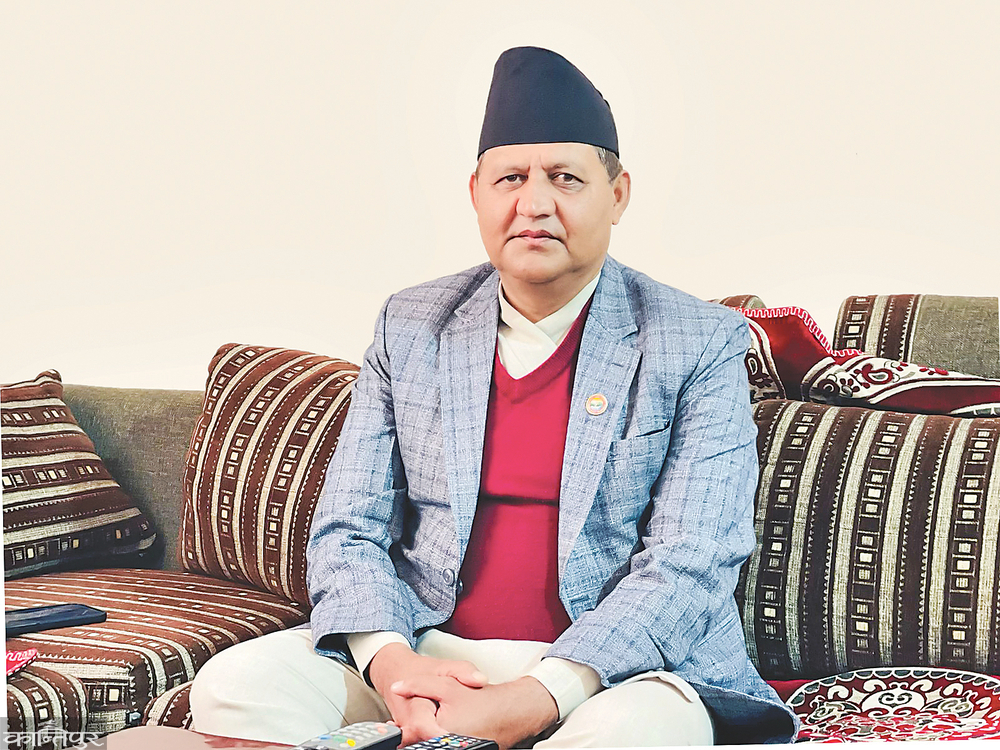
Lumbini province's overall development situation is improving. The provincial government has paid attention to the proper development of all sectors including economic, social and cultural. If we look at the situation since the establishment of the provincial structure till now, the overall development of the province has accelerated. The gross domestic product which was 5 trillion 40 billion in the financial year 2075/76 has reached 8 trillion 14 billion in the current financial year. Per capita income increased from USD 803 to USD 1159. In the fiscal year 2075/76, the rate of multidimensional poverty was 30 percent, but now it has dropped to 24.35 percent. The unemployment rate has dropped from 11 to 8 percent. The under-5 mortality rate is currently limited to 21 per thousand, while the under-5 mortality rate is 45 per thousand. The total enrollment rate at the secondary level (grades 9-12) increased from 75 percent to 84 percent and the net enrollment rate increased from 40 percent to 57 percent. Lumbini Technical University has been established and is operating in accordance with the State Act. The area reached by irrigation is 55 percent. Lumbini Province is self-sufficient in fish, meat and milk production and supplies to other provinces as well. The contribution of the industrial sector to the gross domestic product is 14 percent. In the year 2075, the length of the road was 11 thousand 233 km and now it has reached 15 thousand 76 km. The population with access to a paved road within 30 minutes has increased from 50 percent to 65 percent. Accessible roads have been constructed in twelve months in 108 out of 109 municipalities. The population with access to electricity has increased from 81 to 98 percent. Households with access to the Internet increased from 49 percent to 76 percent. In this way, the overall development of the province has improved. The provincial government is placing special emphasis on judicious and equitable distribution of the limited resources available to make development efforts more manageable.
You also mentioned some data, but are such data used in the provincial government's policy, planning and budget allocation?
The state government has made its plans and programs based on data. Now we have prioritized and implemented nutrition programs to solve the problems of maternal mortality, child mortality and malnutrition. This program has been implemented by giving priority to the Terai districts where there are problems in the 12 districts of the province. The Ministry of Health has worked on it. How can these figures be reduced? We have developed the practice of making the annual program of the state government based on these data. The Province Planning Commission has created a province profile based on the overall area of the province. A data portal has been created and implemented in the Provincial Planning Commission to organize the overall data of the province. It has helped in plan selection, implementation and construction as well as in analyzing the utility of each plan. The Ministry of Economic Affairs and Planning publishes the Economic Survey every year. These sources are the main statistical sources for the state government. Based on this, the second periodic plan of the state government has been prepared. In that plan, around 505 result indicators have been determined on a statistical basis for plans and programs. Therefore, the Lumbini State Government has practiced data-based policy, planning and program formulation.
Looking at some of the social indicators of this province, it seems weak compared to other provinces. For example, the maternal mortality rate is still 27 per 100,000 women. The infant mortality rate is 20 per thousand. The infant mortality rate is 6.7 per thousand. These indicators have shown that the condition of maternal and child health in Lumbini province is weak, what is the government doing about it?
Lumbini state government is fully aware of these problems and data. Maternal mortality, child mortality and malnutrition are major problems in Lumbini region. The provincial government has intensively advanced its programs to reduce this figure. Terai districts that are close to the border, health problems are also seen as complex. Even in areas that have access to universal facilities, people now have to deal with problems such as maternal mortality, child mortality, and malnutrition. The state government has carefully studied these problems. Child marriage is prohibited by law. However, child marriage is still practiced in some communities. Maternal mortality, child mortality and malnutrition are also seen due to child marriage. We have tried to carry out targeted community-focused programs by analyzing these problems in detail. For this, the provincial government has tried to address it through annual policies and programs and regional strategic plans.
Earlier, when you were the finance minister, the current year's policy, program and budget came. How did you choose the plan then? Based on what did you distribute the budget?
, the current year's budget was made under my leadership. We took into account the data, study reports, demographic situation while preparing the annual policy and program and budget. We used the data of National Census 2078 and Living Standards Survey 2022 as the basis for choosing the plan. We also said that there is no need to go to the ministry to choose the plan. We included the procedurally generated plan. We have been discouraging the comment that access and power are needed to choose a plan. We have linked policies and programs and budgets according to a balanced concept to those who have ministers, their constituencies, districts, where there is too much budget, and those who are not ministers, there is a lack of projects and budgets. There are some problems in planning and budgeting, the government is determined to reduce such problems. For that, the state government is preparing guidelines for the formulation of annual plans through the Planning Commission. What are the basis of
development plan selection?
The provincial government has considered the province's geography, population, resources, culture, and local needs as the basis for selecting development priorities. Terai, hills and mountains are three layers of geography in our province. We are choosing the plan keeping in mind the geographical conditions and possibilities here. For example, the state government has planned to construct a road covering the high hilly areas from Rampur in Palpa to Kapurkot in Salyan to build a hill station. At the time of construction, the government had set the goal of building the road and expanding the market in the mountains by taking into account the population of the highlands, the number of farmers, the population that can directly benefit from the road and the economic benefit from it. Lumbini region itself is a region with cultural significance. Proper development of religious and cultural, as well as agriculture, forestry, water resources, and mining sectors is another basis. There is a resolution to improve the living standards of the residents of remote areas by ensuring health, education and employment opportunities. Therefore, the economic, social and human development index is considered as the main basis for selecting the plan.
He said that the road connecting Palpa to Salyan will build a 'hill station' and increase the economic sector. What is the basis of that?
The road leading from Rampur to Kapurkot will connect the high hilly parts of all the 12 districts of Lumbini Pradesh. Accordingly, Palpa will develop tourism in Srinagar. More than 100,000 tourists visit Palpa every year. The part of Gulmi from Ridi to Resunga is touched by the road. There are about 5,000 small and big farmers in it from Baletxar to Tamgha. They will be assisted by roads to market their produce. The government believes that this road will connect more than 2100 farmers of Arghakhanchi, 1500 of Pyuthan, 900 of Rolpa and 700 of hilly areas of Dang and promote at least 5 small markets.
What is the potential of the province's internal economic resources?
The government has taken an initiative to improve the state's internal resource collection. Not only the transportation sector, but also the revenue from the consumption of other natural resources is being collected. In order to increase internal revenue, the state government is trying to widen the scope of revenue collection. In addition to modernizing vehicle-related taxes, fees and duties, the amount of vehicle-related fines within the province will be collected in the provincial reserve fund, and the vehicle tax collected from the transport management office on rickshaws, rickshaws, autorickshaws and electric rickshaws has been arranged to be levied and collected by the local level from the next financial year. Among the national forest areas, which are the main source of income of the province, the forest yield fee received from community forest management and the profit from the sale of the river products of such forest area have been amended and made equitable. However, the provincial government has taken initiatives to increase the revenue figures obtained from the forest sector. However, there is a challenge for the provincial government to increase the share of internal revenue. For that, the federal government needs some policy and structural support.
What is the reason for the mismatch between the province's population, plan selection and budget distribution?
population is concentrated in cities. Development plans are also focused on areas with increased population. The state government has considered all the indicators as the basis while choosing the plan and creating the budget. From the centralized mentality, we have improved the selection of plans when we come to the concept of decentralization. There are some such subjects, where the development is not only based on the population and human habitation. There is a need to choose and implement a plan for religious, cultural, heritage conservation and tourism development. The government has made the basis for selecting the scheme by considering all the bases. Due to current limited resource constraints, identification seems to be relatively elusive but the government is serious about it. Therefore, the province has advanced the construction of the project bank to organize planning and budgeting.
What is the economic growth rate of Lumbini Province?
The gross domestic product which was 5 trillion 40 billion in the financial year 2075/76 has reached 8 trillion 14 billion in the current financial year. Per capita income increased from USD 803 to USD 1126. In the second periodic plan being prepared by the state government, an investment of Rs. 15 trillion has been projected. 36 percent of public sector, 60 percent of private sector and 4 percent of community cooperatives are projected to invest 15 trillion. Under the five-year periodic plan, the target has been set to increase the gross domestic product of 8 trillion 14 billion to 11.5 trillion. It is estimated that the average economic growth rate during the plan period will be 7.16 percent during the final phase of implementation of the second periodic plan. There was an economic growth of 4.05 percent in the last financial year. Therefore, not only the economic growth of the province but also the overall development has been justified and we have moved forward.
How is Lumbini's periodic plan being made?
Lumbini government's second periodic plan has reached its final stage. The draft Periodic Plan has been passed by both the Steering Committee and the Development Council. It will be implemented after it is passed by the provincial cabinet meeting. Prosperous Lumbini aims to build a prosperous society based on social justice with sustainable and inclusive economic development with long-term thinking of happy citizens. It can be considered as an important document for the overall development of the province. We are creating a periodical plan with agriculture, tourism, industry and digital economy and human capital building as the main priority.
What is the role of Provincial Planning Commission in data analysis and planning?
State Planning Commission is planning based on data. The state has created its own data portal. And made a profile. Based on that, the Planning Commission makes a plan. The government is also preparing the road master plan based on the analysis of the data.
spoke about the road master plan. Why is it necessary?
The provincial government is investing in building roads. However, there was no standard on which road it belongs to. The state government has built many roads but they are not identified. The local and federal governments have taken responsibility for the roads built by the state. As there were many roads, the problem of their safety, maintenance and protection became complicated. The state has spent a lot of money on road construction. A road master plan is also necessary for its accounting and management of roads and traffic.
Will the number of roads decrease?
Even now we have almost 3500 roads. The province cannot keep all the roads under its control. Since the responsibility of the road construction and its maintenance also belongs to the province, it will become the criteria for the selection of the roads included in the master plan. Based on the same criteria, the government has set a target of reducing the number of roads to a maximum of 2,000.
Reducing the number of roads will not increase the rate of migration?
As the number of roads decreases, the quality increases. Roads that are not maintained by the province in their area will be prioritized by the local government. The province will build roads according to its standards and the local level will also build roads according to the same standards. Road construction standards will be made to connect districts, municipalities, borders, tourism, agriculture and other areas.

