Because the political and private sector did not understand the risk, we were put on the 'grey-list' of asset laundering. Due to the 'grey list', the cost of international payments may increase as foreign banks conduct additional checks on some transactions. Foreign investors may hesitate to make or add new investments in Nepal.
We use Google Cloud Translation Services. Google requires we provide the following disclaimer relating to use of this service:
This service may contain translations powered by Google. Google disclaims all warranties related to the translations, expressed or implied, including any warranties of accuracy, reliability, and any implied warranties of merchantability, fitness for a particular purpose, and noninfringement.
The international organization Financial Action Tax Force (FATF) has again put Nepal on the 'grey list' of money laundering. Recently, after one of Nepal's biggest donors, America, shut down organizations including USAID, the grants coming to Nepal have also been affected.
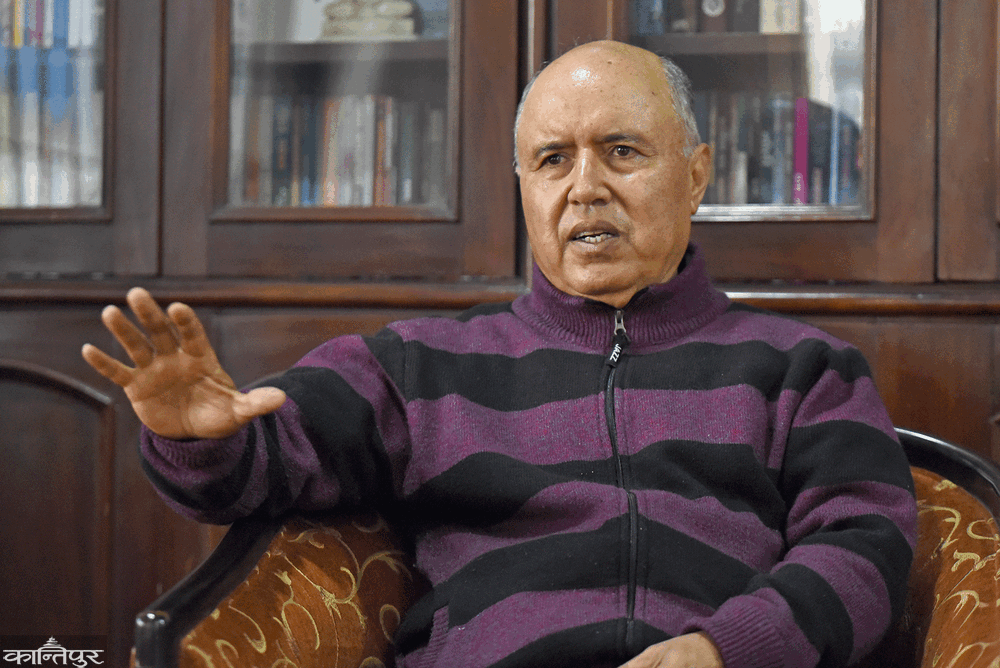
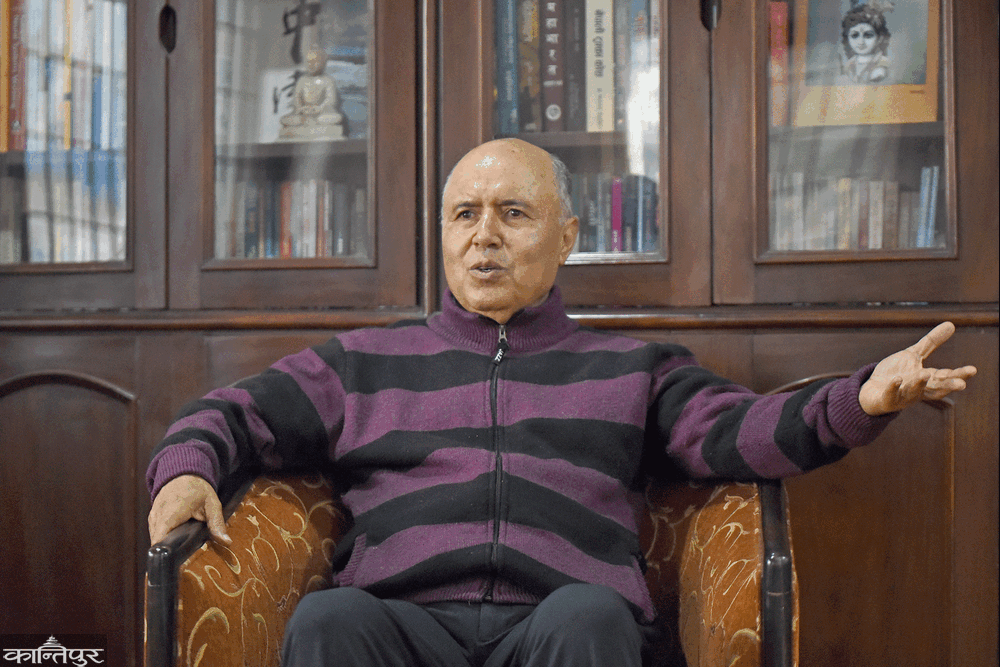
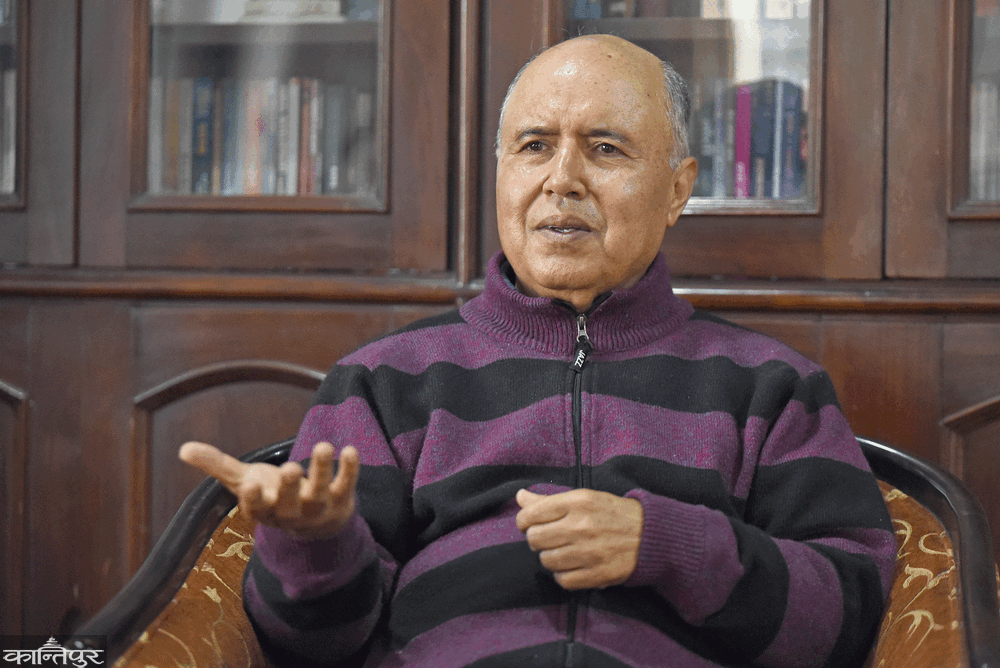
What will be the impact on Nepal after the US has unilaterally suspended the MCC project, which was approved by the Parliament and is also linked to Nepal's investment? Is it time to review the policy of receiving foreign aid? After being listed in FATF's "grey list", where will it be affected? Durga Khanal of Kantipur and Yagya Banjade spoke with Rameshwar Khanal, chairman of the High Level Economic Reforms Suggestion Commission, which was formed to give suggestions for economic reforms: The international organization Financial Action Tax Force (FATF) has again put Nepal on the 'grey list' of money laundering. Why was Nepal unable to improve despite being given ample opportunities for improvement, what weaknesses remained?
It seems that FATF has assessed that Nepal has made good legal and policy reforms. The FATF expressed its displeasure on issues such as the high political circles not being committed to this issue, not having enough resources available for monitoring, the private sector not wanting to understand or not being prepared for the risks that money laundering activities can bring, and mainly the lack of progress in prosecuting and punishing money laundering activities.
Similarly, the lack of appropriate methods and mechanisms to identify terrorist financing is also a problem. Nepal's position is said to be weak in targeted financial prohibition. These could be improved. But the lack of political commitment as stated by the FATF and the private sector's inability to understand its risks remained a problem.
Now where will its impact and impact be?
This may affect Nepal's international trade payments, payments coming to Nepal. The cost of international payments may increase due to additional checks by foreign banks on some transactions. Foreign investors may hesitate to make or add new investments in Nepal. But I don't think foreign aid will be affected because of this.
How should the government, Rashtra Bank and other agencies work to get out of this list quickly?
Nepal can come out of this list in less than a year if it is really hard to correct the weaknesses identified now and if a high political leadership is prepared. If we had been able to reassure our allies and get them on board, we probably wouldn't be where we are now. It is important for the top political leadership to understand this.
On the one hand, it is said that the economy is not getting the expected speed due to strict and control-oriented policies, at the same time, FATF is calling for the role of the government and regulatory bodies to be tight. How to proceed at such a time?
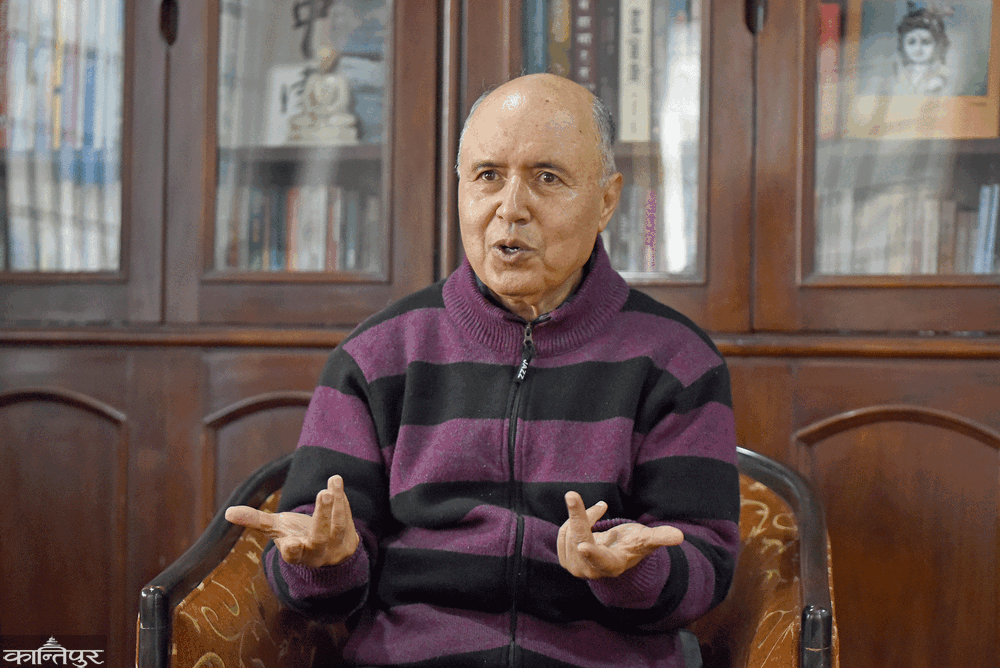
Controlling criminal activity does not disrupt the economy, but rather improves it. Controlling money laundering helps good businesses. Therefore, the assumption that it is control-oriented is wrong. Economic growth is supported by sound fiscal policy and sound monetary policy. The capital expenditure of the government is to be done by capacity. These are not affected by anti-money laundering. We must be clear on this.
After US President Donald Trump shut down the donor organizations including USAID, the budget coming through it has also been stopped in Nepal. The Millennium Challenge Corporation (MCC) has also been suspended. How can it be viewed?
When Trump was a presidential candidate, he said that he would set up the Department of Government Efficiency to control the misuse of taxpayers' money and unnecessary expenses. After being elected, the department was set up and entrusted to Elon Musk. It is being tried to reduce the foreign aid given to countries that are fraudulent, misused, conflicting with American interests, and also go to countries that do not support the United States.
Those who receive financial aid have to somehow work in the interest of the donor country. Now in 90 days we will know how it will proceed after the review. One thing is certain, the US now only helps those who protect their interests. It is not possible to tell now where, how and what such assistance will come.
In the context of Nepal, the US President himself has said that 20 million dollars (about 20 million dollars) went to Nepal for financial federalism, and 150 million dollars went to biodiversity conservation. Withdrawal from the Paris Agreement and lack of interest in issues such as biodiversity and nature conservation is probably a sign that Nepal will not receive assistance in the future. Similarly, since financial federalism is a national issue, why enter into it? The meaning can be understood from Trump.
If you say that the form of foreign aid policy will change, does it mean that there is a possibility of aid coming in other than the given area? Yes,
, that can happen. Policies that protect America's commercial interests and create jobs can be prioritized. However, even earlier, aid from donor agencies used to come only to fulfill some interests. No country helps another country selflessly and without any thought. No matter how we explain it, there is selfishness in aid. If we give something to someone in our daily life, we expect something in return.
What can happen in the matter of MCC?
MCC is not supported by the US government. It is supported by the US Congress. Trump was the President of the United States at the time when the signing was done in Nepal. Now it is said that we should stop payment of work for 90 days.
The American embassy in Nepal also issued a statement saying that it may be released later, but it has been stopped for some time now. The opinion of the American president is a bit traditional on issues such as third-sex communities, sterilization, family planning, etc. Much of USAID's support was in the health sector. That area may be affected.
The MCC agreement was not to be repudiated by either party. The US unilaterally postponed the matter which was passed by the Parliament of Nepal. Which is against the agreement?
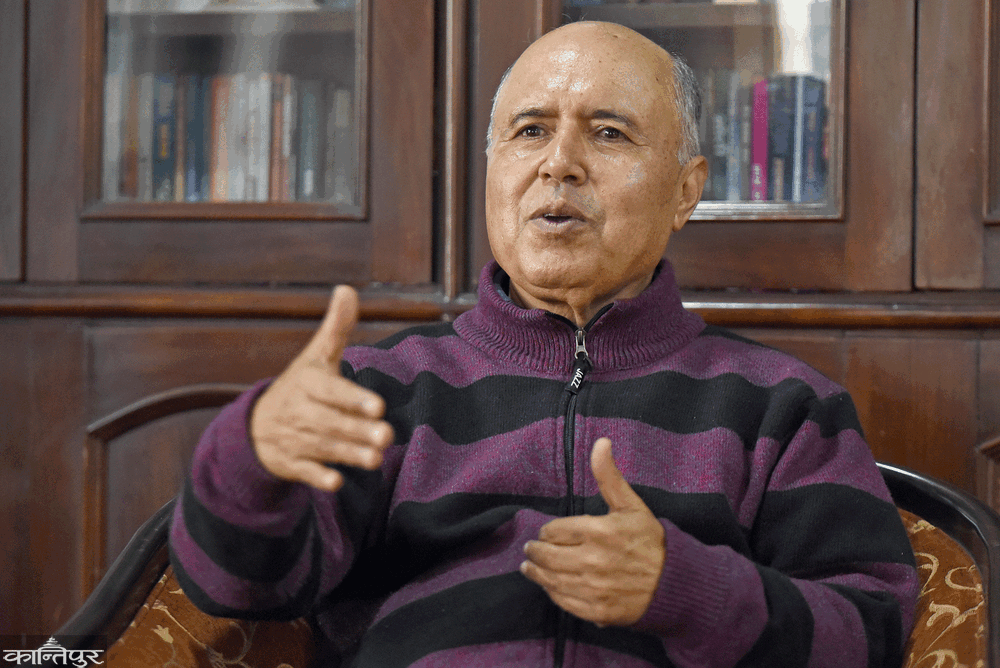
There is no need to panic and say anything about MCC. There is a provision in the contract that either party can withdraw by giving sufficient notice. Now the US is just about to review its cooperation policy. In some cases, we also conducted such a review.
If the program is canceled even after 90 days, we have a legal basis that the liability created by it is part of the US government and you have to pay it. Not only the American government has all the responsibility in the SCC, some of it also belongs to Nepal. We can claim responsibility for the American share.
Many projects under MCC have been contracted and work has started. Now, if the US stops helping, can the Nepalese government operate by itself?
9 billion rupees have been allocated for MCC in the budget of the current financial year. The Nepal government can also complete it by raising resources. Nepal Electricity Authority has also introduced a policy of issuing shares to the general public as an alternative source. Those projects can also be completed with the capital collected from the sale of
shares. In the past one year, a regional agreement has been made regarding Nepal's energy trade. Therefore, there is a good chance that the Indian government and the financial institutions will agree for the construction of these projects.
It seems that grants can come from America for matters of strategic importance, but in the field of building social awareness, doesn't it?
Some of the issues in society are issues that we have raised ourselves. In turn, donor agencies helped with the issue. Therefore, in Nepal, a commentary was also created that those cases are of donor agencies. Inclusion, women empowerment are our issues.
International agencies including USAID also supported the case. But the US president's view is that diversity, inclusion and equity (DEI) has lost quality. Therefore, it can be assumed that the American government will no longer support the issues of inclusion, women's empowerment, etc.
At the same time Trump mentioned the case of Nepal, he talked about why he should invest in India to build electoral public opinion. Has it also given us a message that we should not seek help from anyone regarding decisions to be made with our conscience?
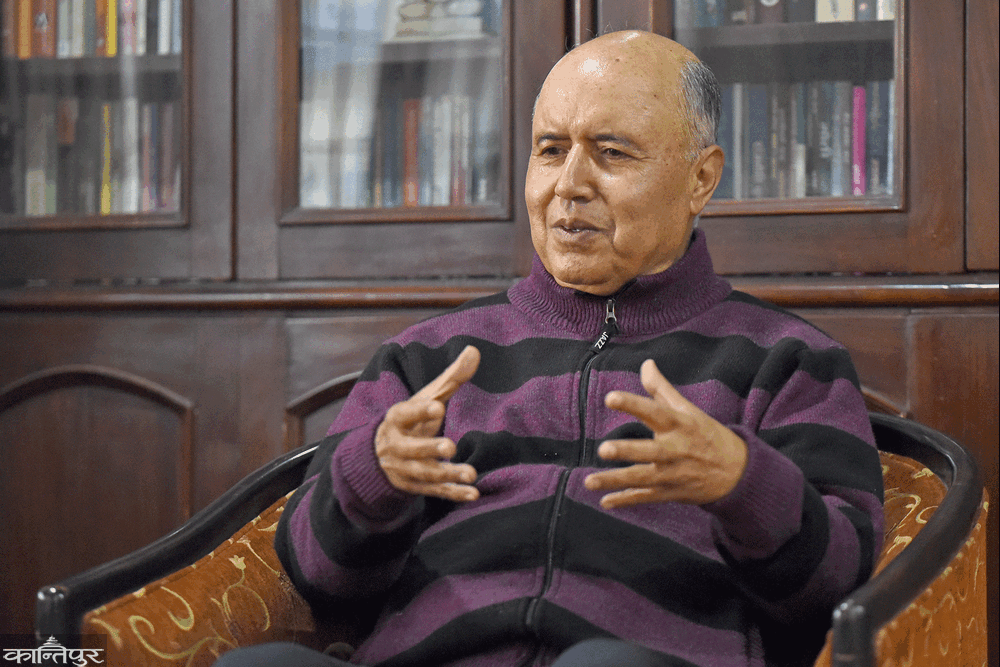
Trump's opinion seems to be that America is not becoming the world's 'guru'. Democracy is a matter of their choice. In the context of Nepal, support has come not only for the voters, but also for building the awareness of the parliamentarians. We also accepted aid that should not be accepted. We also took the monitor placed inside the parliament with the help of USAID. We did it wrong.
We also used our national issues in some cases to create a negative perception among certain sections. It was not possible in a single state system that everyone should be able to live with self-respect and get political rights in a country with all classes, castes and languages.
That's why we went to federalism to empower everyone. No one pressured us. The option we chose received international support. We had to make our own financial contributions in the subjects we started according to our needs. Assistance outside of
had to be reduced. The question arises when it is not there. No one has questioned the assistance received in the construction of infrastructure such as roads and airports in Nepal. Taking foreign aid in infrastructure projects is also acceptable. We understand now that the American government has taken steps to create a kind of conflict between one class and another class in the society, if foreign aid is received, then the conflict will escalate.
When it comes to foreign aid, there is a big divide between MCC or BRI. Now we have come to a situation where we need to build a national consensus on which topics and how to get help?
Efforts to create a national consensus through various means have not happened in the past. Our basic policy is a five-year plan. The National Development Council consists of all political parties. Even in the constitution, it is clear what are the guiding principles and policies of our state. We also have a foreign aid policy. It is made in consultation with all political parties.
Therefore, it does not mean that the national opinion has not been formed. Our policies and constitution are on one side, but as soon as the government is out of government, it is based on political urges. Sometimes MCC and sometimes BRI have fallen victim to it. Due to the narrow mindedness of our political parties, we have also spoiled geopolitical relations. As a result, sometimes India and sometimes China get angry. It is because we have not been able to strike a balance between them.
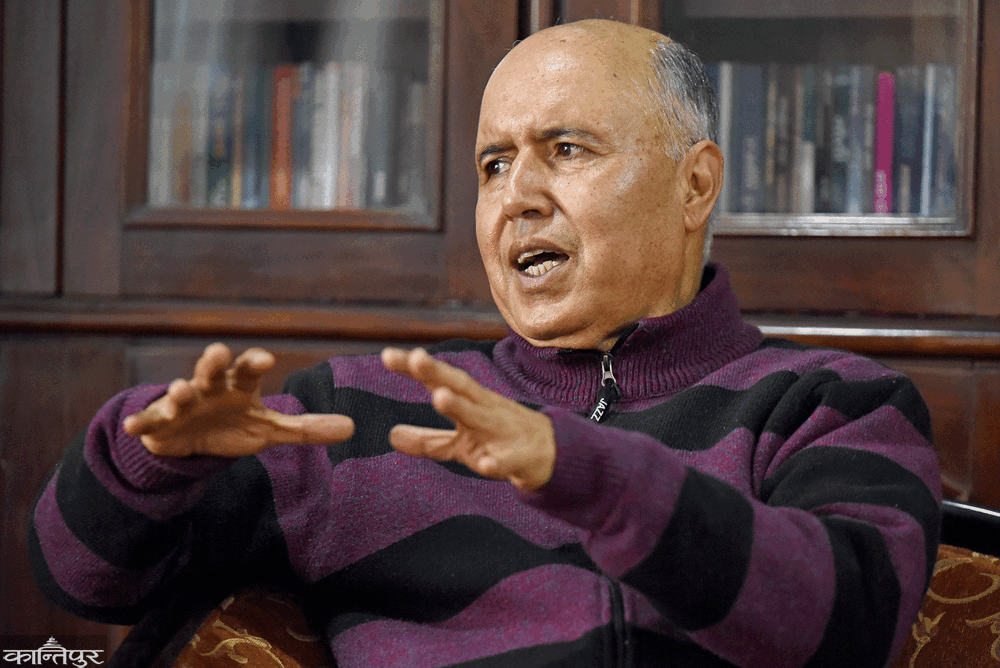 2058 years ago we had no foreign aid policy. Foreign aid policy was formulated for the first time in 2058. We changed the policy twice. Now the Ministry of Finance is preparing to revise it for the fourth time. From 2026 onwards, we will move from least developed to developing countries, adding some of our challenges. We have to decide the policy regarding which areas we will give priority to.
Trump's decision will directly or indirectly affect the economy of Nepal?
Looking at the data of the last three years, the share of foreign aid in the total public expenditure of the government is not more than 15 percent. Out of that, grant aid from USAID, China, India, Britain, Germany and other countries is less than 2 and a half percent. This amount is not that big for the government. The government could have done those works from its own resources. We have spent on unnecessary programs like electoral development programs. Being a
grant, we were generous with such expenses. In social security, we reduced the age by being more generous than the ability. Grant support has not provided an opportunity to enhance our resource efficiency. Now if the subsidy is cut, we have an opportunity to increase resource efficiency. So subsidy cuts have been good.
Various programs were being conducted by more than 300 NGOs and INGOs only under USAID. Do you see a situation where Nepal can conduct those programs by itself?
We can easily run those programs from our own resources. If public expenditure is managed well and the government implements the reports given by various commissions, a lot can be done from internal sources. Don't depend on the donor.
As soon as the budget is cut in the non-productive areas, the government can use the money left over. The results of grant-run programs are also not very satisfactory. Some of the aid flowed from non-governmental organizations was used for consultancy, report preparation and other work. We will not be greatly affected by the reduction.
For the continuation of many programs run by American grants, what alternative methods can Nepal adopt to receive aid or investment?
Grants from many agencies have been stopped many times before. In the past, the World Bank said it would help Arun III, but he shrugged it off. Now that project is in the final stage of completion. At that time, the government had little chance of alternative sources. Now the government has an option. The government can give benefits to the private sector in terms of taxes, royalties, free electricity etc.
Similarly, in the Melamchi project, the support was stopped after making a commitment at the beginning. When the project was about to start, the World Bank said it would not help. However, the Melamchi project was also completed. After the work started in Melamchi itself, the Swiss International Development Agency (SIDA) suddenly stopped the support.
At that time, King Gyanendra brought the government into his hands. We need to find an alternative source. In the future, other donors can also make such decisions. There is no need for Nepal to continue to support other countries , We have also introduced distortions. Therefore, this is a very good opportunity for us to improve those weaknesses.
We have always been talking about grants instead of foreign loans. But in 071/72 it was 44.6 per cent loans and 55.4 per cent grants, in 076/77 it was 90 per cent loans and 10 per cent grants. This financial year too, loan is 80.6 percent and grant is 19.4 percent. Why is there no improvement in this situation?
It is heard that many are worried that the debt has increased, the interest rate has become high, and the percentage of GDP has reached such a high level. So don't be afraid. An important aspect is whether the return of the project we invest in is low or high. By investing in a project, we get 50% return per year, but paying 10% interest rate is considered cheap. However, if the return of a project is very low or non-existent, even one/two percent interest rate is expensive.
Internal debates say debt is always deadly, expensive interest rates should not be high. But what is the project like, is it a type of return according to national priorities or not? Was it done at political request? This should be looked at carefully.
As of last January, government debt owed by the government has reached 45.47 percent of GDP. Is this a concern or not?
In the past, Nepal's public debt reached 67 percent of GDP. That too was reduced to 23 percent. Earthquake, covid, big construction and other reasons are now starting to increase again. Out of that, 50.87 percent is internal and 49.13 percent is external debt. I do not claim that all foreign debt investments have given good returns.
It is said that the foreign aid that Nepal is receiving is not being used in a transparent manner. How can it be improved?
It is neither completely wrong nor right to say that grants are not transparent. The government of Nepal can easily see how much subsidy has come from which government. Yet opaque aid is on the rise globally. Its voice is loud beyond Nepal.
Official Development Assistance (ODA) and Private Development Assistance (PDA) are of two types. Currently, the size of PDAs worldwide has increased to about one-fourth. Some of the help that comes through this means we don't even know. It is not even transparent. Some such cooperation is being used to bring division in our society.
Regarding the policy of receiving foreign aid, is it necessary to revise Nepal's policy now?
There is also something in the report of the High Level Economic Reforms Suggestion Commission regarding grant receipt, proper utilization. The important thing is to improve our mentality. There is a tendency in the non-governmental sections of the society to say that it is good until they get the benefits, but when they stop getting them, they are bad. In some development projects, the people who go to protest are unrelated to it. Such people do not protest without financial support.
The commission headed by you is also studying. Especially now, what is the reason why the economy has not become viable and frustration has increased?
The mindset that the economy is not good because the demand for loans in banks is not good is wrong. Just because the economy is lax doesn't mean that people are depressed. There are many other reasons for frustration. Due to the lack of administrative capacity of the government, the youths are disappointed even when they go to get services. They have developed a negative feeling towards the government. Disappointment seems to have increased because the political leadership has not fulfilled what it said. In the long term, the economic growth rate of Nepal is an average of 4.2 percent.
In recent years, our economic growth rate has been around 3.5 percent. The problems faced in some sectors such as construction, industry, cooperatives etc. are serious. As a whole, the economy is not depressed. More than ever, medium and long-term reforms are needed. In order to improve the economy, it seems that there is an urgent need to make policy arrangements that are unpleasant. For example, in the ordinance brought by the government, information technology has been opened up for investment abroad. Should other businesses also open investment abroad? There is a need to be liberal in such matters.
You have made and submitted a draft including a loan law that is not available to us to improve the economy. What other new things are coming to the report?
Some laws will have to be repealed and new ones made. For example, we have an Act to nationalize private forests. A boss can nationalize a private forest at any time if he feels like it. This power is a law that can be abused. It should be canceled immediately. A ticket is required when going to a government office for work. In the past, we had enacted the Income Stamp Act. Now citizens are suffering because of that act. The government can also collect money for tickets through other means. Citizens should not suffer.
It is said that the problem of the cooperative sector is the main reason for the economy not being viable. What are the recommendations of the commission regarding cooperative problem solving? Millions of people have sunk money for
cooperatives. Citizens' purchasing power has been lost. For this, the government itself should take the initiative and make the payment. We have received information that the government has started work on this.

