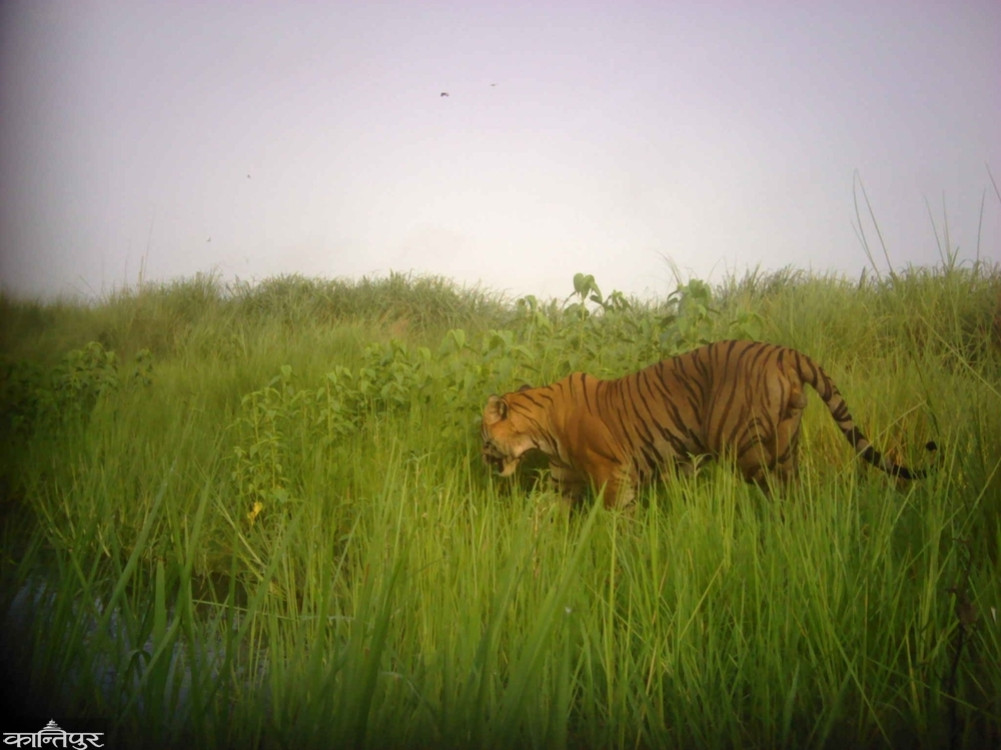
What is the number of tigers in that particular place? It is a study to find out what is the density of tigers. Not only tigers but also food species are studied in it.
We use Google Cloud Translation Services. Google requires we provide the following disclaimer relating to use of this service:
This service may contain translations powered by Google. Google disclaims all warranties related to the translations, expressed or implied, including any warranties of accuracy, reliability, and any implied warranties of merchantability, fitness for a particular purpose, and noninfringement.
As soon as the tiger is mentioned, everyone remembers that it is the king of the jungle. For those who have never seen it, they are curious about what it will be like. Recently, there have been incidents of tigers attacking people in various protected areas and settlements near forests.
Tiger is also known by many as a violent animal. Monitoring and enumeration of tigers and ahara species, which are considered the kings of this forest, are being carried out in the Brahmadev Biological Way connecting Kanchanpur's Shuklaphanta National Park and the forests of Chure area and in the surrounding areas .
In Shuklaphanta National Park, the tiger count has been completed recently. How is the tiger, which is considered the king of the jungle, calculated? What method is adopted? How long does it take? Based on this topic, ZSL (Zoological Society of London) Nepal program officer Santosh Paudel Kantipur Karmi Bhawani Bhatt conversation:
What is the monitoring of tiger and food species by camera trapping method?  ;?
Monitoring is specifically how many tigers are there in that place ? It is a study to find out what is the density of tigers . In it, not only tigers but also food species are studied. Overall, it is found out whether the tiger has roamed in that area or not. In particular, the biological route is more important than keeping the wild animals themselves, so it shows where the tigers and other wild animals have migrated from. Like
 , the same tiger has been captured in Shuklaphanta, the same tiger has also been captured in the biological way, and information is received that the tiger living in Shuklaphanta is going to India through the biological way . The study of food species gives information on how many tigers can roam in that area in the future. Even when tigers live, they need food . Since food species are a major factor in determining the number of tigers, monitoring is also included. The
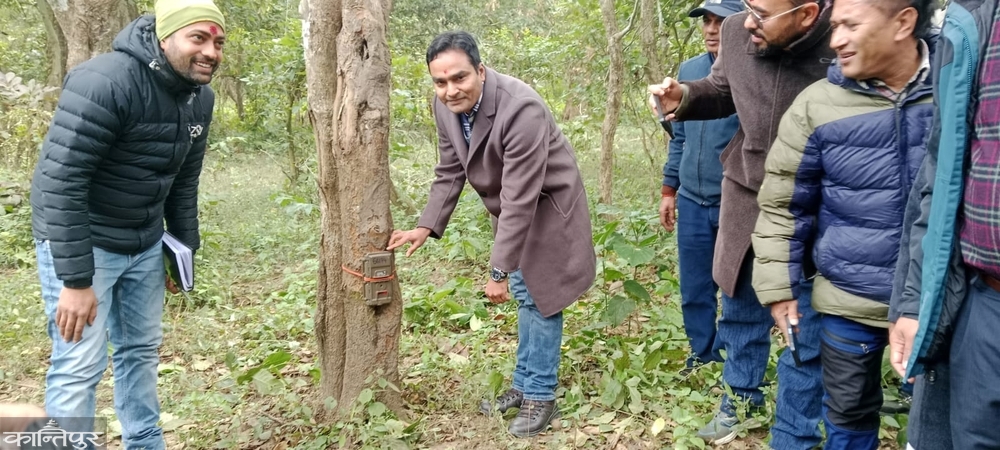
camera trapping method means that pictures are collected by placing an automatic camera along the tiger's path. For this, a fixed grid is made and a camera is placed within it by finding a place that is more accessible.
How many automatic cameras have been installed in the Brahmadev Corridor which is currently being monitored? How many days will those cameras be kept ?
Currently, 75 pairs of automatic cameras have been installed in the Brahmadev Corridor and the surrounding area of 300 square kilometers where tigers and wild animals are being monitored. It is kept for a minimum of 15 days from the date of installation .
How expensive are the cameras being used in monitoring and counting tigers? Where did it come from? And how does the camera keep charging and how does it record photos or videos?
The cameras we are using in the Brahmadev Corridor are mostly from Panthera and a couple of Cuddybag companies. Its price is around 40/50 thousand rupees. It contains a memory card . The photo or video taken by the camera is saved on the memory card.
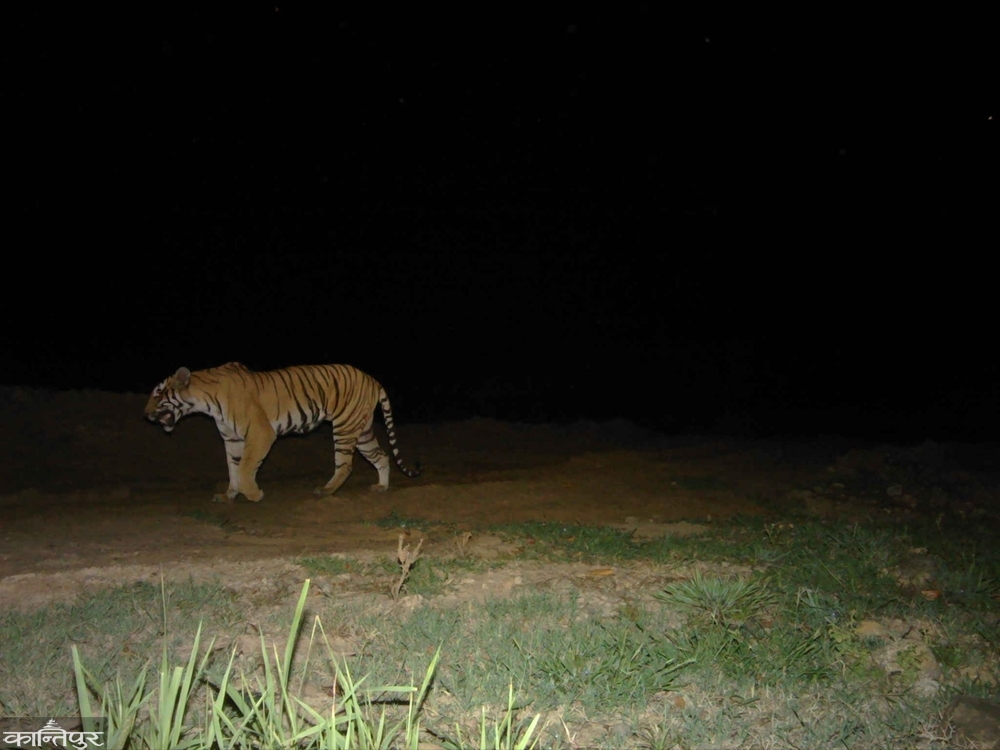 If a living object moves or a leaf moves in front of the camera, it is motion sensitive and captures any activity in front of it. Various settings can also be made in it. Like taking three photos at once or making a video if the object moves in front of you. It is already set up and placed in the field . The battery is also double A size . If less photos are taken, it will take 15/20 days . If you take a lot of photos, you need to change the battery once in between.
How and on what basis is it decided where to place the camera?
Initially, the overall survey area is divided into grids of 2 by 2 km. In each grid, if there is a hot road or a fire line where the tiger can walk, the camera is installed after detecting it. It is believed that a tiger walks that path once in every grid. The path can be found on the basis of signs such as tiger feces, scratches on trees and soil.
How do you know if the same tiger has been seen on multiple cameras?
Like human fingerprints are different, tiger paws are also different . One does not match the other . Based on that, tigers can be distinguished from each other . For example: if there are 500 photos, how many tigers are there, by comparing their pages, it can be pointed out that this tiger is different from this one according to the page. That's why two cameras are placed in a grid. So that the photo of both sides of the page comes clearly. Which one is on the right and left profile ? A tiger's right Or can only capture the profile on the left . It is difficult to distinguish from it . That is the reason for placing two cameras on both sides of the road at a distance of 6 to 10 meters at one place .
How many manpower are employed in this work and how many days will they be able to work ?
is now working in 6 groups. 35 students from ZSL Nepal, National Nature Conservation Fund, Division Forest Office Dadeldhura and Kanchanpur, Chure Conservation Network, Community Forestry, Forestry Studies Institute have been deployed. They keep the camera for 15 nights . It takes 20 days to deposit and withdraw. Then, depending on how many photos have been captured, the analysis time is more or less . The more photos are captured, the longer it will take. Usually results can be seen in two months .
What is achieved by counting tigers?
A tiger is an apex predator. It is the dominant species of the ecosystem . Tigers have been given special priority for the purpose of protecting the overall biological diversity of other wild animals there. It is also included in various policies of the state .
can then provide more knowledge for management by finding out where the presence of the tiger is. Monitoring also benefits poaching control, food management and habitat management. Monitoring Procedures for Tigers and Food Species, 2073 provides for regular monitoring of biological routes and protected areas where the density of tigers is low and poaching is possible.