We use Google Cloud Translation Services. Google requires we provide the following disclaimer relating to use of this service:
This service may contain translations powered by Google. Google disclaims all warranties related to the translations, expressed or implied, including any warranties of accuracy, reliability, and any implied warranties of merchantability, fitness for a particular purpose, and noninfringement.
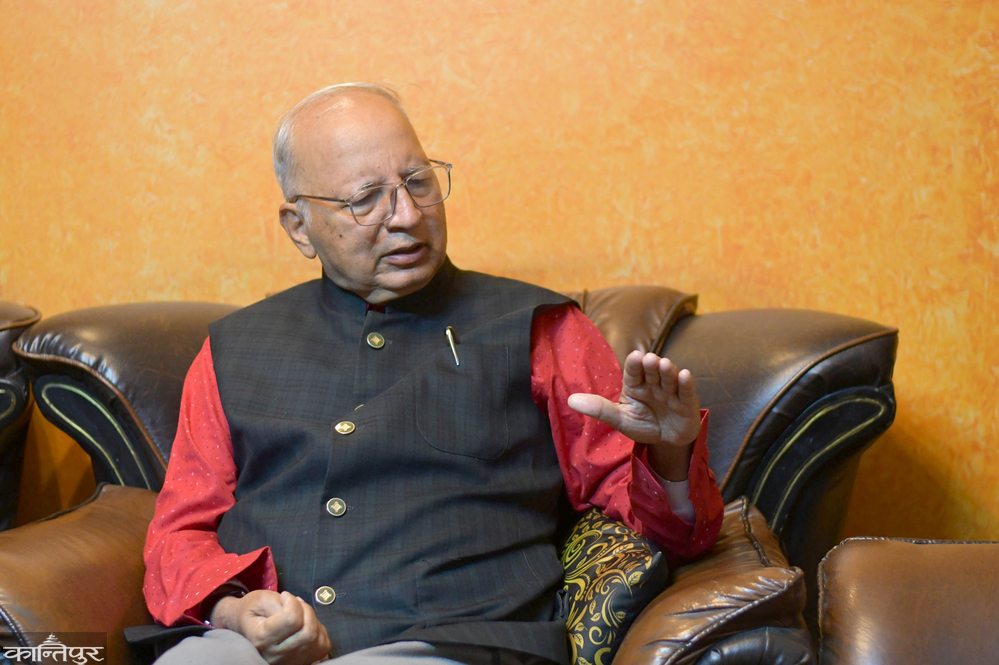
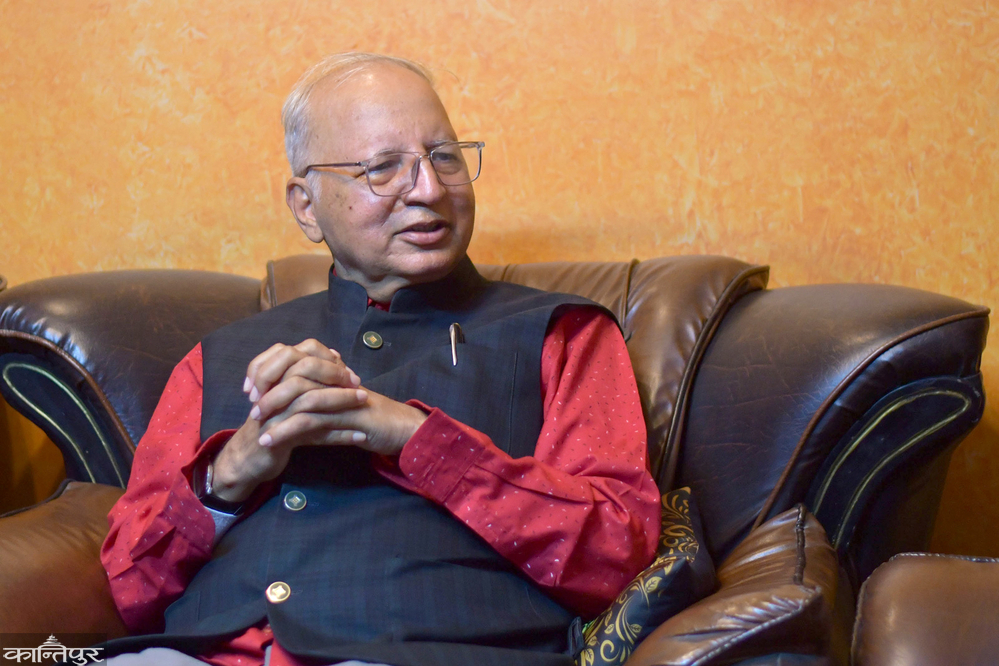
Judge Anand Mohan Bhattarai, who recently retired from the Supreme Court, is internationally known for his judgments, books and research on environmental justice.
In the name of making Nijgarh airport, his decisions ranging from banning the clearing of 8,000 hectares of forest to the need to vacate the place where the water flows on the Bagmati bank are of far-reaching importance in terms of environmental protection. Judge Bhattarai, who has been training jurists and judges on environmental justice from Asia to America, is an edited part of the interview conducted by Kantipur's Umesh Chauhan and Ghanshyam Khadka : recently arrived in Indonesia from a training interaction with judges. Earlier, he went to Harvard University and gave lectures on environmental law, Nepal's constitution and administration of justice. What information or interest do outside judges have about Nepal's courts and justice system? And, how do you find the image of Nepal's court elsewhere?
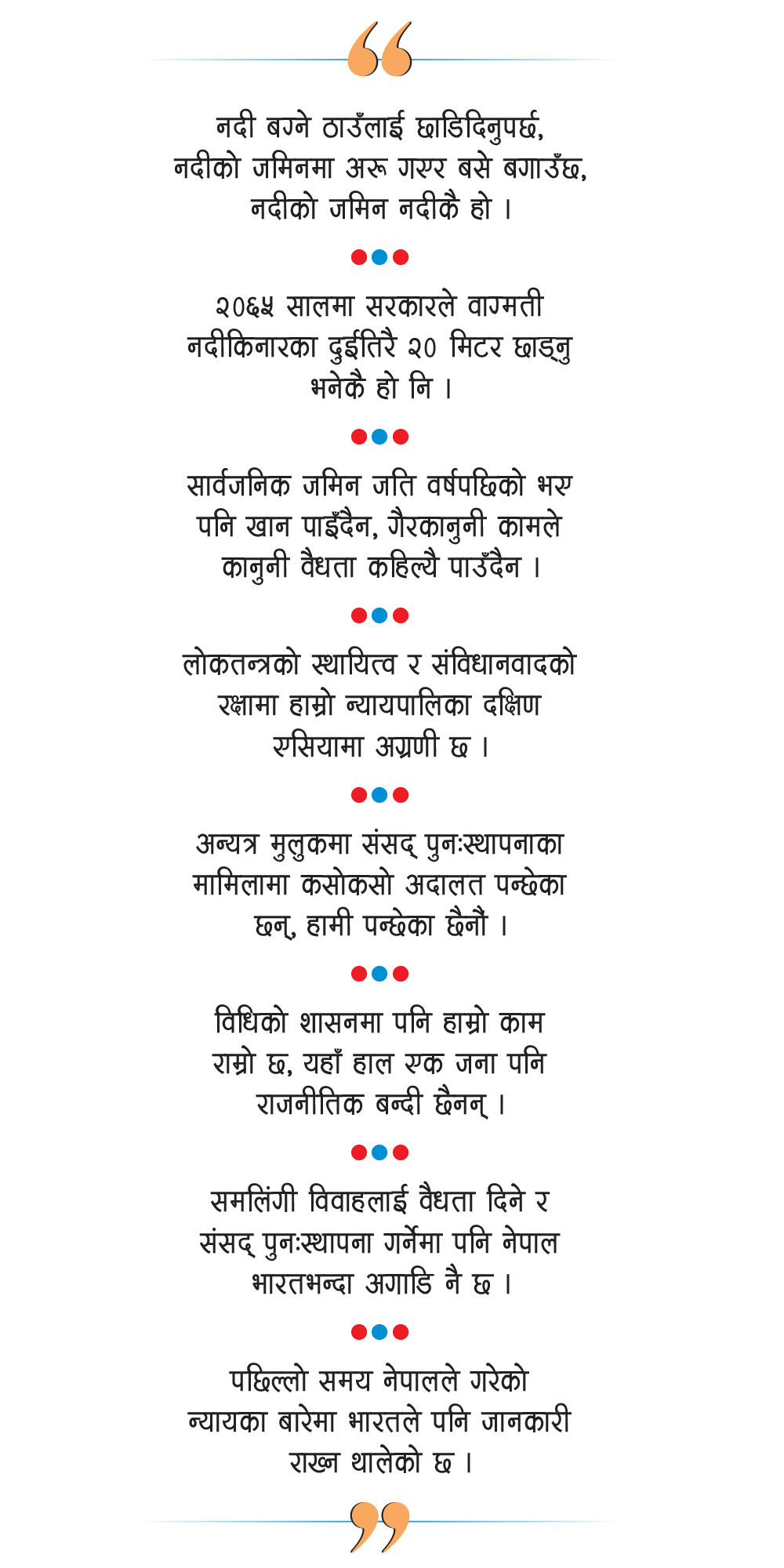
is interested in comparative law at a foreign university. The legal system of one country cannot be transferred to another country. But it can be extracted and put into a new system. When it comes to comparative law, comparative justice also comes up. Despite the disruptions in our country, the work done in the independent judiciary is exemplary. Our Judiciary is the leader in South Asia in protecting the stability of democracy and constitutionalism. Parliament has been dissolved 9 times in the history of Nepal. It has dissolved 8 times since 2047. The matter came to court 6 times. And the court restored it 4 times. What this shows is that our court stands for the defense of constitutionalism.
In other countries, when it comes to the matter of restoration of the parliament, some courts have turned aside, we have not turned away. It has become a matter of interest to the world. Our work is also good in the rule of law. Like, currently we don't have a single political prisoner. There is no other country in South Asia that does not have political prisoners except us. This court effectively dealt with the issue of detention and did not allow anyone to be detained illegally. We did this even during the conflict. Our administration of justice is better than in Pakistan, Bangladesh and Sri Lanka.
Bhutan and Maldives did not matter. Our functioning as an independent judiciary and the jurisprudence developed by us is also the best in South Asia after India. In some respects we are even ahead of India. As, our courts have previously ruled that domestic violence is punishable, our decision on marital rape is ahead. We are also ahead in giving share to daughters. Nepal is also ahead of India in legalizing same-sex marriage and restoring parliament. We are also ahead in the matter of environmental protection, which the courts of the world have begun to look at with interest.
On the day of your retirement, Chief Justice of India Dhananjaya Yeswant Chandrachud called you on the day of your retirement and expressed his willingness to work together in the days to come. Are the judges and courts of Nepal and India having mutual cases to do in related legal matters?
Although we are an independent country, we are influenced by 'Common Law'. Our borders are open. After 2007, all the first generation law graduates in Nepal studied in India. Some of them sat in the ministry to make laws and made laws. Some came to court and enforced the law. Hariprasad Pradhan, who was living as an advocate in Darjeeling, came to Nepal and became the first Chief Justice. Since then, seven Chief Justices have graduated in law from India. Because of this, there is a lot of information about Indian courts in Nepal.
We second generation lawyers also went to study in India. When I was in the Supreme Court, 7 judges had obtained some degree in India. Similarly, many people from the legal community have also studied in India. Recently, India also started keeping information about the justice done by Nepal. Like Sunil Babu Pant's case and my own decision in Suman Pant's case and the last time Hari Phuyal's decision has become a topic of discussion in India. These judgments became 'reference points' in Chandrachud's court. 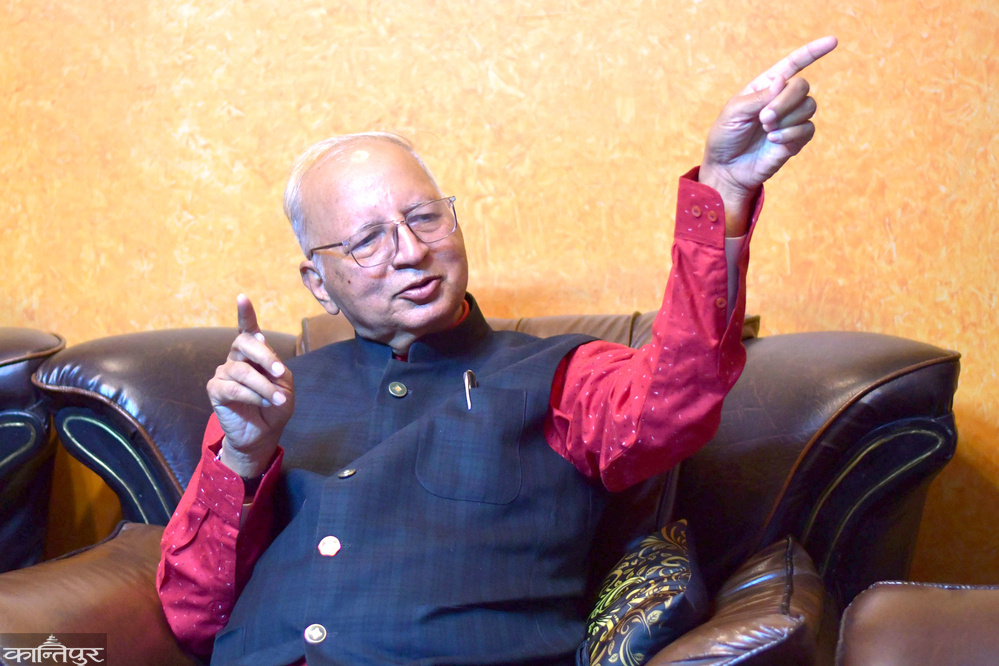
In this way, the closeness between our two courts is increasing and the judges are also familiar with each other. One of the problems with South Asia is that despite being so close, we are legally separate. However, as a sovereign country, the justice system of each country is run by the country itself. However, being fragmented and without communication cannot lead to unity in the regional issue. Like
? Like
, India and our intellectual property laws are different. Forest laws are also different, while forests exist in both countries. We have an ongoing 'Tarai Arc Landscape Project', which includes 14 ecological zones across the border between India and Nepal. Just as a forest does not know that I am a forest of a country, neither does basmati rice and turmeric.
Whose 'patent right' is the issue in such matters. Like, there is a question whether Basmati rice belongs to India, Pakistan or Nepal. Another thing, our rivers flow downstream, but plastic and pollution flow upstream. Plastic first came to Nepal from India. That's where Coca-Cola came from. Our mountain was organic. The chemical fertilizers that spoil its purity come from the south. How do we see it? When I read about climate laws, I read that pollution, forests etc. are local issues.
Climate change has shown that these issues are not local. Forests consume carbon. It was not only regional, it became global. Rather, biodiversity is a regional issue. However, forests are not a local issue as they help reduce global pollution.
Similarly, pollution, plastic is also not local. Therefore, it is necessary to have similar laws between countries to solve it. Because, the issues are regional and global. Our legal systems are local and national. As a result, our courts are working in a fragmented manner. This narrows the issue.
Intellectual property laws should also be made a little more liberal. For example, it can be a job to set up a company in India using the biological resources of Nepal or to use the biological resources of India by setting up a company in Nepal. In this case, there may be a problem of who owns the intellectual property rights. Therefore, regionally we have to exchange judicial views.
Chandrachud's tenure was strong in many ways. There was also criticism that the closeness with Prime Minister Narendra Modi was seen in some issues from matters of democracy and court defense. Today he lives in retirement, like here. How do you see Chandrachud as the Chief Justice?
Chandrachud is the most read Chief Justice of India. After completing his BL from Delhi, he did his LLM and PhD from Harvard. His father also became the longest serving Chief Justice of India. Chandrachud's family has become a judicial family. Raised in such a family, Chandrachud initially became a High Court judge in Bombay. Became Chief Justice of Allahabad High Court, Judge and Chief Justice of the Supreme Court.
Rohinton Nariman, another Harvard-educated judge, was on the Supreme Court of India at the same time. They put their hands on the JJ and wrote the judgement, upsetting the Courts of India. His judgments about the Great Indian Bustard and the Florican bird are astonishing.
After a transmission line affected these birds, a judge ordered the line to go underground. Later the government came for review. The government said that diverters can be used to ensure that birds do not die. He took notice of that. And, by forming a scientific committee, he also wrote in the decision what the mandate would be. Chandrachud's decision not to implement the ban until then is not only balanced, but it solves a complicated matter.
It is not clear in the Constitution of India that an environment like ours is a fundamental right. Their Article 21 deals with the right to life. The right to life includes the right to a dignified life. Chandrachud explained that the right to avoid the deadly consequences of climate change is also the right to life. It has been highly appreciated by the international community.
Like many Chief Justices, if a tough case came up during their tenure, they would argue without deciding. However, he did not do so. Dealt with the issue promptly and resolved it. Similarly, there is a comment on Article 370 in his judgment in the Jammu and Kashmir case. However, he did not want to avoid it like others. So, he looked brave. He also made a wonderful decision on the issue of electoral bonds and promoted transparency. Information technology was also advanced.
We are the only court in South Asia, which writes judgments in its own language. The Supreme Courts of India, Pakistan, Bangladesh and Sri Lanka write in English. Because of this, Chandrachud felt that the court was far from the reach of the common man and ordered the verdict to be overturned in the regional language.
Another thing, tried to create a 'real time data base'. By appointing vacant judges, the administration of justice was also streamlined. He may not have been perfect, but he added a brick to the Indian court. Today, when two senior judges of the Indian High Court met in Indonesia, I asked - who is your towering judge of this decade? Both said – Chandrachud and Rohinton Nariman. In the eighties there were PN Bhagwati, Krishna Ayer and in the nineties Chinapa Reddy, Kuldeep Singh, Bekat Chalaiah, Benkat Ramaiah etc. In this decade there have been lunar eclipses.
Some debates are live in India. Is such a live broadcast possible in our hearing?
I see potential. We have already submitted a model of transparency by starting Gola, for the courts of the world. There is an organization of judges called 'Global Judicial Institute on Environment'. It has launched a project called 'Model Forest Law Initiative', I am on its drafting committee.
During the meeting of this organization, there was a meeting with Pakistani judge Mansoor Ali Shah in New York. "You have been on strike for 40 days, haven't you?" he asked. I said that I did not watch the bench in the pesi set by the Chief Justice to stop the silent justice, not even on strike. To solve it, I explained how we, together with the judges, made a procedure for the round procedure and implemented it. After hearing this, he wished he could implement it in Pakistan as well.
"Even in our country, the court is in trouble due to the arbitrariness of the Chief Justice," he said, "Please send me the procedure, I will take a look." He was on the roll of the Chief Justice at that time. However, he did not get to head the court as Yahya Afridi, the third ranked in Pakistan, was made the Chief Justice. Otherwise, perhaps, shelling would have started there as well.
It's not like we're not promoting transparency by starting the pesi round. Now this direct hearing is also desired. Virtual hearings are held in High Court Biratnagar's Ilam Bench and High Court Doti. This has made it easier for lawyers in Terai including Dhangadhi and Jhapa, the pressure to change jurisdiction has decreased. This work can be done all over the country.
If the petitioner tells me that he has no faith in the impartiality of any organ or mechanism of the government, then the Court of India will form a separate independent committee like the SIT and submit its report to the court. For example, the SIT formed in India's Gujarat riots. How much of this trend do we have?
We have also formed a committee. Like, Balram KC husband did this in Koshitappu's case. Koshitappu's animal ate the farmer's crops. Farmers ran for compensation. However, they did not get anything. Then they came to the Supreme Court with a writ.
At that time, the right to food sovereignty was placed as a fundamental right in the interim constitution. He creatively explained that if animals eat the farmers' crops, it will lead to famine and that the right to food sovereignty is also the right to avoid famine and ordered them to be compensated. A committee was also formed to determine the compensation. That decision is very famous.
Other judges have also formed a committee and taken the report and implemented the decision. Recently, Sapna (Sapna Pradhan Mall) ji and my bench also asked the government to form such a committee to protect farmers' crops from monkey terror and submit a report within three months.
Even though we did not form a committee on the issue of rhetoric, we asked all the municipalities for a written answer. In the same way, the Council of Ministers was asked to give details of the progress of the work done regarding the removal of pollution and encroachment of Bagmati. The Attorney General was also asked to attend the hearing himself.
The order was made to vacate 20 meters of land along the Wagmati River. Comments that the order was unreasonable were widespread. Later, after seeing the damage caused by the rains and landslides during the end of the monsoon, people began to say that the Supreme Court was right. Here was its forecast?
The constitution has given the court the right to hear the petition of public concern, it is necessary to consider it first. After many years of hard work in India, this right was achieved through judicial interpretation in the 1980s.
With us, the constitution has given us the right to enter the court for any matter of public interest. In this way, it has become our duty to settle the disputed matter in the country after it comes to the court.
In the case of Nigjadh, we said that eight thousand hectares of forest cannot be cut. The question may also arise as to whether the court has that right. The court must speak to stop the government administration, which has proceeded badly by copying and pasting the Environmental Impact Assessment (EIA) to create a runway of 3,000 hectares and cutting down 8,000 hectares of forest to make an airport.
Whether it is an order not to build a building up to 65 meters from the shore to protect Pokhara's Fewa Lake, or a directive issued to keep the name of a rape victim confidential, the court has fulfilled its duty in the absence of law.
The EIA of the Chitwan Wildlife Conservation Park, which is on the World Heritage List, was also rejected by my bench because they were going to make a road through the park by preparing it in a similar manner. My judgment in Vagmati has gone to the Bench for review, so I should not say much as it is a pending case. This year's big flood in Bagmati is not the first. And, there will be no final flood either.
because the flood will come again. Now due to climate change, rain has started falling in limited areas due to 'cloud bursting'. This has happened in many places in Nepal. It happened in Pakistan, it also happened in Sikkim. When this happens, we have to leave the place where the river flows. If others go and live on the land of the river, he washes them away. The land of the river belongs to the river. Even if someone cultivates it, the river cannot stop it.
Our constitution has provided for environmental sustainable development. Article 30 of the Constitution says clean and healthy environment. That 'healthy' means keeping the environment clean. Therefore, an uninterrupted flowing river belongs to our environment. In fact, it was also broken. In 2065, the government said to leave 20 meters on both sides of Wagmati. Consider for a moment, if we leave 20 meters at Pashupati Aryaghat, it reaches Pashupatinath temple.
The government did not say that. It means to keep the heritage intact. This judgment also does not say to remove the heritage. In other words, if it is open, don't structure it. That is also under consideration. The court will speak on this. A very important person of the state body said 20 meters without understanding the court, then it includes Pashupatinath and Guhyeshwari too. If Pashupati falls, it will fall not by the court's decision, but by the government's decision.
is the office of rhetorical civility, which is an institution established by executive order. No one can resist it. That organization came to the court and asked us to give the law. The court made a law and asked all city chiefs within the Wagmati civilization to take sides and make them members of the board and proceed with discussions. As the flood has caused damage, does not the rehabilitation of displaced people become the responsibility of the state? And the court does not fulfill its obligations?
At the bottom of Nakhkhu for two hours, people did not get help even when they pleaded and they went away. What would have happened if there was a minister or an MP? Big and rich people don't get flooded, but the poor and marginalized people do. Environmental degradation has devastating effects and it hits the poor and vulnerable people the most. In order to protect them, the courts are more active in environmental justice. Where standards are needed, that's what we do.
We did this in Chure too. Ever since the Court began to hear environmental issues, the Court has also been a binding rule-making institution. This is the eighth judgment of the Division Bench along with ours in Vagmati. The court is constantly ruling on it. They keep the party office in the flood area of Bagmati, so what should we do? What should we do if the leaders in the flood area of Bagmati keep their reputations? What will that flood do? What should rhetoric do?
Regarding the damage to the structure of the person, there will be upheaval, do you have anything to say about it?
Oratory has flowed since the beginning of civilization. The last time our Napi is the year 2021 It has to be seen whether all the coastal areas of Bagmati have been surveyed. The second survey took place in the year 2045. If we compare these two gauges, we can see how much is the river bank and coastal area including Wagmati, Bishnumati. Section 24 of the Property Act does not allow anyone to usurp public land.
There is a UN Park near Kupandola. The park is built on public land. Wasn't there such a land in other rivers like Vagmati and Bishnumati? Of course there was public land along the banks of the river. Children used to go there and play. From Gokarna down to Chobhar there are pilgrimages on the banks of the Vagmati.
People used to walk from one shrine to another along the same coastal path. Was the land he walked on private or public? The state machinery should look at it effectively. Public land cannot be eaten no matter how old it is. The thing is, if the government acquires the person, who has legal ownership, it should be compensated.
The same land has been sold in four-five generations. The question is, how will the sixth person come and suffer the punishment? The
case is pending. What should be understood is that illegal acts never get legal validity. The comparison between the power to protect the environment and the power to destroy the environment is very unbalanced. The defense side is weak. The court is not looking for power, but for justice. Overall, it is the responsibility of the court to protect the constitution, prevent the destruction of the environment, etc.
In an undeveloped country like ours, on the one hand we need infrastructure, on the other hand we have to protect the environment. For us, development is ahead or the environment is ahead?
This is a topic of debate not only in our country, but also elsewhere. Other courts in South Asia have been accused of stopping development in the name of protecting the environment. Environment and development go hand in hand, not in competition with each other. If so, there was no need to write "environmental sustainable development" in the constitution. The United Nations has said that no one should be left behind in the Sustainable Development Goals.
includes development, environment, climate, poverty and hunger. Courts of various countries have now accepted that rivers also have the right to live and be healthy. Based on this principle, we decided on Upper Karnali.
Karnali river only or civilization? For thousands of years, people have preserved the soil by living there and cultivating it gradually. If the flowing soil is taken to Karnali again, how much will it cost? This is an environmental service they are doing by saving the soil for free. If you have to give water to the people below, you have to tell the people above to stop using pesticides etc. They should be compensated for the loss of livelihood by not doing so. This is what we said in the decision of the Upper Karnali project.
Some argue that the court stopped the possibility of the government selling stolen stones/sand to generate income.
Chure is an important biodiverse natural heritage spread across both Nepal and India. The more we can protect it, the more nature is protected. In India's Uttarakhand, the forest region called Shivalik is also Chure. 164 river systems either cross or originate in Chure. In 38 districts of Nepal there are some kind of theft. The broken soil is loose. If the soil is removed from the bottom, the crumbs will fall. India's hunger for development led to an enormous amount of gravel/sand being pulled from Chure. After this matter came to court, it was ordered to stay.
Where, who extracted how much natural resources and what is the situation can now be seen from satellites. The court said that a team of scientists would be formed to find out where conclusions can be drawn on the basis of their report. For that, a plan should be made based on the national discussion and deliberation in the legislature, not on the basis of the executive's decision. Only then can ecologically sustainable development take place. Otherwise it doesn't happen. In the case of
theft, the government's proposal to reduce the trade loss by extracting stone, gravel, and sand through the budget is not only against the principles of sustainable development, but it is also a kind of environmental crime, the court said. Banning the export was not only a discussion in the parliament, but also an order to create a law.
What is environmentally sustainable development?
This is development with a plan . A plan made on someone's whim cannot be called development. Because, there is no idea about the sustainability of the environment . We can plan any country we want. It is not difficult for such a small country.
was previously called Jal Shakti Aayog. At that time, the Commission has written down what can be done when planning the watershed. Similarly, a land use map has also been made, while surveying the land . What can be done in the country is also written in it . While doing development work, at least by looking at these reports, you will know a lot.
Environmental development seeks planning . Environmental development cannot be planned at the whim of a leader. The work of such development should be told to the people, should be discussed and the plan should be approved through a detailed discussion of the parliament after finding possible risks and solving them.
In a conversation here, he said that people are generally ignorant about what and how much the area of the Himalayan environment is. What is that ignorance and what is the need to know ?
The Himalayas is a system . This is not just a tip of the iceberg. Within the Himalayan system, the watershed in Tibet north of the high Himalayas is separated from the rest of the land by the westward-flowing Indus and the eastward-flowing Brahmaputra (it has a different name in Tibet). This territory extends to the Galchi cut by the Brahmaputra in the east in Arunachal and the bare hills cut by the Indus in the west and all the plains north of the Ganges in the south. It is not enough for one country to protect it . Nepal is located in the Central Himalaya region.
There are 36 hotspot areas in the world, of biodiversity. As many as 4 of them are in the Himalayan region. A limited area with extremely high biodiversity is called a hotspot . In this area, there is a very narrow idea about the mountains with such importance. In the 1980s, the Indian media said that floods and landslides occurred in India due to deforestation in Nepal. Later, scientists Jack Ives and Bruno Messerelli published a book called 'Himalayan Daily' in 1985. It states that the geological structure of the Himalayas is responsible for the floods and landslides in North India rather than deforestation, and that there has been no deforestation as claimed in Nepal.
After we implemented community forestry in Nepal, it has increased from 27 to 45 percent in 24 years . This is a very good job . The Convention on Biological Diversity is abstract and national laws are inconsistent. It is important to make the regional law for that and NBSP;. As the protection of the Himalayas Area, Pakistan, Nepal, Bangladesh, Bangladesh, Bangladesh, Bangladesh, and Nbsp, If these countries have not yet under particular control, one cannot be promoted, and Nbsp;. & Nbsp;

