India and China getting together is good for South Asia, but Western powers don't want to see it happen.
We use Google Cloud Translation Services. Google requires we provide the following disclaimer relating to use of this service:
This service may contain translations powered by Google. Google disclaims all warranties related to the translations, expressed or implied, including any warranties of accuracy, reliability, and any implied warranties of merchantability, fitness for a particular purpose, and noninfringement.
A famous journalist of India is N Ram. He started reporting in 'The Hindu' in 1966 and was the editor-in-chief from 2003 to 2012. He has also been the chairman of 'The Hindu Group of Publications', which runs 'The Hindu' magazine, and is currently working as a director.
The investigative reporting of Ram, who has worked for a long time in a popular newspaper in India, started by his own family, has brought attention not only in India, but internationally. When the 79-year-old Ram, who is now in a management role, came to Kathmandu last week, he discussed geopolitics in South Asia, the state of press freedom, the impact of social media, etc. Jagdishwar Pandey from Kantipur edited part of the conversation : You did excellent reporting in 'The Hindu' during your journalism journey. Then he became the editor-in-chief of the same magazine. After becoming the Chairman in a managerial role, he is now the Director of 'The Hindu Group of Publications'. What is the experience of playing different roles in the same magazine? I come from a family background where there was always a magazine. My family used to run the newspaper 'The Hindu'. This family started publishing the newspaper on September 20, 1879. It is now 145 years old. When I completed my Masters in History in 1966, everyone expected me to go into journalism. I decided to become a journalist. I am the eldest son. My sister was not involved in the magazine business. But my brother went into newspaper business, he is a chartered accountant.
I started working from reporting to news editing. In 1967, I went to New York to study at Columbia University's Graduate School of Journalism. After studying a one-year course, I returned to 'The Hindu' newspaper and did a lot of reporting. I also started writing editorials in the 1970s. I also reported the cricket series against India and the Best-Indies in 1974-75.
That is why reporting is so important in journalism. They can't do well if it goes up without reporting. Reporting is the heart of journalism. Certainly those who research and keep informed in the academic field, who can write good columns and articles, will make progress.
American journalist Bob Woodward recently came to Mumbai. Together with Carl Bernstein, he exposed the 'Watergate scandal' in 'The Washington Post' in 1972. He has written some books. In the 1970s, books on Nixon led to Nixon's downfall.
and finally had to resign. He was in Mumbai to interact about his new book 'War'. But he introduced himself as a reporter. He also writes columns and editorials, but such a famous journalist still prefers to be called a reporter. I just said that to explain. Reporting is very important in journalism.
I have written editorials as well as led the team for a lot of investigative reporting. The first break in such reporting was during 1980-82 when I was working for The Hindu from Washington DC. At that time, India and the International Monetary Fund (IMF) agreed to a partnership. They agreed to $6.2 billion. However, there was a condition that the subject of the agreement should not be made public. In the
agreement, India's private sector should be made more active, the rupee should be changed, and trade unions should be controlled. It was a secret. But, it fell to me. I wrote about it. At that time the amount was very high. And, there was a widespread outcry in the Indian Parliament. The government was criticized for accepting too many conditions. The government's 'Line of Credit' and 'Balance of Payments' were also criticized. Then there was investigative reporting about India's nuclear deal.
You did investigative reporting in the 1980s on the Bofors scandal (an arms deal between India and Sweden. It initially involved Indian and Swedish government officials, including Indian National Congress leader and then Prime Minister Rajiv Gandhi). Even after stepping down as a journalist in 2017, he also reported on the Raffle deal scam (there was a political controversy in India over the Rafale multi-role fighter jet purchased from France for INR 58,891 million for the air force) purchased by the Modi government. What about those two scams?
The first Boffers scandal was significant. It was seen as the biggest scam since India became independent in 1947. At the time, Columbia University also listed the Boffers scandal among the 50 best investigative stories by its alumni in the media by any medium. That investigative news made a big impact. The opposition parties also made their agenda based on this. That lasted for about two years. For this we had teamwork, which was led by me.
raffle is investigative reporting that happened by chance. Because at that time I was not in any regular journalism. The necessary information regarding the Raffle Agreement was available, we published it. As we are a bold magazine, 'The Hindu' has no objection to publish such news. Thus it became big news but did not have the same impact as the Bofors scandal. After that, the effect of that news was not seen in the 2019 Lok Sabha elections.
You are the director of 'The Hindu Group of Publications'. Why do you keep writing anyway?
If something new happens, I would like to write. Apart from 'The Hindu', I also write for 'Prospect Magazine' in Britain. When they request it, I write it. I also write on 'Front Line'. I also wrote 'Making of Modi'. I have written in a critical and balanced way. Since my thoughts are also they are a bit long. Also, I have written about media freedom. I have also written some
books. I have also written a biography of author RK Narayan with my ex-wife (Susan). He was in association with 'The Hindu' since 1935. I have also written my chapter in the book 'On Citizenship'. His book on corruption 'Why Scams Are Here to Stay : Understanding Political Corruption in India' got a good response. The book is written about political corruption in India.
Right now I am limited to the board level only. We give the magazine complete editorial freedom. Because pressure is coming from different sides. We must protect the freedom of the press. 'The Hindu' has a good reputation because of its quality journalism for a long time. Moreover, it is easy to work because the Bharatiya Janata Party's influence is weak in Tamil Nadu.
Due to the impact of various information technology tools, the Internet and social networks, the future of print media has been questioned for some years. How do you see the future of print media now that you yourself are running it? The
print medium is on the decline. Mainly vernacular newspapers still survive in India. Their sales are decreasing. The most serious thing is that the habits of the youth are changing. Some youngsters go for digital editions even if they don't have print. Studies have shown that most news is viewed on mobile phones. Those news can be read by searching in Google search engine. After that ease, they don't read the newspaper. News can be read from Google's search engine and algorithm.
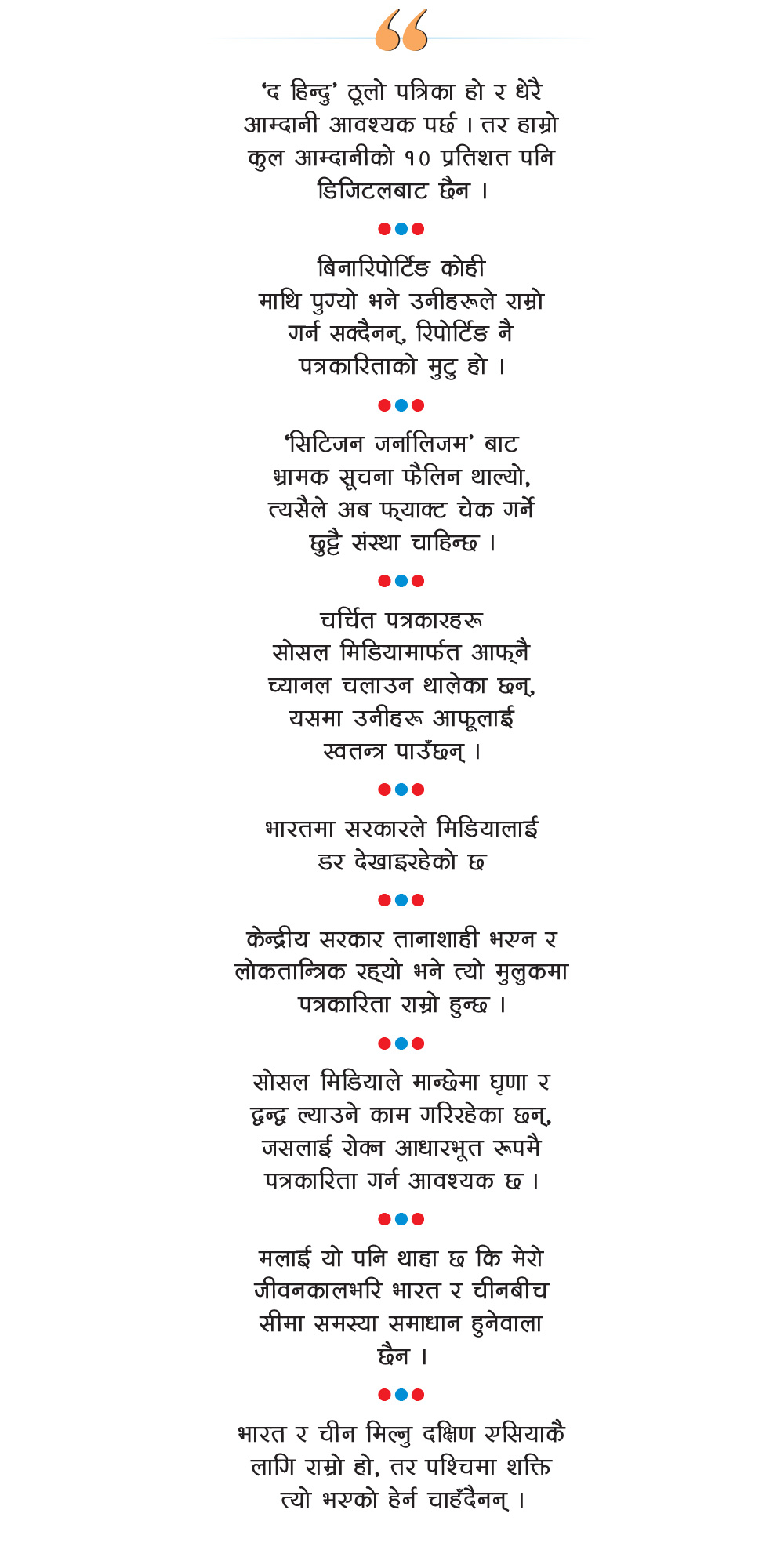
So print is having a challenging time. 'The Hindu' is a big magazine and needs a lot of income. But not even 10 percent of our total revenue is from digital. About nine lakh magazines are sold. Newspapers need advertisements to run. Staff cannot be hired without advertising. So the future of printing is uncertain. We now have to move forward in a new way. Let's hope enough readers support the media.
With social media becoming active, 'Citizen Journalism' is also being discussed.
What is the difference between '
main stream journalism' and 'citizen journalism'? I was also optimistic when first came up as 'citizen journalism'. But now readers complain that 'toxic news' has started coming from 'citizen journalism', 'disinformation' has started spreading. We must distinguish between 'disinformation' and 'misinformation'. 'Misinformation' is the flow of wrong information. This is not planned. But 'disinformation' is a planned misinformation. It is being used a lot more. "Deepfake" has also started but it has not been widely used in our area. Its influence abroad has also started to increase. Common misinformation can be easily spotted.
India has a fact check website called Altnews. Every media has started fact checking. Our 'The Hindu' is also fact checked. Fact check is very important nowadays. Fact checking websites need to be a separate entity. Now AI (Artificial Intelligence) has also arrived. We can use it properly. But in deepfake, AI is also challenged.
If we look at Indian journalism in the last decade, journalists working in mainstream news organizations are leaving their jobs and using social media to run their own channels, why?
In doing so, they find themselves free. Also, they want to use that medium as well. Dhruv Rathi, Ravish Kumar and others are running the program on YouTube. Ravish Kumar is a famous journalist of NDTV. He has won the hearts of many by doing journalism for a long time. But they have a small team. Another example is Karan Thapar. He is a famous television journalist.
The interview he did can be seen on YouTube. He is collaborating with 'Wire News Portal'. Journalists like them need help. Everything on YouTube is free. No one pays to watch it. Otherwise you have to either bring ads or get help from other means or the reader has to help himself.
Are you saying that independent journalism is going downhill in India?
India's press freedom is getting worse under the Bharatiya Janata Party rule that started in 2014. You can also see this in reports from international organizations including Reporters Without Borders.
The report that 19 journalists were killed during the tenure of Narendra Modi has been published. The Global Committee to Protect Journalists (GPJ) tracks every incident involving journalists and reports on what happened. If a journalist dies due to other incidents, they don't bring it into independent journalism. They write that if there is a murder.
Another is to show fear to journalists in India. Especially Muslims do that. Modi government arrests journalists. And the judiciary has not played a good role either. Because the court
Takes too long to unravel any event. Will not be released. Any case is kept in jail until it is solved. Pranoy Roy, a good journalist from NDTV, used agencies from income tax to other agencies after Bharatiya Janata Party came to government for his reporting on the incident in Gujarat. Then came financial problems in NDTV.
was forced to sell and Gautam Adani Group bought NDTV. Now NDTV doesn't have the same influence as before. Now I also stopped watching NDTV. Daily Bhaskar had published a photo of a dead body in the river Ganga during the time of Covid-19. Income tax raided Dainik Bhaskar newspaper because it had other businesses.
Then the newspaper had to work on the government's line. What is seen from this is that the government is showing fear. It appears that this was done to warn others not to do so. But we have independent journalism in Tamil Nadu through journalists from other areas working in local languages and YouTube.
Before the last Lok Sabha elections, Indian television channels broadcast that the BJP would win more seats. But the results were very different. As we can see, the same thing happened in America. Everyone knew that Trump would win. The same propaganda was done in India during Modi's time.
How do you view journalism in South Asia?
In independent journalism, I have seen the good situation of Nepal in South Asia. The condition of Nepal is much better than that of India. It can also be seen in the reports issued by various organizations. In South Asia as a whole, journalism is good in that country if the central government is not dictatorial and remains democratic. Because we have good journalists.
I don't know what happened in Nepal during the king's time. But at that time there was no independent journalism like it is now. There would have been self-censorship as well. But I know about Bangladesh. Journalism is done under a lot of pressure there. Journalism was under pressure in Sri Lanka in the beginning. Currently, there is no law to bring criminal charges regarding journalistic incidents.
When Ranil Wickramasinghe was the Prime Minister, the criminal prosecution law was abolished. India, Pakistan and Bangladesh still have laws that allow criminal prosecution of journalistic incidents. Nepal is in a good condition in terms of press freedom.
Social media (X) is run by people like Elon Musk. He is now a fellow traveler of the Trump administration. What could be its effect?
can have a big impact. The journalistic world must respect its independence, the basic principles of journalism and work faithfully. The truth should be established while working for social responsibility. A famous incident happened in the 1970s in America. A young man wanted to burn himself, while a cameraman kept taking pictures instead of saving the young man. There was a big debate about
, whether the journalist should shoot first or save the life of a person in crisis. After India's independence, the people also set themselves on fire during the agitation for reservation during VP Singh's tenure. At that time the journalist filmed it and others nearby watched. That is not the religion of journalism. That is an important example of social responsibility. Journalists should not play a role in raising racial conflict and promoting it in difficult times. Populists are now on the rise in the
world. It has started to affect every country and society. What is the reason for the rise of populism?
Populism and majoritarianism are different types. Trump, BJP, RSS (Rashtriya Swayamsevak Sangh) are examples of this. Hindus are the majority but not all Hindus want to be like them. People are doing things that bring hatred and conflict. Social media has done the job of dispelling it. The latest example of this is the incident in Manipur.
Before that, the same thing happened in Gujarat. WhatsApp and Facebook are the most used apps in India. WhatsApp groups are very dangerous in India. Also, there are more users of Instagram. Through these means they exchange wrong information. To prevent that, we need to do journalism in a basic way.
Lately, there is an allegation that the Indian media either do not write news about Nepal, or even if they write, they only write in connection with China?
I don't agree with that. Nepal is an independent country. Nepal has full right to do or not to do. Nepal has its own foreign policy. As far as I can see, Nepal is conducting its foreign policy well. Nepal has not done anything against India.
is sometimes a problem. I have visited China more than 30 times. Our magazine has always been reporting on the establishment of better relations between India and China. We are writing news in a balanced manner. When it comes to borders, the problem should be resolved through dialogue.
Rajiv Gandhi did a great job during his visit to China in December 1988. I also joined the tour. At that time, Deng Xiaoping proposed to Gandhi that we should resolve the border issue. But along with that, we also developed other relationships.
Then trade started between India and China. At present, more than 120 billion US dollars are being traded. Recently there has also been talk of some dialogue on the border issue. But I also know that the border issue between India and China is not going to be resolved in my lifetime (laughs).
If the relationship between India and China improves, the geopolitical pressure on other South Asian countries will also be reduced, won't it? A
, of course. India and China coming together is good for this region. But Western powers don't want to see that happen. Mainly America doesn't want that. Trump has tried to pressure China to raise tariffs. Which escalates the trade war. Trump started it, Biden kept it going. You may have differences in ideologies and policies, but cooperation must be done. The Nixon administration opened the way for cooperation with China.
After Narendra Modi came to power in 2014, India
The '
neighborhood first policy' has moved forward into foreign policy. How do you see Modi's policy progressing? Sri Lanka is a continuation of India's foreign policy. Relations with Pakistan should be increased. Media has also played some negative role in relation with Bangladesh. To begin with, Modi flew to Pakistan on Nawaz Sharif's birthday, which was a good thing. Sri Lanka was not close to India before. But India's relations with the new administration are improving. The new administration of Maldives has removed the Indian security personnel, that is their wish. The conflict between Bangladesh and India also needs to be resolved. Muslims have been attacked in India as well, other countries have shown interest about it. At that time India said it was not your concern. While India is saying this, they can also say the same about the incidents happening in other countries including Bangladesh. That is why it is appropriate to tell others not to do such things.

