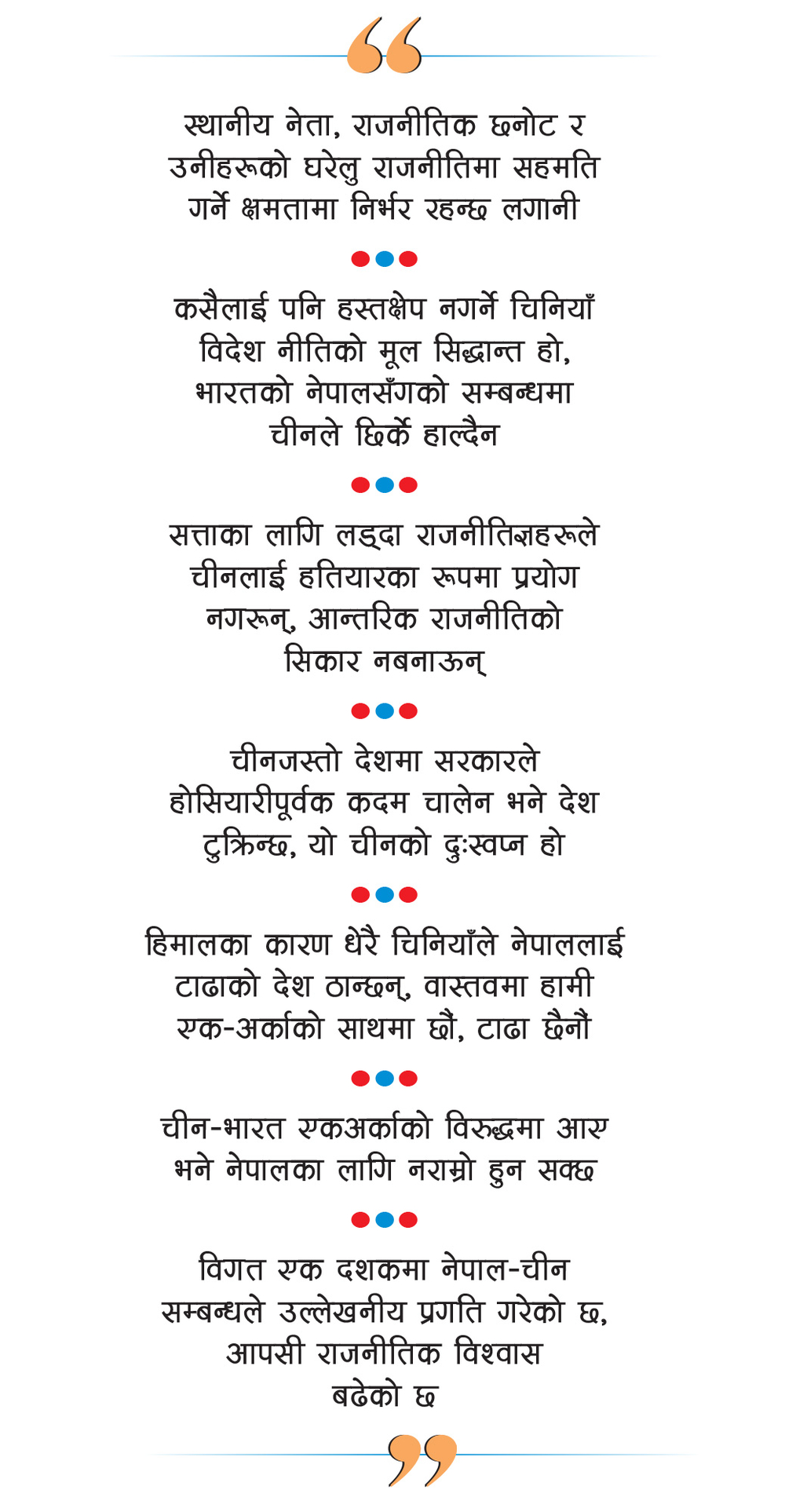
The main principle of Chinese foreign policy is not to interfere with anyone. China does not interfere in India's relations with Nepal. When fighting for power, politicians should not use China as a weapon, and should not become a victim of internal politics.
We use Google Cloud Translation Services. Google requires we provide the following disclaimer relating to use of this service:
This service may contain translations powered by Google. Google disclaims all warranties related to the translations, expressed or implied, including any warranties of accuracy, reliability, and any implied warranties of merchantability, fitness for a particular purpose, and noninfringement.
Wang Peng is a research fellow at Huangzhong University of Science and Technology under the Institute of State Governance in Wuhan, China. Previously, Wang served as the Deputy Secretary General of the National Academy of Belt and Road Green Development (NABRGD) in Beijing.
He studies and researches China's foreign affairs. In addition, the Belt and Road Initiative (BRI) promoted by Chinese President Xi Jinping, neighborhood relations, Nepal, South Asia and the world politics as a whole are closely watched.
The Kathmandu Post with Wang who came to Nepal to participate in the fourth edition of 'Kantipur Conclave-2024' Purushottam Paudel and Kantipur Jagdishwar Pandey story An edited excerpt of -break's conversation with Wang before returning to China about bilateral relations, geopolitical dimensions and Prime Minister KP Sharma Oli's four-day official visit to China from Monday: When you come to Nepal for the second time after 2018, comparing it from political and geopolitical point of view, what did you find different in Nepal?
In general, bilateral relations between Nepal and China have been stable for many years. Politically, China's leadership and foreign policy towards Nepal has remained stable. Although the administration of Nepal is changing, we know that there is a stable and friendly policy towards China. The relationship is constantly moving forward. Indeed, we still have room to progress.
Nepal's Prime Minister KP Sharma Oli is going on a visit to China. This is the best opportunity to enhance mutual understanding and political trust between the government of Nepal and China. A face-to-face meeting between the leaders of the two countries is important. Because of the mountains (in the border region of the two countries), many Chinese, including myself, consider Nepal a distant country. But actually we are with each other, not far from each other.
Nepal is an hour's flight from Lhasa and a few hours from Chendu (the capital city of Sichuan province), which is much closer.
Even though China is a close neighbor of Nepal, it is said that it does not invest here like it does in other countries, why?
I couldn't agree more with what you said. No need to compare with other countries. Because every country has its own circumstances. China's investment in Nepal is important, especially considering Nepal's current economic situation, population and ability to use foreign capital effectively.
We can talk about the cooperation between the 'China-Pakistan Economic Corridor' being built in Pakistan as a flagship project of BRI. China has huge investments in Pakistan. China has good relations with Pakistan for many reasons. And, among them, there is one important thing – Pakistani politicians often do not play the so-called 'China card'. Despite political changes in Pakistan, relations between Beijing and Islamabad have rarely deteriorated.
Within the framework of the BRI, China has an equal partnership with every side. Therefore, the matter of investment mainly depends on the political choice of the local leaders (relevant country) and their ability to build consensus in domestic politics.
What do you mean by Pakistan not playing the Chinese card?
Many Chinese international relations scholars, including myself, praise Pakistan. Despite the alliance in internal politics, Pakistanis do not go beyond a particular border and use China as a card. That is why we admire Pakistan. Because of this, Chinese companies are daring to invest heavily in Pakistan. These companies can do good for the local people there.
In the past few years, more than 10,000 new jobs have been created for local people. In this way, China-Pakistan has achieved a high level of strategic mutual trust. Non-interference is the core principle of Chinese foreign policy. In most developing countries, politicians often present the phenomenon differently. Citizens of a country can change the government if it does not act in their interest. In this we want to make it clear that politicians should not use China as a weapon while fighting for power.
Politicians should not make us victims of internal politics. You should make a 'win-win' (win-win) plan that benefits both parties rather than doing something wrong for your friends.
You mentioned China's investment level process and the conditions under which Beijing wants to invest in other countries. But don't you think that the investment level process of China, which is called a democratic government and an undemocratic one, is different?
China is a democratic country. But when I describe China's democracy, people say China is a democratic country. Because China does not have elections. That is not true. For the Chinese government, for Chinese leaders, there is a strong pressure to think about history. The Chinese government and leaders must work for the benefit of all citizens of the country, not just for their supporters. Take Donald Trump for example.
Trump does not need to serve all the American people. It works even if you support the people who support you in the election. However, this is not the case in China. The Chinese government should unite different groups of people, encourage them, and commit to joint development.
If the government does not act carefully in a country like China, which is famous for land and has a large population, the country will break up. This is China's nightmare. We have experienced many such calamities in history. So we don't want this to happen again. The Chinese Communist Party (CPC), the government and top leaders believe in history. Therefore, the Chinese should try to design a five-year structure, project or reform plan. The Chinese, for example, still consider themselves the legacy of Deng Xiaoping.
Despite being an unelected leader, Deng did not exercise arbitrary power. He used his power judiciously to ensure that the people of the country remembered him as their leader even after 50 years. Which brought many changes and benefits to China. There are other Chinese political leaders who have taken responsibility for all Chinese people. They have made significant improvements to create an environment for investment in new technologies such as AI and indigenous technologies.
How do you evaluate China's relationship with South Asian countries?
China should not get into too much conflict. The border dispute with India needs to be resolved and there is a need for reconciliation. There is no border dispute between China and all neighboring countries including Nepal. We have no border disputes with any of our neighboring countries except India and Bhutan. Bhutan is also set to sign a border agreement with China. But perhaps the Bhutanese are waiting for a message from New Delhi. China will not put any pressure on Bhutan.
Keeping silent on the internal affairs of other countries is the proper way for China. Sometimes the decisions of neighboring countries are not favorable to China's interests. Yet China often sits quietly and waits for the best. China has enough land, so we have no ambition for the land of our neighboring countries. If so, why is there conflict in the South China Sea? China has no ambition for land, so we don't want an inch of land from other countries. At the same time we want to assure you that we are not going to give up an inch of our ground.
If you witness the United Nations Security Council, China is the most prudent country among the 5 members. China says decisions should not be made by weapons. In South Asia, Sino-Indian relations have started to become smooth again. This is a good start. China's relations with Nepal and other South Asian countries are stable. China and India are ancient civilizations. We have enough power to solve our problems together.
China doesn't need the long arm of a third party to tell us what we should and shouldn't do. China does not need such education. We are brothers. If China has problems, we can solve them together. The best way to solve the problem between China and India is to develop mutual political trust, security solutions and economic cooperation. I believe that there will be an understanding on such matters. The two leaders of China and India seem to have already used their respective political styles to bring about change and create a better environment for the future.
Apart from security, what are China's other aspirations for Nepal?
The mainstay of China's foreign policy with neighboring countries is peace and stability. If you read the Chinese line, we appreciate your mutual respect. We want to commit to a one-China policy with our allies. Second, China wants to promote better economic cooperation with Nepal. This is what China wants not only with Nepal, but with all countries. Simplifying the import-export process, promoting business environment and bringing transparency in laws and policies. If the above-mentioned things are achieved, Chinese companies will try to increase their investment.
During his visit to China last year, the then Prime Minister of Nepal, Pushpa Kamal Dahal, signed the 'One China Principle' from 'One China Policy'. Nepal has long been a supporter of the 'One China Policy'. Why is it necessary to commit to the 'one China principle' now? There is no difference between the two in
short. While China's fundamental issue is the One China Doctrine, our friends adopt it as the One China Policy. Even if the Allies accept the One China Doctrine, they will operate the One China Policy. This means that friends of China will not develop official contact with Taiwan.
Earlier there were discussions in Kathmandu that Nepal could become a bridge between India and China. But in your presentations, you made a great assessment that Nepal can become a gateway not only to South Asia but also to East Asia. Please explain it in detail.
We are not saying that Nepal or any other country should do this. We say and expect something. To be honest, China and India are superpowers in terms of population, territory and growing economies. China also has its own advantages. These two countries have blockaded Nepal geographically. But Nepal is not limited to the periphery but can become a potential hub. Both China and India may offer the most attractive economic opportunities in the world for at least the next three decades. Nepal can enjoy its position if it is careful. Geography is constant, but political geography is variable.
If China and India come against each other, it can be bad for Nepal. This can be a nightmare for Nepalese people. But even if it is not like in the 1950s, if Sino-India cooperates and makes a rational decision to promote trade in a reasonable manner and not let the border conflict flare up, Nepal can take its place as an intermediary rather than as a bridge. If the people of that bridge play an active role, Nepal can become a port. In this way, Nepal can make China and India more indebted. Because both the countries have to get permission to use the ports of Nepal to export and import the goods they want.
Goods from China's Tibet Autonomous Region transit to Nepal and then to India. Goods coming to Nepal from Indian cities reach China through Tibet Autonomous Region. It is a very short distance. And, very good too. China will never envy the bilateral relations between Nepal and India. China will never interfere in India's relations with Nepal. We know you're a friend. But don't just make friendship exclusive, it should be inclusive.
noted that China does not interfere in the internal affairs of other countries. Hou Yanchi, the then Chinese ambassador to Nepal, was accused of colluding with the leaders of the then ruling party Nepal Communist Party (NCP) to settle the party's dispute. Apart from that, there is also an allegation that China tried to convey the ideology of CPC to the communist leaders of Nepal by organizing a conference in Kathmandu before the outbreak of Covid-19. What do you say to that?
What anyone should know is that in China, 'international affairs' (between governments of sovereign countries) are 'handled' by the Ministry of Foreign Affairs under the central government. It is like in other countries. At the same time, 'intra-party affairs' (between the CPC and all other friendly parties in the world) are handled within the party system by the International Department, the CPC Central Committee.
The purpose of the International Department of the Ministry of Foreign Affairs and the CPC Central Committee is to promote mutual understanding, friendship and cooperation between the Chinese government, people, political parties including the CPC and other people. In China, the division of labor between the government and the party is slightly different. That is why the confusion is created.
First, it stated that the International Department of the Central Committee communicated only with the Communist or Left Party. That is wrong. In fact, the International Department of the CPC speaks for all political parties in the world that are friendly to China, including the ruling and opposition parties, including the CPC.
Second, the International Department of the CPC Central Committee has maintained contact with opposition parties in other countries. This statement is incorrect and not factual. The International Department of its Central Committee and the Ministry of Foreign Affairs have their own priorities. During this period, the Ministry of Foreign Affairs and government agencies of other countries carried out diplomatic activities and naturally maintained relations with the ruling party of the country. However, the International Department of the CPC Central Committee maintains relations with all political parties that are friendly to China by international recognition and practice.
Everything is above board and conducive to mutual understanding, trust and win-win cooperation between two governments, two parties and two peoples. It means 'non-interference in internal affairs' and 'foreign affairs are not defined by ideology'. Those are the two main principles of the CPC and the Chinese government.
On October 15, 2022, the spokesperson of the 20th National Congress of the CPC, Sun Yeli, said - 'The CPC has maintained various types of contacts with more than 600 political parties and organizations in more than 170 countries, and the circle of international friends has been growing for a long time.' He also said that on the basis of the principles of full equality, mutual respect and non-interference in each other's internal affairs, the CPC has widely exchanged contacts with political parties and political forces. The circle of international friends in the CPC and other countries is growing.
Nepal's Prime Minister KP Sharma Oli's official visit to China is taking place from November 17. How are you taking this tour? The Prime Minister of Nepal, especially the leader of the Communist Party, often visits China. Good promises and agreements are made during the tour, but many are not fulfilled. Looking at this, how optimistic is China about Prime Minister Oli's visit?
I am not an official of the Ministry of Foreign Affairs. So I cannot represent the Chinese government. But Nepal-China relations have made significant progress in the past decade. Mutual political trust between the two sides has continued to grow and economic cooperation has yielded initial results. There is an old saying in China, ``Haste destroys.'' It cannot be rushed. Steady improvement and steady progress are best.

