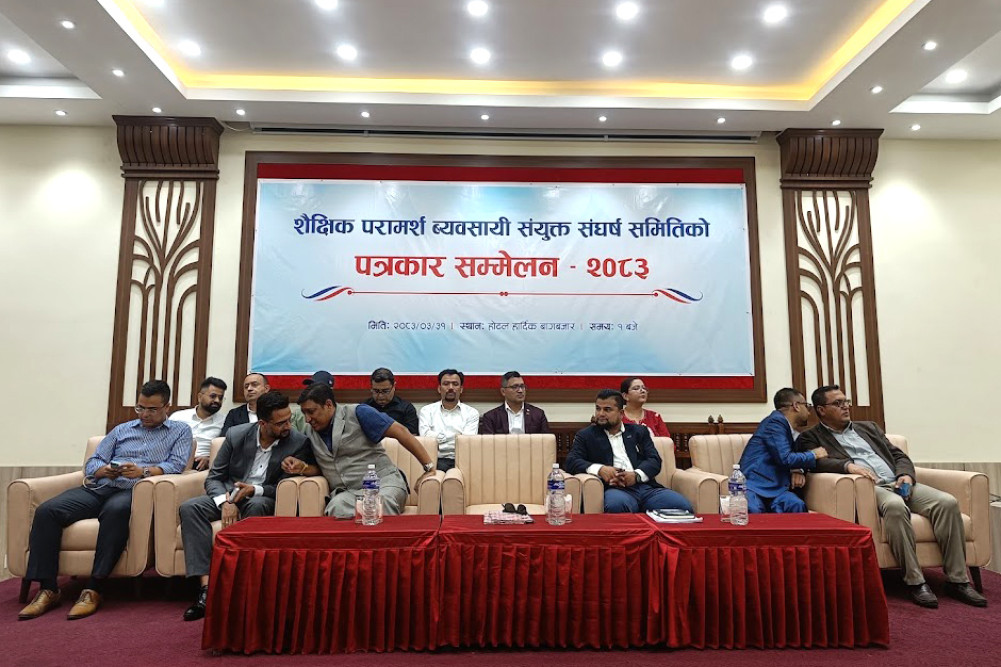
More than a dozen consultancy-related organizations have announced a program of protests, ranging from street demonstrations to handing over the keys to the government, demanding an amendment to the regulations.
We use Google Cloud Translation Services. Google requires we provide the following disclaimer relating to use of this service:
This service may contain translations powered by Google. Google disclaims all warranties related to the translations, expressed or implied, including any warranties of accuracy, reliability, and any implied warranties of merchantability, fitness for a particular purpose, and noninfringement.
Educational consultancy professionals have announced a protest in protest against the Educational Consultancy, Language Teaching and Preparatory Class (Operation and Management) Regulations-2083 issued by the government.
More than a dozen consultancy-related organizations have announced protest programs ranging from street demonstrations to demanding an amendment to the regulations to explain the truth to the government.
At a press conference held in Kathmandu on Wednesday, Deepak Gurung, coordinator of the Educational Consultancy Joint Struggle Committee, said that they were forced to protest because the provisions of the regulations are impractical and discourage the private sector. The government has passed regulations for the first time last week from the Council of Ministers to regulate the consultancies operating under the guidelines.
The protest programs were announced at the press conference. According to them, offices will be operated with black bands on Asar 32, and peaceful protests will be held with placards in Putalisadak, Bagbazar, Dillibazaar, and Hattisar areas on Shrawan 1. "If the government does not listen to our demands even during the symbolic demonstration, the consultancy professionals will submit the keys of their respective offices to the government through the District Administration Office and launch an indefinite street protest," Gurung said.
Nepal Educational Consultancy Association President Laxman Poudel accused the government of issuing regulations that would close businesses instead of regulating and facilitating the professionals. The professionals have been expressing disagreement with the provisions such as the requirement to keep a deposit of Rs 2.5 million, the physical infrastructure standards specified for office operations, the need to renew the organization annually, and classifying consultancies based on services. Poudel disagreed that the law was passed without discussion and dialogue despite the demand of the consultancy professionals. "It was possible to work in the interest of students and parents by creating a student welfare fund, but the government adopted a policy of keeping a deposit of Rs 2.5 million and closing small consultancies," he said.
Former President Prakash Pandey claimed that the government has put forward a policy to close the consultancy business by setting standards related to physical infrastructure in the current situation where consultations can be given online. ‘The state collects 3 percent tax.’ Foreign currency enters Nepal from students who go abroad,’ Pandey said, ‘but the government has not been able to bring regulations in the interest of students and businessmen who pay taxes.’ He accused the government of trying to control the businessmen even though they wanted regulation from the government.
Businessmen have put forward a demand that the renewal period of the institution should be increased from one year to five years, that the ban on conducting educational fairs should be removed, and that the provision that withholds the commission or amount received by businessmen from foreign colleges and universities should be repealed. Businessmen have said that businessmen should pay compensation based on the financial or mental damage caused to students and that an effective insurance system should be implemented by removing the impractical deposit system.
About 1,500 consultancies were registered and operating with the Ministry of Education. Since 2074 BS, only 924 consultancies have been renewed at the Ministry of Education. The regulations stipulate that those registered in the provinces must also be renewed at the center. The Ministry of Education had suspended renewals after provinces including Bagmati started registering consultancies. Renewals began again in 2081 BS as per the guidelines. The regulations stipulate that although language teaching and preparatory classes can be registered at the provincial level and regulated at the local level, consultancy must be registered and renewed at the Ministry of Education. Officials at the Ministry of Education claim that consultancies are operating without registration due to confusion over registration renewal.