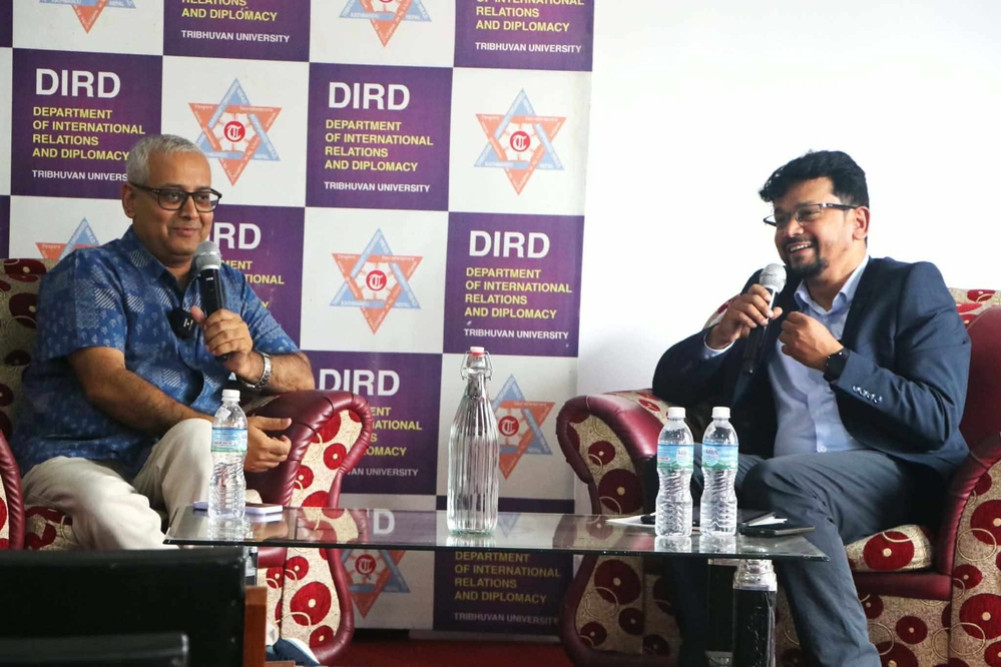
At the program held on Friday, experts in international relations presented the conclusion that knowledge and research are the long-term foundations of development.
We use Google Cloud Translation Services. Google requires we provide the following disclaimer relating to use of this service:
This service may contain translations powered by Google. Google disclaims all warranties related to the translations, expressed or implied, including any warranties of accuracy, reliability, and any implied warranties of merchantability, fitness for a particular purpose, and noninfringement.
Experts from China and the South Asian region have suggested increasing investment in knowledge and research.
At the ‘Regional Dialogue on Knowledge Production in South Asia and China’ program organized by the Department of International Relations and Diplomacy at Tribhuvan University on Friday, experts in international relations presented the conclusion that knowledge and research are the long-term foundations of development.
At the program, Professor Rajeev Ranjan from the Department of East Asian Studies at Delhi University and PhD scholar Prashant Kumar Bik from Sichuan University in China discussed the geopolitics of South Asia and China. Bik, who facilitated the discussion, raised questions about the impact of knowledge production on relations between countries.
In response, Professor Ranjan said that the diversity of knowledge plays a creative role in expanding society, nations, and international relations. He emphasized that every nation should invest adequately in the process of knowledge production. Noting that China has had a strong tradition of knowledge production since ancient times, he expressed the view that this tradition has made policy reforms effective there.
Professor Khadga KC from the Department of International Relations and Diplomacy at Tribhuvan University noted that India and China have been continuously investing strategically in knowledge production. He said that Nepal should also prioritize knowledge production and research with a focus on national interests.
Apeksha Shah, head of the Central Department of International Relations and Diplomacy, said that the department regularly organizes such programs to develop a culture of intellectual dialogue and debate among the younger generation.
Chandan Tamang, co-founder of KIRC, stated that the development of intellectual culture is essential in the present time. KIRC’s Operations Director, Aishah Yasir Khambu, said that the program was organized with the aim of helping students of international relations form opinions on specific topics through intellectual dialogue.
Sumi Sharma, a lecturer in international relations, said that broad intellectual interaction expands the scope of knowledge and makes it easier to understand subject matter.
The program was organized by the Kathmandu Institute of Research and Consultancy (KIRC) in collaboration with the Central Department of International Relations and Diplomacy (CDIRD) at Tribhuvan University.