There has been an improvement in the results of Class 12 this year, with 61.17 percent of students being 'graded' last year and 52.15 percent the year before.
We use Google Cloud Translation Services. Google requires we provide the following disclaimer relating to use of this service:
This service may contain translations powered by Google. Google disclaims all warranties related to the translations, expressed or implied, including any warranties of accuracy, reliability, and any implied warranties of merchantability, fitness for a particular purpose, and noninfringement.
The National Examination Board has released the results of Class 12 within 40 days of the end of the examination. The results, which were released earlier than before, have also shown that more students have passed than in the past.
According to the board's spokesperson Jayanti Satyal, a total of 64.13 percent students have been 'graded' (passed) in the Class 12 examination, both regular and partial. 69.75 percent of students in the regular and partial sections have qualified for higher level studies. Last year, 61.17 percent of students were 'graded'. Only 52.15 percent of students were 'graded' in the Class 12 examination of 2080.
More male candidates, higher pass rate for female candidates, 70.39 percent female candidates passed, while the pass rate for male candidates was 69.17 percent There has also been a gradual improvement in the results of SEE in recent years. Schools say that progress has been seen in the results because teaching and learning are becoming more effective.
This year, 332,241 students took the exam in the regular stream. Out of them, 231,770 have obtained grades. 1471 students could not obtain grades. The board has stated that the grade enhancement exam will be conducted for them on 2 and 3 Shrawan.
Only regular students will be allowed to participate in the grade enhancement exam. 'In the theoretical stream, candidates who have obtained grades of D or higher in all other subjects and have received NG (non-graded) in at most two subjects or are absent in at most two subjects will be allowed to participate in the supplementary (chance) exam,' the notice issued by the board said.
Students who want to take the grade enhancement exam will have to apply online by 19 Asad. A fee of 800 has been fixed for that. There is also a provision to retake the exam by paying a fee of Rs 1,000 if you are not satisfied with the results.
The best results were from Bagmati and the weakest Karnali provinces, while the results of provinces other than Bagmati were weaker than the national average. According to the board, among the students who passed the regular examination, 17,786 have obtained a GPA of 3.61 to 4. 64,821 have obtained a GPA of 3.21 to 3.60. The highest number of students have obtained a GPA of 2.81 to 3.20, of which 94,249 students have obtained a GPA of 2.41 to 2.80. 4,388 students have obtained a GPA of 2.01 to 2.40. 9 students have a GPA of 1.61 to 2.0.
85,929 candidates participated in the partial examination. Of these, 36,420 (42.38 percent) have been 'graded'. The board has said that the exams of 40 candidates, including 30 from the regular stream and 10 from the partial stream, have been canceled.
Students with errors in their results can apply to the board within 6 months to correct them. Spokesperson Satyal said that errors such as postponed results, absenteeism, different subjects, name and surname, and registration number can be corrected.
The government had set a target of publishing the results within 45 days. To publish the results quickly, the board had increased the number of answer sheet testing centers and carried out related work in parallel. According to Examination Controller Krishna Prasad Sharma, the number of answer sheet testing centers was increased from 28 to 42. 'We had made an action plan and worked.' The verification of answer sheets was also done at the examination center itself,' he said, 'after completing all the procedures, the work of preparing for the publication of the results was carried out in parallel.' Earlier, the board had been publishing the results within 70 days.
The results of girls are better than boys
The results of girls have been seen to be better than boys in the Class 12 examination. 70.39 percent of the girls participating in the examination have passed, and the pass rate of boys is 69.17 percent. There were more boys than girls. 172,248 boys and 159,964 girls wrote the Class 12 examination. According to the board's data, 53,100 boys and 47,361 girls have been 'ungraded'.
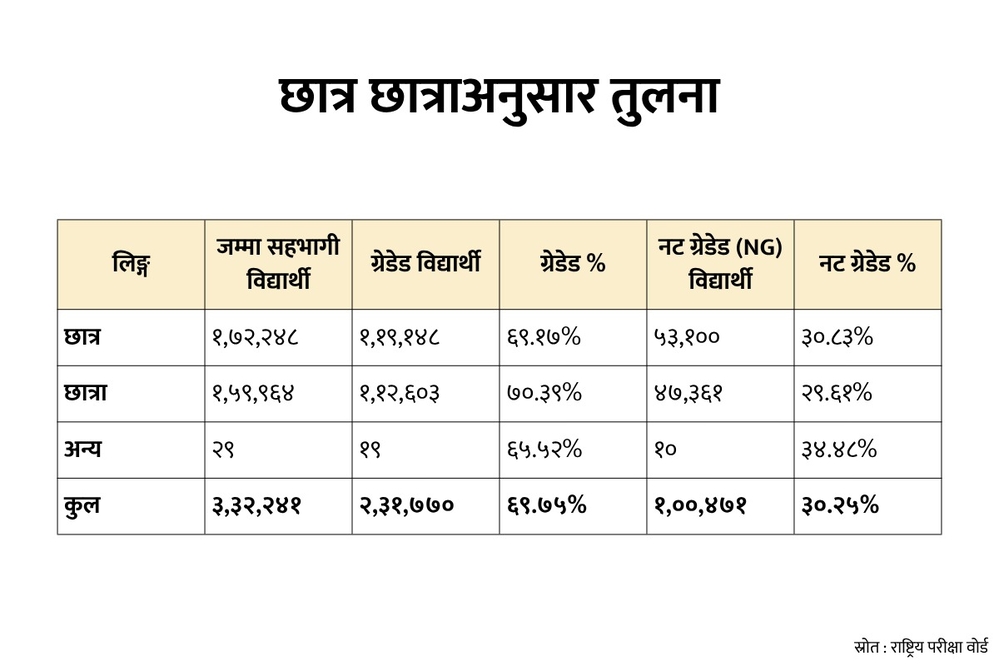
Although there are more 'graded' girls, boys are ahead in obtaining high-grade results. 17,786 students have obtained 3.61-4 GPA, including 10,067 boys and 7,719 girls. Similarly, students are also ahead in getting 3.21-3.60 GPA. 33,405 boys and 31,411 girls have obtained this GPA.
Examination Controller Sharma said that in recent years, girls have been performing well in the results. ‘The results may have been better because girls are more diligent and diligent in their studies,’ he said.
Provinces other than Bagmati are weaker than the national average
Bagmati and Karnali provinces have achieved the best results in the Class 12 examination. The highest number of students participated in the examination from Bagmati and the lowest from Karnali provinces.
13,513 students or 31.15 percent from Bagmati and 22,672 (6.8 percent) from Karnali participated. 78.17 percent of students from Bagmati Province have been 'graded'. In previous years, Bagmati Province has also seen the best results. The number of students with high GPA (3.61 to 4.0) is also the highest in Bagmati, at 11,052.
Only 62.17 percent of students in Karnali have been 'graded'. Only 252 students there have achieved high GPA. There is a 16 percent difference in 'graded' students between Bagmati and Karnali Provinces, with the number of students with high grades being about 44 times higher in Bagmati than in Karnali.
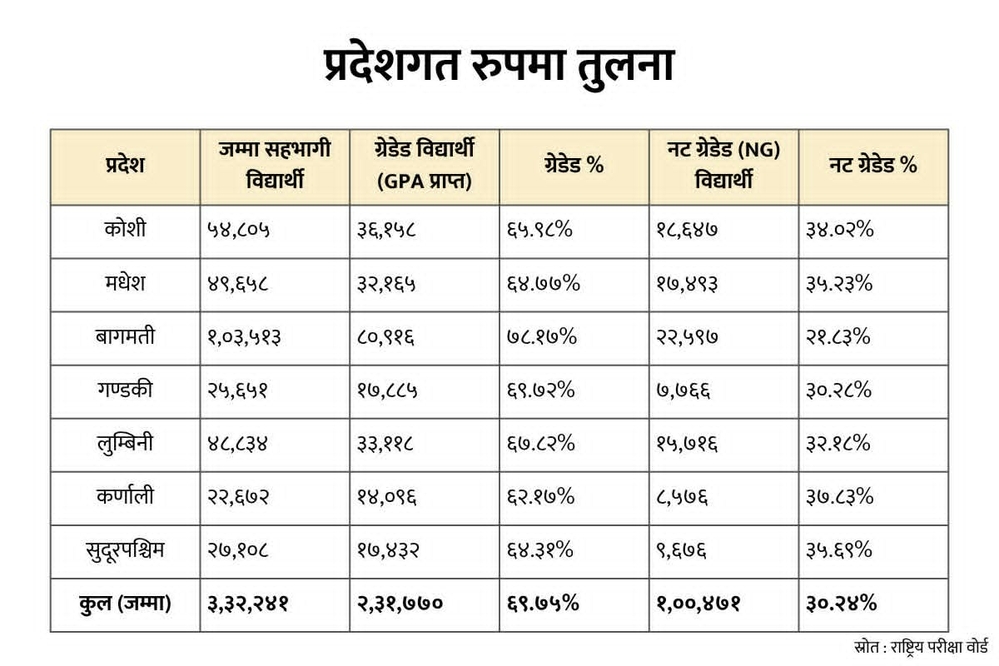
Dhruv Kumar Gautam, former Vice-Chancellor of Madhya Paschim University, Surkhet, says that the results in Karnali are also poor due to low state investment in education. 'The state only thinks about investment in physical infrastructure.' Investment in capacity and human resource development is very low in the districts of Karnali, he said, and the state does not seem to have paid attention to increasing the capacity of teachers and arranging subject-specific teachers. He said that the results of the country as a whole are also high due to private schools. He said that except for Bagmati Province, where there are many private schools, the results are good. The number of private schools teaching grades 11-12 in Karnali is low, Gautam, who is also a professor at Tribhuvan University, added, "The results of private and community schools should be compared separately." He said that the third reason is that excellent students from Karnali also go to cities including Kathmandu to study. In the SEE results published last Jestha, Karnali and Madhesh provinces were weak after Sudurpaschim. After Bagmati, the results of Gandaki Province are good. About 69.72 percent of students from Gandaki have been 'graded', which is about the national average. 64.31 percent of students from the Far West, 64.77 percent from Madhesh, 65.98 percent from Koshi and 67.82 percent from Lumbini have been 'graded'. In last year's results, the results of Karnali, Madhesh, Sudurpaschim, Lumbini and Koshi were weaker than the national average. Only the results of Bagmati and Gandaki were better than the national average.
Examination Controller Sharma said that a study has been started to identify the provinces, districts, local levels and schools with weak results and improve them. 'The examination board has also signed an agreement with the municipality to bring improvements to schools with weak results. We are appointing experts and sending them to the teachers and students of the concerned schools,' he said. He said that to improve the results, teaching and learning itself should be improved.