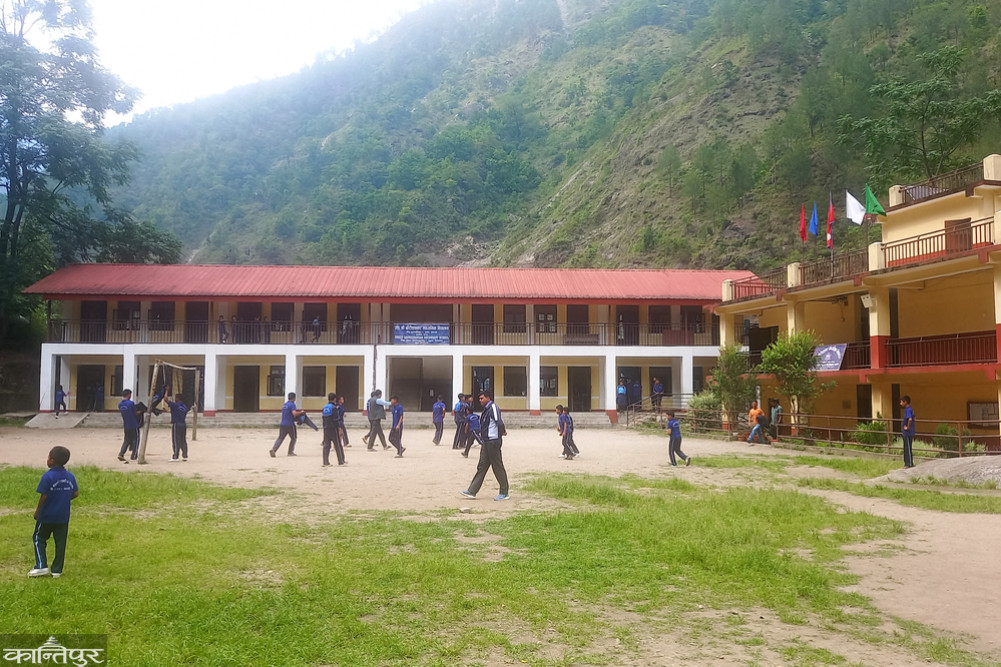
Since the academic session 2082, Gaurishankar Rural Municipality has been providing residential education at Gaurishankar Secondary School for students from remote areas. However, this year, due to uncertainty about the facility, students and parents are forced to stay in dormitories near the school.
We use Google Cloud Translation Services. Google requires we provide the following disclaimer relating to use of this service:
This service may contain translations powered by Google. Google disclaims all warranties related to the translations, expressed or implied, including any warranties of accuracy, reliability, and any implied warranties of merchantability, fitness for a particular purpose, and noninfringement.
Last Baisakh, Lal Bahadur Tamang of Bigu Rural Municipality-1 Lamabagar looked for a place to stay in Jagat in the same ward to educate his daughter in grade 6. There was a school in his own village to educate her up to grade 5. He had to go to Jagat to educate her in the following grades. It takes at least 5 hours for his daughter to travel from home to the school in Jagat.
Last year, Gaurishankar Secondary School in Jagat had residential facilities. The municipality had started operating a residential school with meals for children from remote areas since the 2082 academic session. But due to uncertainty about what will happen to the residential facilities this year, other parents like Tamang are forced to stay in Jagat to educate their children.
This year's academic session has already begun. But the budget allocated for the residential facilities was only for the time when the previous academic session was conducted (Chait). Due to this, the school has not been able to start residential facilities due to uncertainty about whether the municipality will allocate budget for residential students in this academic session, says the school's principal Hiramani Gautam.
'The municipality has made the procedure this year. But since the budget has not been finalized, we have asked students to come from home. We have opened accommodation for students coming from far away and cooked and fed them at their own expense,' he said, 'Currently, 12 students are using the accommodation and cooking and eating at their own expense. Parents of young children have sent them to dormitories for the time being. We have requested for budget allocation to be maintained from the beginning of the academic session from next year.'
The municipality allocated budget for residential facilities only from Shrawan to Chaitra, so there has been confusion among students and parents for 3 months after the start of the new academic session, said Devika Thami, vice-chairperson of the municipality. According to her, the last academic session ended in Chaitra and the budget was also exhausted. But she admitted that no budget was allocated for Baisakh, Jestha and Asar. She said, 'We could not make the budget to provide residential schools from the beginning of the academic session because we were worried that the union or the province would approve it. If we do not get approval this time too, we will make the budget for this fiscal year so that students will be provided with accommodation facilities throughout the year.'
Gaurishankar Secondary School in Durgam is the only school where children from 21 villages in 4 wards of Bigu and Gaurishankar rural municipalities study. Some villages have basic schools up to class 3 and some have basic schools up to class 5. Should children from remote villages come to this school or go to the city to study above class 6?
Lal Bahadur, who has been teaching his daughter in a dormitory, said that there will be residential facilities. ‘Last year, many like my daughter were able to study while staying at the school,’ he said, ‘I enrolled them thinking that they might get it this year too, but it has not been decided yet.’ He said that since it is not possible for young children to walk from Lamabagar to school, they have been looking for a dormitory in Jagat to educate them. He said that those with good financial conditions take their children to Singati and Charikot to educate them. He also said that since there is no residential school, many children are educated up to grade 5 and then kept at home.
‘The road is steep and ravines, and you never know when and where stones will fall,’ he said, ‘When it rains, the river rises and landslides occur. In such a situation, how can you send your children to school after walking for hours?’
358 students are currently studying in this remote school. Last year, 83 children received residential facilities and studied while staying at the school. More interestingly, nearly 100 children, including those without parents and in family situations, are studying in this school. Principal Gautam said that more than 3,500 rupees are spent per month for a student. According to him, in the last academic session, the municipality had spent 30 lakh rupees on residential facilities for 83 students.
Municipality Vice-Chairman Thami said that 60 lakh rupees have been allocated for residential schools in her municipality. She said that 30 lakh rupees have been sent to Gaurishankar School. She said, 'The municipality also provides residential facilities to other schools during SEE. 60 lakh rupees have been allocated for all schools. If it is not enough, we will give more. We have planned to increase the budget this year to make education accessible to everyone.'
ο ο ο
Hari (name changed), who is studying in class 7, studied in the school's residential facilities last year. But this year, due to the lack of residential facilities, he is attending school from a relative's house. That too, he has to walk 5 hours to come and go every day. Due to financial constraints, he cannot afford to stay in Jagat to study at school. He says that he enrolled in the school this year hoping to get residential facilities like last year. But since the school did not open for residential facilities until mid-June, he says that he had to attend school from a relative.
'I enrolled in the school hoping to get residential facilities,' he said, 'I have to walk to school early in the morning. I cannot eat without working at my relative's house. After school, I only reach home late in the evening.' He said that if the school does not provide residential facilities, he has no option but to drop out. He said that many children like him are still unable to come to school after completing grade 5. He gives examples of children like him who come to school working in other people's houses and going to school.
Gaurishankar Secondary School has written to the provincial government to build a school with residential facilities, said Principal Gautam. ‘This is the only school where children from more than 21 remote villages study,’ he said, ‘Some students live in areas where it takes 6 hours to travel from home. On top of that, students from remote areas tend to drop out due to financial constraints.’
He said that preparations have begun to provide residential facilities to 100 students in the school this academic session. He claims that as soon as the municipality makes a commitment to include it in the budget, preparations are being made to provide residential facilities to children without guardians, children in family distress and children from areas where it takes at least 2 hours to travel.
He said that this problem will continue to arise every year if the federal and provincial governments do not make the school residential. Due to this, the number of children dropping out of school after grade 5 will increase, he said. ‘We cannot even tell parents to send children from remote and vulnerable areas to school by walking for hours,’ he said. ‘Those who can find shelters and teach them do so, while the number of children without parents who are deprived of education is increasing.’
He said that it would be easier to bring children with road facilities to school if buses are introduced. He said that local children from this remote area leave their villages and go to the city in search of employment just to be educated. He said that students from Simigaun, Riku, Tasina in Gaurishankar, Lamabagar, Thongthong, Gogardanda in Bigu, etc., are forced to walk for more than 6 hours due to lack of residential facilities.
Vice President Thami said that arrangements have been made for Gaurishankar Secondary School to provide boarding facilities and meals to prevent children from remote areas from dropping out of school. She said that despite repeated recommendations to the provincial and federal governments to make the school a boarding school, the work has not been done yet. She said that even though the province and the union do not show much interest in the right of children from remote areas to get an education, the municipality will make arrangements for boarding at its own expense until her turn comes.
‘The municipality has started a boarding school with the future in mind for children who are orphans and have to walk for hours from remote areas,’ she said. ‘This will continue, we will include it in the upcoming budget as well.’ She said that programs to ensure education for children without parents and those in family discord will be included.