Teachers and parents are unhappy that the school was bulldozed without any decision or consultation. The government is planning to merge the school demolished by the bulldozer with another nearby community school.
We use Google Cloud Translation Services. Google requires we provide the following disclaimer relating to use of this service:
This service may contain translations powered by Google. Google disclaims all warranties related to the translations, expressed or implied, including any warranties of accuracy, reliability, and any implied warranties of merchantability, fitness for a particular purpose, and noninfringement.
The government has also demolished the buildings of three community schools on public land where more than 500 children are studying in the process of clearing the slums in the Kathmandu Valley. The classrooms of Manohara's Saraswati Basic School in Madhyapur Thimi, Bhaktapur, Buddhajyoti Udyan Basic School in Balaju, Kathmandu have been bulldozed.
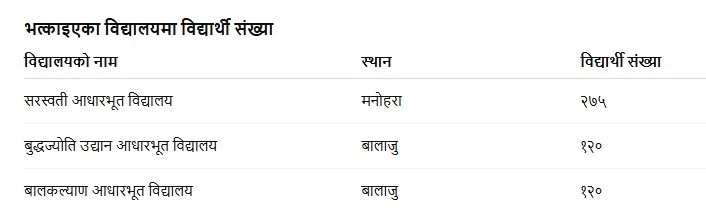
These schools were teaching up to grade 8. Saraswati had 275 students, while Buddhajyoti and Balkalyan had 120 students each. The principals of these schools said that they were confused after the demolition of the school buildings at the time of admission and commencement of classes. The Metropolitan City and the Municipality have said that these schools will be merged.
Even after the demolition of the school buildings, 150 children were enrolled, but it has not been decided where to keep them and conduct classes, said Indira Mahat, principal of Saraswati School. The school was attended by a mixed group of squatters and other residents. ‘There are 5-6 empty rooms in the community building at the ward office of ward number 1. We have taken the school supplies there,’ she said, ‘150 students have already been admitted. There is no idea where to put them and teach them.’
She said that coordination and discussions are underway with the Madhyapur Thimi Municipality, the ward office and the Bhaktapur District Administration Office for the operation of the school. ‘We are taking the initiative to establish the school and conduct teaching. The municipality and the CDO office have talked about integrating with neighboring schools. What to do has not been decided,’ said Principal Mahat.
The locals and teachers, however, had demanded that the school be established and operated in a separate place rather than integrating. 15 teachers are working in the school. The school was established in 2062 BS. The Ministry of Education reconstructed the building after the earthquake. Dozers have demolished 15 classrooms in 3 buildings, including the District Education Office and the one reconstructed after the earthquake. Teachers and parents are unhappy that the school was dozed without any decision or consultation.
Ward chairperson and municipality spokesperson Krishnahari Acharya said that discussions are underway to reopen the demolished school. ‘There has been consultation to merge Saraswati Basic School with other nearby community schools.’ Since the mayor is out of the country, a decision has not been made. A decision will be made as soon as he returns,’ said spokesperson Acharya.
The 16-room building of Buddhajyoti School, which has been operating in Balaju, Kathmandu Metropolitan City-16 since 2053, was also demolished on Saturday with a dozer. The building, built with the help of community labor and financial support, was demolished, said principal Shantaram Shrestha. ‘There were many children of parents who worked in the new bus park area,’ he said, ‘After the dozer was used, we have taken the school supplies to the neighboring school Tarun Mavi and kept them there. We have asked the teachers and students to come there.’ There were 120 children studying in the school, while 14 teachers and staff were working there.
He said that the Metropolitan Municipality has been requested to transfer the school. ‘Now Tarun Mavi has provided shelter. All the school supplies are kept there. The Metropolitan Municipality has also asked to be dependent on Tarun Mavi,’ said Principal Shrestha, ‘The school has submitted a letter to the Metropolitan Municipality to find land and transfer the school. We do not know what the decision will be.’ Parents are confused as there is no school building even though 15 new students have been admitted this year. The school has stated that the government side has not listened to their requests not to demolish the school building, which is located on government land.
The building of the Balkalyan School, which has been operating since 2049 BS in Balaju, Kathmandu Metropolitan City-16, has also been demolished. Principal Arjun Mudbhari said that 120 students are studying in the school. There are 11 teachers and staff in the school. ‘The school built on public land was demolished with a bulldozer.’ We have taken the school materials to the nearby Nepal Yuvak Mavi and kept them there. The teachers and staff have been attending school there,’ he said.
Principal Mudbhari said that a request has been made to the local level for the operation and rehabilitation of the school. ‘Children should be educated in a suitable place.’ Now, the place where the bulldozer was installed was at risk of floods and landslides. There was no place to play,’ he said, ‘Now, we should find land in the above-mentioned place and operate the school.’ The school should not be destroyed. The school should be opened by giving alternatives,’ he said.
Metropolitan spokesperson Navin Manandhar said that the collapsed schools in Tarun and Nepal Yuvak Secondary Schools have been relocated. ‘Two schools in the metropolitan city collapsed. Both of them have been relocated to nearby secondary schools,’ he said. ‘Now those schools will be merged there. No new schools will open,’ he said. The National Campaign for Children’s Peace Areas has concluded that the demolition of squatter settlements has seriously affected child rights. The campaign’s chairman Tilottam Poudel and general secretary Raju Ghimire have issued a statement demanding the government to immediately establish child-friendly learning centers for displaced children, provide alternative education, and make a clear commitment not to damage schools under any circumstances. The Ministry of Education has urged the local level to make arrangements for the relocation of collapsed schools, including the relocation of teachers and students.

