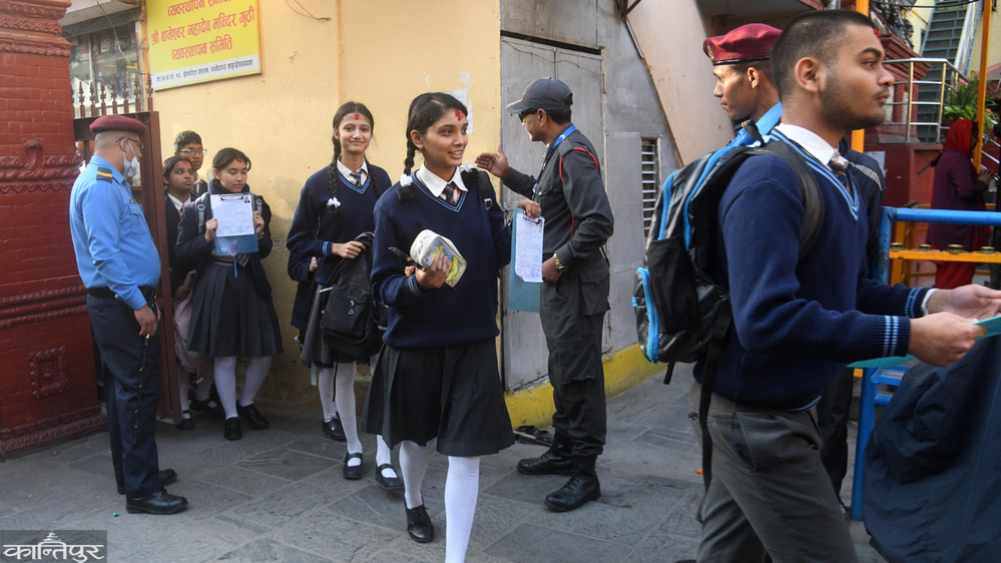
Even the Supreme Court order and the ministry's circular could not stop the school's arbitrary actions.
We use Google Cloud Translation Services. Google requires we provide the following disclaimer relating to use of this service:
This service may contain translations powered by Google. Google disclaims all warranties related to the translations, expressed or implied, including any warranties of accuracy, reliability, and any implied warranties of merchantability, fitness for a particular purpose, and noninfringement.
Private schools have started receiving complaints from government agencies alleging that they are charging higher fees than prescribed. After complaints started increasing from the local level to the Ministry of Education, the government has warned private schools not to charge higher fees.
The Ministry of Education has issued a circular to the local levels, warning them not to charge higher fees. Ministry spokesperson and Joint Secretary Shiva Kumar Sapkota issued a statement on Sunday, warning them not to charge excessive fees. It is said that the ministry's attention has been drawn to the fact that evidence has emerged of students being admitted before the start of the academic session 2083 and collecting heavy fees.
The Supreme Court had also ordered that students be admitted only after the start of the academic session last week. To implement the order, the Ministry of Education has directed that fees be charged only in accordance with the Institutional (Private) School Fee Determination Criteria Directive 2072. Sapkota has urged them to make arrangements not to collect fees other than those determined by the directive.
 The Ministry of Education, through the Ministry of Federal Affairs, has issued a circular to all 753 local levels to take action against schools charging additional fees. Yuvraj Sharma, President of the Higher Education and Secondary Schools Association (HISAN), complained that the state is looking at educational institutions differently even when they are operating according to the state's own laws and regulations. 'We have been charging fees only after approval from the local level, we have given 10 to 15 percent scholarships, and private schools have been accused of charging illegal fees,' he said.
Although the directive has been implemented, it is 10 years old, he said that it needs to be revised in line with the times. 'There are ambiguities on some issues, the right to school education has gone to the local level, the directive does not cover local level issues, parents have the right to choose what kind of school and how much fee they want to send their children to,' said President Sharma. 'The state should regulate the private sector, and it should be finalized through dialogue and discussion.'
According to the Private School Fee Determination Criteria Directive 2072, private schools have been allowed to charge fees under 14 different headings. It is mentioned that fees can be charged for monthly tuition, annual, admission, deposit, examination, computer, transfer certificate, special training, accommodation, food, transportation, educational tours, inter-school competition and educational materials. There is a provision that monthly tuition fees cannot be charged for more than 12 months in a year. According to the fee title and criteria description of the
guideline, the admission fee can be charged only once for the approved fee of the class in which admission is made. The admission fee cannot be charged more than 1 month's monthly fee. These fees can be charged only after getting approval from the concerned body.
There is a provision that the school must get the fee approved from the concerned local level. The guideline states that the annual fee can be charged only equal to the approved monthly fee of 2 months. The annual fee amount should be spent on sports, extracurricular activities, laboratory, library, building, including physical maintenance and first aid. The
guideline also sets criteria for examination and educational material fees. ‘The examination fee cannot exceed 50 percent of the approved monthly tuition fee for each class, and all expenses incurred in accordance with the examination criteria and the cost of printing the transfer certificate must also be included in this,’ the directive states, ‘Only 10 percent of the monthly tuition fee can be charged once a year for educational materials.’
The directive sets out the school’s criteria, spending area demarcation, determination of fee rates, and the method of approval and approval of fees. The directive stipulates that accommodation (hostel), lunch/food and transportation fees in private schools should be determined by the parents’ meeting.
‘The determination of the fee for accommodation management will be as per the agreement between the parents of residential students and the school. The fee must be approved by the parents’ meeting of residential students. The lunch and lunch fees must be approved by the parents’ meeting of the parents who use the same service. The fee for students using transportation must also be approved by two-thirds of the parents’ meeting,’ the directive states.
According to the Education Act 2028 and the Education Regulations 2059, the Ministry of Education implemented the fee determination directive in private schools 10 years ago. Violation of the provisions of the directive will result in a fine of up to 25,000, cancellation of the school's license, and action as per prevailing law. 'For the first time, a fine of up to 25,000 will be imposed depending on the severity of the offense, cancellation of the school's license for the second time, and charging fees without meeting the fee basis/process criteria will be considered completely illegal and action will be taken as per prevailing laws and regulations,' the directive states.
The school must be given a chance to clean up before taking such action. The Compulsory and Free Education Act has made it mandatory for public schools not to charge fees under any heading. Private schools must provide free scholarships to designated students. According to the act, privately funded schools and schools under public educational trusts must provide scholarships to students from early childhood development to grade 12.
 There is a provision that schools with up to 500 students must reserve seats for at least 10 percent, schools with 500 to 800 students must reserve seats for at least 12 percent, and schools with more than 800 students must reserve seats for at least 15 percent of students to provide free education.
The Regulation on Compulsory and Free Education 2077 has provided for a scholarship management committee chaired by the local level chairperson or head. PABSON Chairman Krishna Adhikari said that private schools have charged fees as per the guidelines.
‘A new government has just come to power. The government has just started its work. PABSON has no active reaction to the government’s work,’ he said. On Chaitra 20, the Supreme Court issued an interim order to admit students only after the academic session begins. A single bench of Justice Bal Krishna Dhakal issued such an order in the name of all stakeholders, including the Office of the Prime Minister and Council of Ministers, the Ministry of Education. The Supreme Court issued such an order while hearing the first writ petition filed by Ayush Badal.
‘It seems that there is a legal provision that students must submit the annual examination marks and transfer certificate given by the school to get admitted to the school. The school academic session will start from Baisakh 15 and will continue until mid-Chait,' the order states, 'There is a legal provision that no one should enroll students before the academic session has started, and the government of Nepal, Ministry of Education, Science and Technology, Education Development and Human Resource Development Center, Sanothimi, Bhaktapur has also published a notice stating that the annual examination should be conducted and the results published, and the admission program should be conducted after the start of the new academic session 2083.'
Some private schools had been publishing notices for student admission since the beginning of Chait and moving forward with the process.