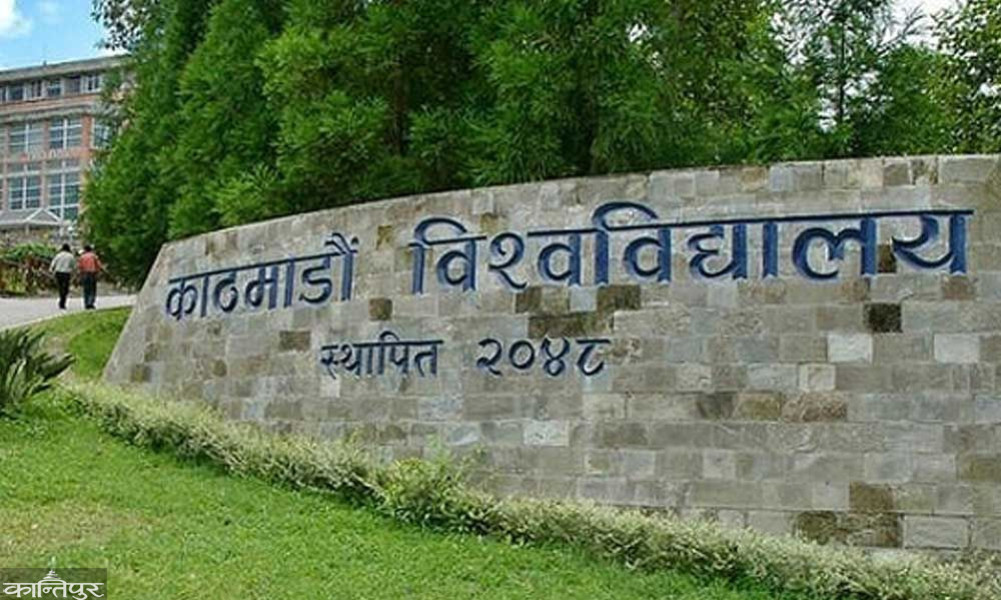
Kathmandu University (KU) has been ranked 122nd out of 507 universities in the world in the 'HE- Higher Education Rankings' conducted by an organization based in the US. Is KU really seen as superior in global competition?
We use Google Cloud Translation Services. Google requires we provide the following disclaimer relating to use of this service:
This service may contain translations powered by Google. Google disclaims all warranties related to the translations, expressed or implied, including any warranties of accuracy, reliability, and any implied warranties of merchantability, fitness for a particular purpose, and noninfringement.
The news written by the National News Agency (NSA) about the ranking of Kathmandu University (KU) was published on various online portals including Ikantipur on Tuesday. The news stated that Kathmandu University was ranked 122nd out of 507 universities in the world in the ‘HE- Higher Education Ranking’ conducted by an organization based in the United States. KU Vice Chancellor Achyut Wagle expressed his happiness on social media, taking pride in the matter. Wagle wrote, ‘This is a proud moment for Nepal’s higher education and KU as well. KU has taken a leap towards becoming a world-class university. Congratulations to all the faculties and researchers of KU. I appreciate the hard work of KU’s Directorate of Academic Excellence.’ Experts and knowledgeable people are criticizing the news topic and Vice Chancellor Wagle’s response. There are thousands of universities around the world. There is disagreement that KU is ranked 122nd in the competition of 507 universities and that there is an attempt to garner attention through media hype. Is KU really good at world-class competition? Questions have been raised. On the other hand, the credibility of the ranking organization has also been questioned. There have also been doubts about the universities/educational institutions that competed and were deemed excellent.
Stan Aston College London has ranked first in the study of the American Higher Education Rankings (HE). Nepal's Divyabhumi College is ranked 271st. In the rankings of organizations that measure the level of thousands of universities, including the relatively well-known Times Higher Education, Oxford, Harvard, Stanford, Cambridge and other universities have been ranked first and second respectively. These universities are not included in the KU participating rankings. In the 2025 Times ranking, Tribhuvan University (TU) is ranked 1,500 behind. KU is not officially included in the ranking yet.
Critics have commented that the organization that ranks KU is not credible and that any educational institution (college, institute, training center) is also participating in the ranking. KU's ranking has been ridiculed on this basis. On social media, Krishna Sharma claimed that there are 25,000 institutions like 'HE Higher Education Ranking' around the world and mentioned that an American agency ranked KU 122 out of 500 institutions.
Dean of KU School of Arts Uddhav Pyakurel said that the university is trying to get KU ranked by various institutions. ‘Earlier, various institutions used to rank KU themselves based on information and data found on Google,’ he said, ‘Now, KU has set up a department to get Times Higher Education and other institutions ranked and is providing information and data.’ According to him, the HE Higher Education Ranking has also given the same results.
Pranay Rana has argued that the Nepali media is celebrating KU’s 122nd position without looking at other universities on the list. He said that universities that have not been recognized also participated in the ranking and asked, ‘Which is the first university in the world?’ Most have commented that the ranking organization has been promoted in a hurry without checking the credibility of the ranking organization, its methodology, and the results of the competition between universities.
KU Educational Excellence Directorate Chief Hemraj Kafle said that he participated in the HE ranking with the aim of testing the ability. ‘I was invited to participate in the ranking. It was free. We participated to test the ability,’ he said. He said that he would also participate in the ranking in Times Higher to promote the university. ‘Different/different agencies rank universities. We are also doing it with the popular Times,’ Kafle said, ‘We are going to test ourselves by ranking in various organizations.’ He said that HE studied the university with 136 questions on 25 indicators and gave a 64-page report. He said that KU will continue to improve based on the report.
It is claimed that 136 indicators under 25 criteria were used to measure the impact of universities on higher education in the ‘ranking’, which includes 507 universities from 95 countries around the world. This ‘ranking’ is mainly focused on evaluating the operational capacity of emerging universities in South Asia, South America and Eastern Europe. In an email sent to Kathmandu University, Noora Abduljalil, Secretary of the ‘HE Higher Education Ranking’, said that the achievement is the result of the collective efforts and commitment to education of the university’s leadership, professors, staff, students and alumni. This achievement, the email stated, reflects Kathmandu University’s unwavering commitment to academic excellence and innovation. The email was distributed to the media by KU officials.
It is stated that the organization evaluates universities based on their actual operational processes and performance to present a fact-based overall picture. As mentioned in the evaluation report, the university has shown special potential in facility and resource management, academic transparency and future-oriented planning. The specialty of the HE higher education ‘ranking’ is its emphasis on measuring policies, processes, services, products and results related to the operation of the university. The indicators included for the evaluation include inclusion, sustainable development, transparency, accountability, research system, campus safety, internationalization, academic integrity and digital access. The organization stated that the ‘ranking’ was prepared with the aim of guiding meaningful improvements in teaching, research, good governance, equality and social impact.