For the first time, educators and Gen-G have engaged in a dialogue on public education reform.
We use Google Cloud Translation Services. Google requires we provide the following disclaimer relating to use of this service:
This service may contain translations powered by Google. Google disclaims all warranties related to the translations, expressed or implied, including any warranties of accuracy, reliability, and any implied warranties of merchantability, fitness for a particular purpose, and noninfringement.
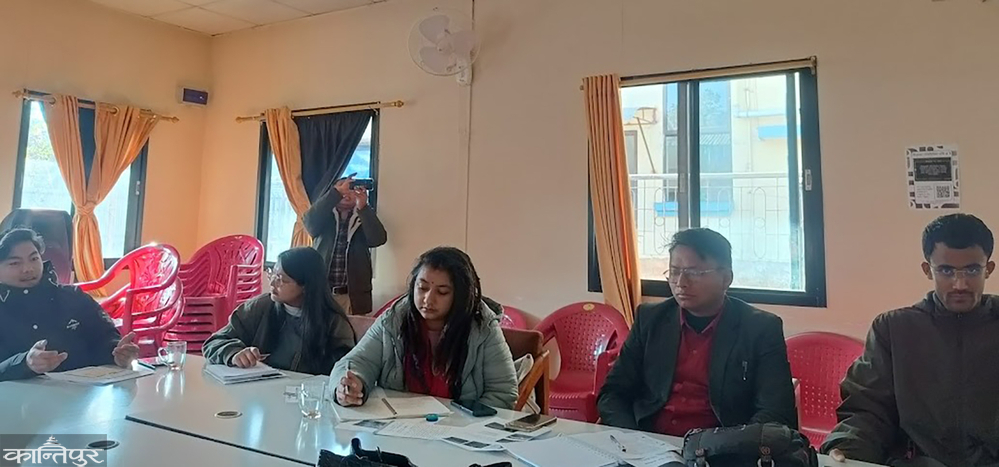
Educationists discussed public education reforms with Gen-G youth on Monday. During the discussion, educationists complained that despite the collapse of public education, youth were not interested in it.
Former Vice Chancellor of Tribhuvan University Kedar Bhakta Mathema, Professor Susan Acharya, Prem Fak, Peshla Dahal and Tika Bhattarai had inquired about Gen-G's views on education sector reforms. In response, Gen-G leaders said that public education reform is a matter of concern.
Mathema said that the political parties and the leadership of the three parties have abandoned the agenda of public education reform and said that the youth should take up the issue. 'The issue of building a society by reforming education has never come from the political leadership,' he said, 'The state and the government are not interested in it either.' He commented that by implementing two types of education systems, government and private, society is being destroyed. 'Yesterday, the children of gold and silver merchants studied in the same school. The entire society was found within the school. Today, the schools where children study have become different according to the class,' he said, 'The backward class has become a community school of the community.' Education itself has not allowed them to move forward. He said that even though democracy gives the right to choose a school and study, the state should think about the discrimination it brings.
Gen-G leader Rijan Rana Magar said that although public education reform is a matter of concern for the youth, it is not possible without political change. ‘Education itself is linked to class discrimination.’ The political leadership should be made aware, he said, ‘We may have to fight for that.’ He pointed out that public education should be accessible and free to all. ‘Our schools cannot teach students to wash their hands.’ That work should be done by NGOs,’ said Rana Magar. ‘The education system should also be changed according to the constitution, democracy, federalism, and secularism.’ Gen-G leader Vikas Kami said that the concept of the education system should be changed. ‘The Education Act of 2028 cannot address the sentiments of the youth of 2082,’ he said, ‘Current education has only taught them to go to embassies to go abroad with certificates.’
He pointed out that although political parties advocate public education, their cause has become weak. ‘Education has been handed over to a limited class and those with access. Indigenous education is being destroyed in the name of formal and modern education,’ he said. Gen-G leader Monica said that reforms should be initiated by changing the curriculum. Claiming that education is the root cause of inequality and class division, she said that the existing system of government and private schools should be changed. Another leader, Paras Magar, emphasized the need to increase the quality and investment in community schools. ‘Reform is not possible unless the state intervenes in a policy-level manner. Private schools should be eliminated,’ he said.
Professor Fak said that the problem is that the policy for physical infrastructure development and the practice of making education policies are the same. ‘The process of building bridges and the process of making curricula for children are the same. Budgets are sought. This is how they are measured. Those who know how to build are given the responsibility of increasing the curriculum as if it were a contract,’ he said, ‘The process of making education policies and curricula is wrong. Improvements should be sought from there.’ Fak said that the policy and curriculum are more confused in the search for quality than social justice and diversity. ‘Nowadays, those who can study. Those who cannot study. Those who can pass. There is also an attempt to establish the narrative that those who cannot do not study,’ he said, ‘This further increases inequality in society.’
She said that political parties, leaders and education administration employees are the main culprits in the weakness of public education. ‘The leaders who say they are reforming public education are the operators of private schools. They have registered schools with companies. But they don't pay taxes,' she said, 'First of all, we need to decide what to do with the current practice of having private and community schools.'
Professor Dahal said that the government should be clear about the dilemma of private and community schools. 'Privatization is being practiced even within community schools that are doing well.' The state is slowly moving away from public education. Caution is needed in this,' he said, 'Gen-G's voice and commitment should also be included in this.' This is the first time that educationists and Gen-G have had a dialogue on public education reform.

