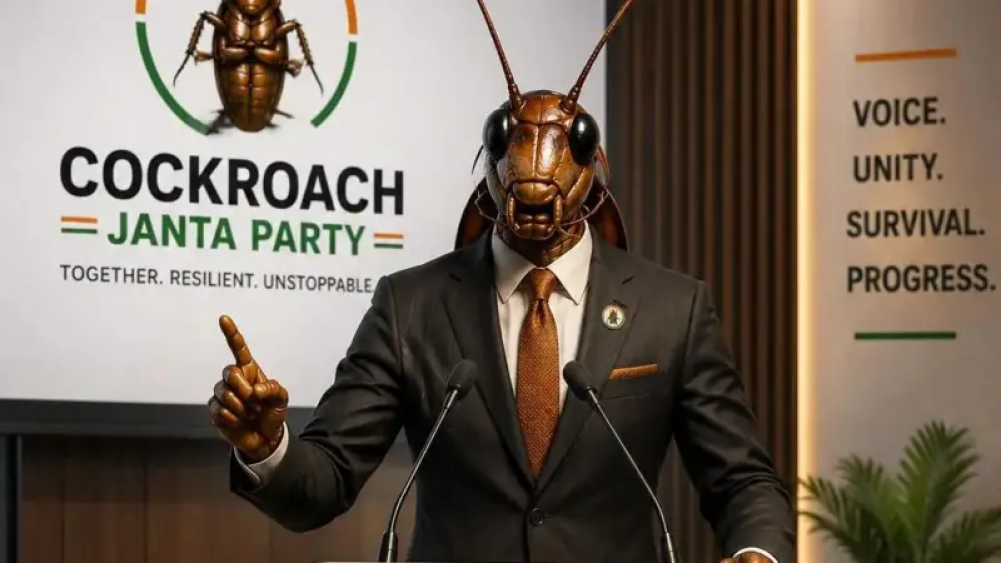
CJP was founded last May by 30-year-old Abhijit Deepke.
We use Google Cloud Translation Services. Google requires we provide the following disclaimer relating to use of this service:
This service may contain translations powered by Google. Google disclaims all warranties related to the translations, expressed or implied, including any warranties of accuracy, reliability, and any implied warranties of merchantability, fitness for a particular purpose, and noninfringement.
India's Union Education Minister Dharmendra Pradhan has resigned. He was drawn into controversy after the question paper for the National Eligibility cum Entrance Test (NEET) was leaked.
In India, young people demanded that Pradhan take moral responsibility and resign. However, both Pradhan and Prime Minister Narendra Modi ignored this demand. The outrage, initially limited to social media and online platforms, eventually took on a collective form and ultimately forced the government to yield.
The entire movement was led by the Cockroach Janata Party (CJP). The CJP was founded last May by 30-year-old Abhijit Deepke.
Recently graduated from an American university, Deepke became extremely enraged after hearing India's Chief Justice Suryakant compare the country's unemployed youth to 'parasites' and 'leeches' during a Supreme Court hearing.
He wrote on social media, 'What would happen if the millions of leeches in this country united?' His post went viral on Instagram. After that, he announced the formation of the Cockroach Janata Party (CJP) through social media.

The party was named CJP as a satire of the Bharatiya Janata Party (BJP). An online link to join the party was also included in social media posts. In a short time, a large number of young people in India began to follow it.
Within just two weeks of its founding, the CJP's Instagram page had more than 22 million followers, surpassing even the ruling BJP.
Unable to tolerate criticism, the Modi government tried to ban CJP's social media accounts citing national security, but this attempt was unsuccessful.
Since its inception, CJP has advocated for educational reform. After the NEET question paper leak was discovered, the government postponed the exam, forcing 2 million candidates to retake the test.
Following this incident, 12 students preparing for exams in India committed suicide. CJP demanded compensation for the students' families and the resignation of the education minister.
At the beginning of June, CJP registered itself as a political party. It then organized a protest in New Delhi.
After returning from America, Abhijit Deepke led this protest. This was the first physical protest organized by CJP, which had been active in the virtual world. A large number of young people participated.
In particular, youth from India's Gen Z and millennial generations participated in the protest, demanding educational reform. They also protested against nepotism and abuse of power. According to a recent study, about 40 percent of Indian graduates under the age of 25 are unemployed.
At the end of June, CJP decided to stage a sit-in at Delhi's Jantar Mantar. The youth vowed not to leave the site until Education Minister Dharmendra Pradhan resigned. Environmental activist and renowned Ladakh engineer Sonam Wangchuk also participated in the protest. He began a hunger strike in support of the demonstration.
During the 'Parliament Chalo' protest on July 20, a large number of demonstrators gathered on Parliament Street. During this, many protesters were injured in clashes with the police. After that, CJP continued the protest for six consecutive days.
During this period, Wangchuk continued his hunger strike for 26 days. He said he ended his fast at midnight on Thursday after the government gave written assurances to fulfill two demands.
On behalf of the government, Union Minister JP Nadda gave a written assurance that compensation would be provided to the families of students who committed suicide after the NEET question paper leak, and that no action would be taken against those involved in the movement.
Recently, protests have been taking place in various cities across the country at CJP's call. Several opposition parties, including Congress (I), have supported CJP in this protest.