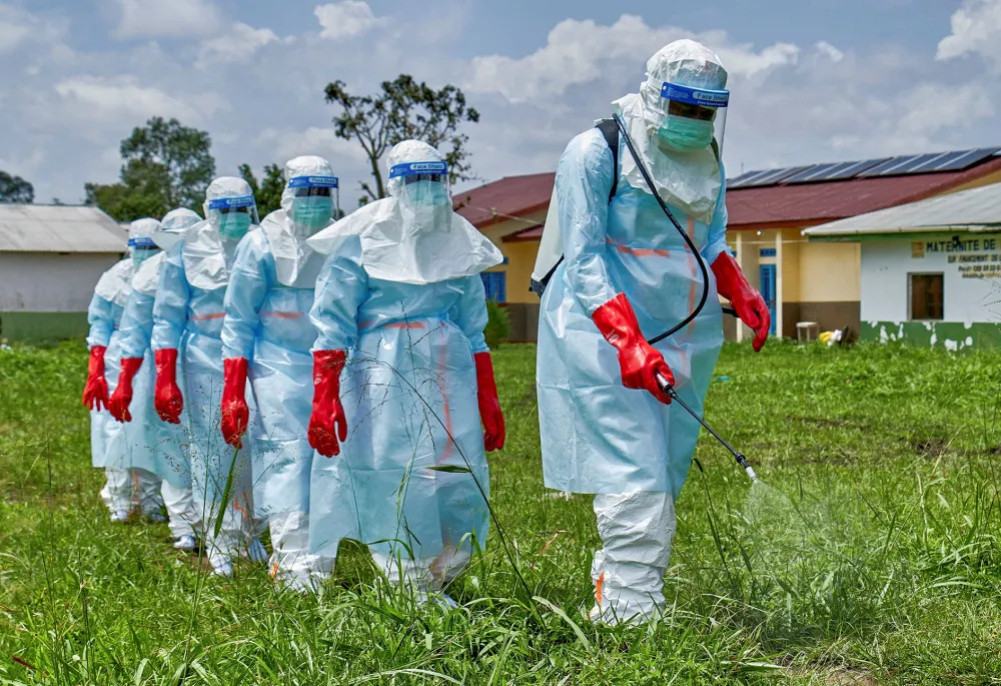
The World Health Organization (WHO) has warned that the outbreak is still spreading rapidly.
We use Google Cloud Translation Services. Google requires we provide the following disclaimer relating to use of this service:
This service may contain translations powered by Google. Google disclaims all warranties related to the translations, expressed or implied, including any warranties of accuracy, reliability, and any implied warranties of merchantability, fitness for a particular purpose, and noninfringement.
More than 1,700 people have been confirmed to be infected with Ebola in the Democratic Republic of Congo (DRC). The World Health Organization (WHO) has warned that the outbreak is still spreading rapidly.
Congo has reported 580 deaths and 1,708 confirmed cases, officials said. The number of deaths and infections is increasing in health zones in Ituri and North Kivu provinces, according to a WHO report released on Tuesday.
Speaking to reporters in Bunia, the capital of Ituri province, WHO representative Anne Ensia said the public health risk in Congo was high.
According to the WHO report, of the 430 deaths investigated as of Sunday, 397 died before reaching hospital. This shows the delays in the treatment process.
The outbreak, declared on May 15, has mainly affected the provinces of Ituri, North Kivu and South Kivu in eastern Congo.
The WHO reports that there are about 700 treatment beds in more than 22 Ebola treatment centers and care facilities in Congo. Ansia said that treatment centers are under pressure and that it is not yet possible to meet all the needs of Ituri province.
WHO officials said that testing capacity in Kinshasa has increased rapidly from about 30 tests per day to more than 2,000 per day. Similarly, Ansia said that 10 decentralized laboratories have been opened in the affected provinces.
The current outbreak is caused by the Bundibugyo Ebola virus infection. There is currently no approved vaccine or specific treatment for this strain of the virus.
The clinical trial was officially launched in Congo on Thursday, with the support of the WHO.