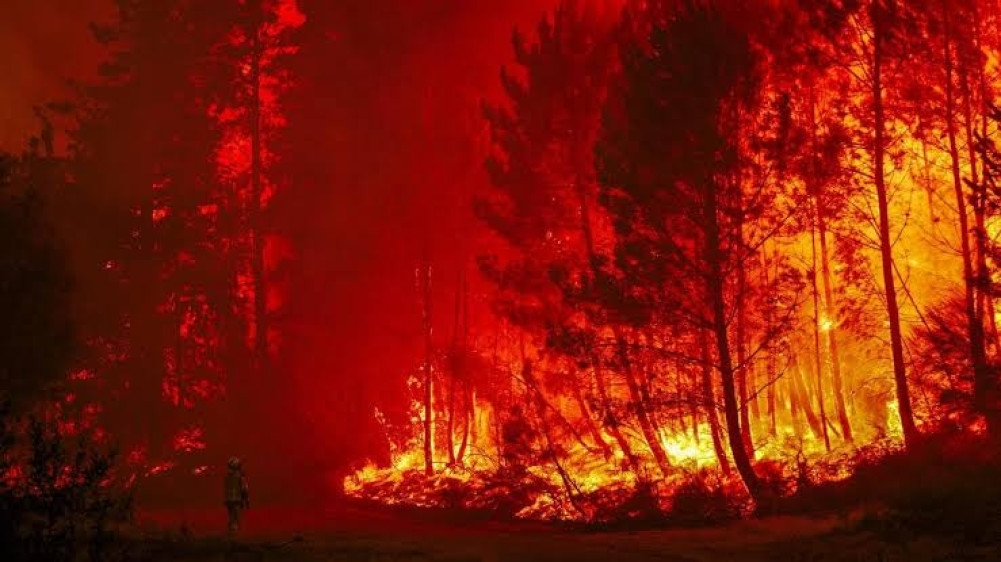
Residents in some areas have been instructed to stay indoors and close windows and doors as the threat of toxic smoke from wildfires in Greece increases.
We use Google Cloud Translation Services. Google requires we provide the following disclaimer relating to use of this service:
This service may contain translations powered by Google. Google disclaims all warranties related to the translations, expressed or implied, including any warranties of accuracy, reliability, and any implied warranties of merchantability, fitness for a particular purpose, and noninfringement.
The risk of wildfires raging in Portugal, Greece and Spain spiraling out of control is increasing. Hundreds of firefighters, dozens of aircraft and international aid have been deployed, but the fires have not been fully contained.
In Greece, residents have been told to stay indoors and close their windows and doors in some areas as the risk of toxic smoke from the blazes increases.
The fire, which started on Saturday evening at a recycling plant near the Oraiokastro suburb of Thessaloniki, Greece's second largest city, was spread by strong winds.
The toxic smoke has prompted an alert and partial evacuation for three surrounding suburbs and homes housing 157 people with disabilities.
About 160 firefighters worked overnight to control the blaze, while water tankers were deployed since morning. Local mayor Pandelis Sakiris said some homes and businesses had been damaged, although details were not yet available.
Meanwhile, 210 firefighters, volunteers, special teams and 29 aircraft have been deployed to control another fire in a pine forest in the Mandra region, west of Athens.
Authorities have stepped up efforts to bring the fire under control before dusk, as air rescue operations will be affected after dark.
More than 1,200 firefighters, around 400 vehicles and 15 aircraft have been deployed to fight the blaze in Portugal's central region of Vaucluse since Thursday.
The fire had burned about 12,000 hectares by Sunday, according to the European Union's (EU) Copernicus satellite system.
Spain has sent 120 firefighters and 45 vehicles to help Portugal, while three firefighting aircraft have been deployed from Italy and Spain.
Officials say the fire has slowed down but hot spots remain in some places.
The fire, which broke out in the northeastern Girona region of Spain since Friday, has burned about 2,200 hectares.
The fire has spread to about 40 kilometers (25 miles) and is unlikely to be brought under control soon, according to Catalonia Fire Service chief Edward Martinez.
Greece's fire department said it had arrested a 76-year-old man on suspicion that the Thessaloniki blaze was started by a spark from a car that ignited vegetation on the roadside.
A 12-year-old boy and his father died in another blaze in the same area a few days earlier. Fire department spokesman Brigadier Ioannis Artopios said about 85 percent of fires in Greece were caused by human negligence.
Sparks from agricultural equipment, cigarette butts and careless barbecues in open spaces were the main causes, he said. He said most fires could be prevented with awareness.
Greece has been hit by devastating fires every summer. In 2018, wildfires near Athens killed more than 100 people, while in 2023, wildfires in northeastern Greece became the largest in the EU's history.
In response to the growing risks posed by climate change, Greece is also preparing to strengthen its fire monitoring system with the help of four recently launched satellites.