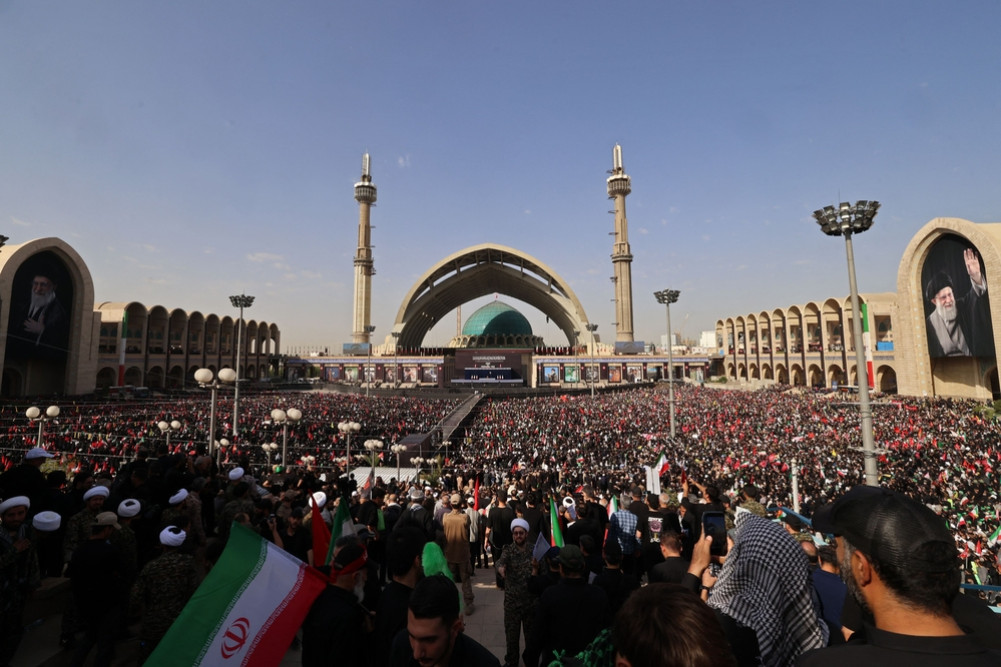
Some of those attending the funeral carried pictures of the new Supreme Leader, Mojtaba Khamenei, who has not been seen in public since he became his father's successor.
We use Google Cloud Translation Services. Google requires we provide the following disclaimer relating to use of this service:
This service may contain translations powered by Google. Google disclaims all warranties related to the translations, expressed or implied, including any warranties of accuracy, reliability, and any implied warranties of merchantability, fitness for a particular purpose, and noninfringement.
Thousands of mourners gathered in Tehran on Saturday morning to pay their last respects to Iran's late Supreme Leader Ayatollah Ali Khamenei. Khamenei's body has been placed in the Grand Musalla prayer complex in Tehran for tribute.
Earlier on Friday, a program was held with the participation of foreign leaders, diplomats and religious leaders.
The program was attended by representatives of more than 100 countries, including China, Russia, India, Pakistan, Afghanistan and Bangladesh. Pakistan was led by Prime Minister Shahbaz Sharif. Recently, Pakistan has been mediating to end the war between the United States and Iran.
Representatives of US allies in West Asia such as Qatar, Saudi Arabia and the UAE also attended the program. Programs in tribute to Khamenei will continue until next Thursday.
His body will be taken to Qom in Iran, Najaf in Iraq and Kerwala for funerals. It will then be taken to the Imam Reza Shrine in Mashhad, Khamenei's birthplace, for a funeral on July 9.
Khamenei, who led Iran for more than three decades, was killed in a US-Israeli attack on February 28. The attack sparked a regional war.
According to an AFP correspondent present at the memorial service in Tehran, the citizens who came to pay their respects carried red flags, a symbol of revenge in Shiite Islam. Some participants beat their chests and chanted "revenge, revenge."
A mourner at the ceremony said, "We have not come for a final farewell, but for revenge. We will never avenge your blood."
Many of the mourners were emotional as they paid their respects amid tight security. “We must rise up and, God willing, avenge the blood of our leader,” 18-year-old student Hamidreza Shabani told AFP.
After the recitation of the Quran, Khamenei’s coffin, draped in the Iranian national flag, was carried onto the stage from behind a dark blue curtain. The coffins of his family members who died in the US-Israeli attack were also carried alongside.
Rows of Iranian national flags lined the stage, while the walls of the grand musalla were decorated with photographs depicting various stages of Khamenei’s life.
Some mourners also carried pictures of the new Supreme Leader, Mojtaba Khamenei. Mojtaba, who succeeded his father, has not been seen in public.
The yellow flag of the Iranian-backed militant group Hezbollah was also seen at the event. Hezbollah has been fighting Israeli forces in southern Lebanon since the start of the regional war.
Hezbollah is part of the Iran-led “Axis of Resistance” network of armed groups in West Asia. The network is active in opposing Israel and the United States.
Authorities sprayed water on the crowd to relieve the heat as temperatures in Tehran soared above 30 degrees Celsius. Similarly, makeshift stalls were set up around the event venue to distribute food and drinks to attendees.
Many parked their vehicles a few kilometers from the event venue and walked the rest of the way due to a traffic ban imposed across the capital.
Khamenei, 86, was killed on February 28 at his residence in central Tehran when the United States and Israel launched the first airstrikes in the war.
Khamenei's son-in-law, his eldest daughter, and his 14-year-old granddaughter were killed in the incident. Khamenei's son Mojtaba Khamenei survived the incident. However, Mojtaba's wife was killed in the incident along with other family members.
Mojtaba is now Iran's supreme leader. However, he did not attend the event on Saturday due to security reasons. He has not been seen in public since becoming supreme leader.
After more than 100 days of war, an initial agreement was reached between Iran and the United States last month with the aim of ending the war. However, talks for a permanent peace agreement are still ongoing. Even after the agreement, sporadic shootings have occurred between the two sides.
Paul Musgrave, an associate professor at Georgetown University in Qatar, said that this memorial service is meaningful for Iran both domestically and internationally.
‘The public display of grief and solidarity seems to have established the legitimacy of the regime among the large population within the country. There was no such unity before in November and December. The unity seen now is the result of the war led by the US and Israel,’ he said.
Musgrave said it was meaningful that leaders from many countries outside Iran were participating. ‘It shows that there is some kind of solidarity with Iran, not just in this region but globally,’ he said.