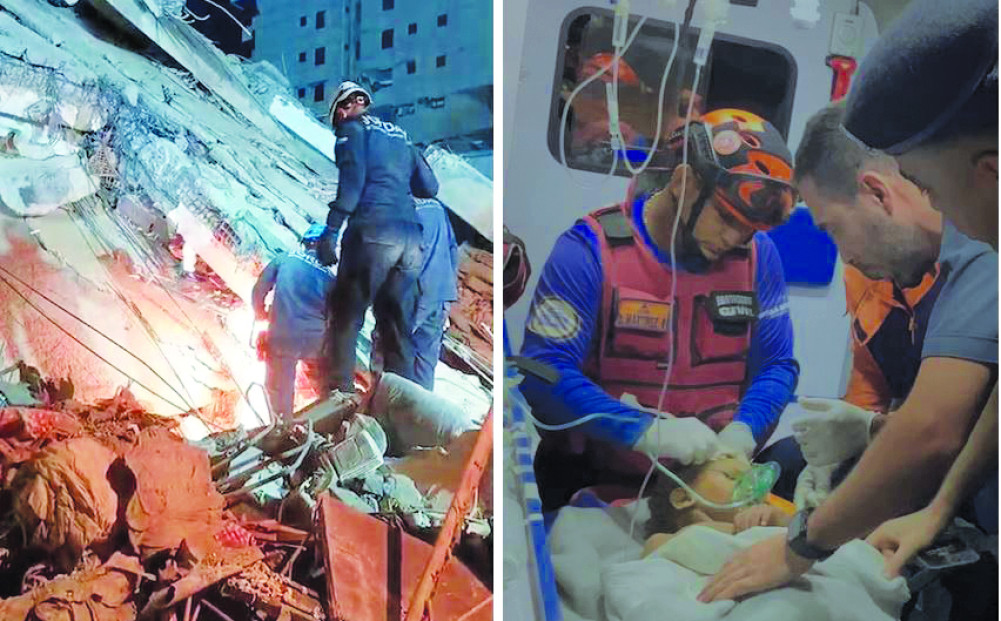
The earthquake that struck last Wednesday has left 1,943 dead, more than 10,000 injured, and thousands more still missing.
We use Google Cloud Translation Services. Google requires we provide the following disclaimer relating to use of this service:
This service may contain translations powered by Google. Google disclaims all warranties related to the translations, expressed or implied, including any warranties of accuracy, reliability, and any implied warranties of merchantability, fitness for a particular purpose, and noninfringement.
A three-year-old boy was pulled alive from the rubble on Tuesday, six days after a devastating earthquake struck Venezuela. Jordanian rescue teams pulled the boy, named Kleber Moran, from the rubble. According to the rescue team, Kleber was taken to hospital after receiving first aid. His condition is stable. A video circulating on social media shows rescue workers celebrating after the boy's safe rescue.
Interim President Delcy Rodriguez said the rescue had brought hope to the people. The United Nations has warned that thousands of people in Venezuela are in urgent need of food and shelter. The death toll from Wednesday's 7.2- and 7.5-magnitude earthquakes has risen to 1,943. More than 10,000 people have been injured and thousands are still missing.
Initial assessments from NASA satellite data show that the quake damaged 58,870 buildings. Experts say the three-day period after the earthquake is the best time to find people alive, but now that deadline has passed, the chances of finding those trapped alive are diminishing. La Guaira is one of the worst-hit areas. Many locals are helping with the rescue efforts themselves.
The United Nations High Commissioner for Refugees (UNHCR) said on Tuesday that food shortages were widespread in La Guaira, with basic services disrupted and communications cut off in many places. The UNHCR said it urgently needs $14.85 million to provide temporary shelter and relief for up to six months for some 30,000 people.
World Health Organization (WHO) spokesman Christian Lindmeier said health facilities in Venezuela were overwhelmed. He said thousands of people needed treatment. He also said that the strain on the health sector is causing an epidemic of vaccine-preventable diseases. “Vaccination coverage for measles and diphtheria was low before the earthquake. Such problems can spread,” he said.
Locals in La Guaira have criticized the government for not arriving on time. Angelica Mundren wants the bodies of her son, niece and nephew to be removed from the rubble of her collapsed beachside apartment. She has been waiting for the heavy machinery needed to remove the concrete slabs and bent iron bars for the past six days. The situation is similar for other earthquake victims in Venezuela.
They say that Venezuela’s self-proclaimed socialist government has failed to help its people when they are most in need. The United Socialist Party of Venezuela has been in power here for the past 27 years. Delcy Rodriguez has been running the government as interim president since the US abducted party leader and President Nicolas Maduro in January. People have been angry that the government has not played an effective role in the rescue and relief efforts since the earthquake. “We have been abandoned,” Mundren said. “We feel helpless.”
Residential buildings, grocery stores, pharmacies, hotels and convenience stores have collapsed in La Guaira state, Caracas and surrounding areas. Retired Venezuelan army general Antonio Rivero said the government had failed to mobilise the army and police immediately after the earthquake.
“The country’s security forces should have been sent to the scene with trucks, generators, portable lights and water. But that didn’t happen. The security forces are not trained to help people, they are trained to protect the government from danger,” he said.
Angel Rangel, the former head of Venezuela's civil defense agency, also said the military's role was not effective. "When the worst happens. When there's an earthquake, the security forces are nowhere to be seen," Rangel said. "They're prepared for riot control. Not for natural disasters."
Ordinary citizens are searching for their loved ones in the rubble themselves. They have received help from some foreign rescuers. Hospitals are running out of supplies and manpower. Emergency teams are working with little or no equipment.
Some 27 countries have sent teams to help with search and rescue efforts. Foreigners have deployed more than 2,000 trained people and more than 160 dogs, said Gianluca Rampolla, the UN coordinator in Venezuela.