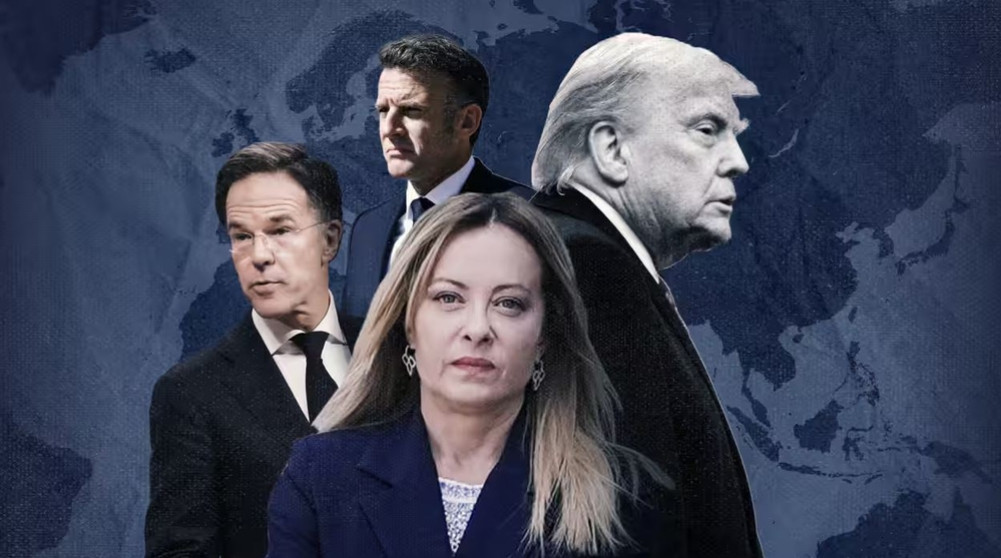
Analysts say Trump's pressure has prompted European leaders to side with Meloni, suggesting that European unity is becoming stronger in defense, security, trade, and foreign policy.
We use Google Cloud Translation Services. Google requires we provide the following disclaimer relating to use of this service:
This service may contain translations powered by Google. Google disclaims all warranties related to the translations, expressed or implied, including any warranties of accuracy, reliability, and any implied warranties of merchantability, fitness for a particular purpose, and noninfringement.
US President Donald Trump's public criticism of Italian Prime Minister Giorgia Meloni has backfired. Analysts say Trump's pressure has prompted European leaders to side with Meloni. This is believed to be strengthening European unity in defense, security, trade and foreign policy. Trump had questioned Italy's credibility and accused Meloni of trying to attract attention. He also claimed that Meloni had paid too much to take a photo with him during the C7 summit. Meloni strongly denied this, saying that she and her country Italy do not ask for anything from anyone. She said that Trump's claim was fabricated. She also said that Trump has shown more kindness to competitors than to allies. After this incident, Italian Foreign Minister Antonio Tajani postponed a visit to the US, saying that he had insulted his country. Some European countries that had previously kept their distance due to Meloni's right-wing political background are now in favor of increasing cooperation with him.
Analysts say the wars in Ukraine and Iran, the growing trade imbalance with China and the security challenges posed by Russia have forced European countries to forge a common strategy.
According to Sudha David-Wilp, vice president of the German Marshall Fund, Europe now feels the need for the US and China to act collectively to protect their influence. This unity is expected to be tested at the NATO summit in Turkey next week.
Meloni's relations with European leaders have grown significantly since her row with Trump. In March, she decided not to allow US bombers to use a military base in Sicily without parliamentary approval.
Meloni, who was previously often excluded from important foreign policy discussions, is now seen in regular coordination with the leaders of Germany, France, Britain and Poland. A bilateral summit with French President Emmanuel Macron also signaled the same shift.
Nationalist parties in Europe have also begun to change their views on Trump. French far-right leader Jordan Bardella has described Trump as an unstable leader, calling US policy a foreign intervention.
Germany's Alternative for Germany (AfD) party has also criticized the US military campaign against Iran. Analysts say these parties are adopting a strategy of focusing more on domestic politics than international issues in view of the upcoming elections.
Trump's relations with Denmark and Albania have also deteriorated. Protests have erupted in Denmark and Greenland after Trump threatened to annex Greenland. A luxury project linked to the Trump family in Albania has become a subject of political controversy.
Hungarian Prime Minister Viktor Orbán has also been under political pressure due to his close relationship with Trump, according to an analysis. While Meloni and Trump share similar views on some issues, such as immigration and security, Meloni's stance on the Ukraine war is closer to that of European partners.
She has consistently supported Kiev, opposing the Russian invasion. It has also played a role in strengthening relations with Europe. After a public spat with Trump, Meloni also responded that her relationship with him had not benefited her popularity.
A recent Pew Research Center poll found that 83 percent of Italians do not trust Trump's foreign policy. Support for Trump's role in the Iran war, tariffs and immigration policy is also low.