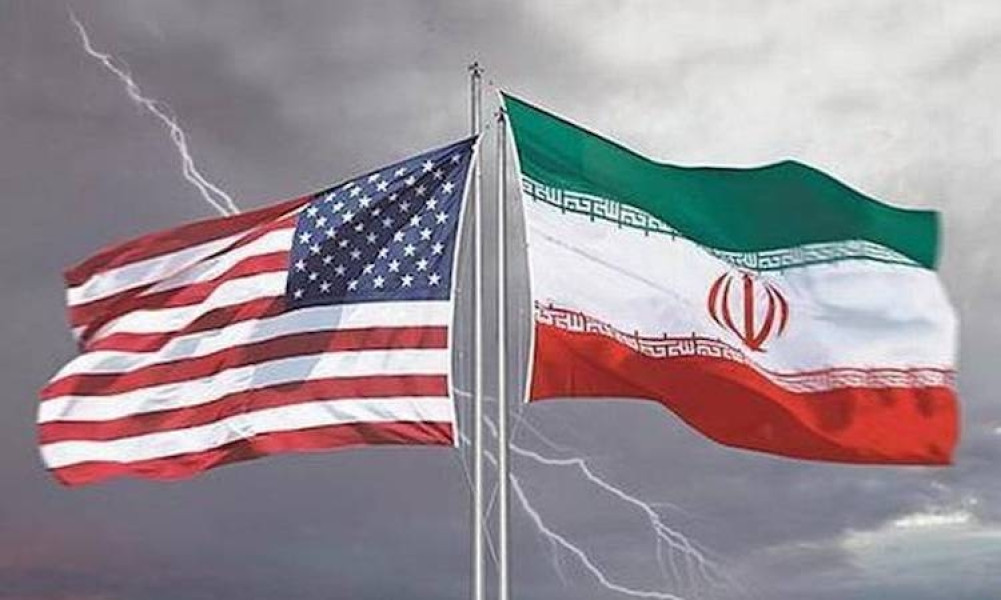
A statement issued by Bahrain's Foreign Ministry said Iran had launched a drone attack on its country early Saturday morning.
We use Google Cloud Translation Services. Google requires we provide the following disclaimer relating to use of this service:
This service may contain translations powered by Google. Google disclaims all warranties related to the translations, expressed or implied, including any warranties of accuracy, reliability, and any implied warranties of merchantability, fitness for a particular purpose, and noninfringement.
Iran and the United States, which signed an interim peace deal last week, have again engaged in a series of attacks. On Saturday, Iran's Foreign Ministry said that attacks had been launched on US military bases in West Asia. Iran claims that the attacks were in response to US airstrikes on its southern coast. However, it has not released details about the locations of the attacks. Bahrain's Foreign Ministry said in a statement that Iran had launched a drone attack on its territory early on Saturday. Bahrain condemned the attack as a violation of its sovereignty and international law. The US had previously attacked Iran on Friday. The US Central Command said that the military had attacked Iranian missile and drone sites as well as radar stations on the coast. The US said that the attacks were in response to an attack on a cargo ship in the Strait of Hormuz on Thursday. It is the biggest violation since the two countries signed an interim agreement to end the war last week. Both sides have blamed each other for the violation. US President Donald Trump said Iran's attack on the cargo ship was a violation of the peace agreement.
On Friday, he said he did not like such an attack. When asked by reporters whether the US would retaliate, he replied, "You will find out." Shortly after, the US attacked Iran.
Ebrahim Azizi, the head of the National Security Commission of the Iranian parliament, responded to Trump on social media early on Friday, saying, "The Strait of Hormuz is under Iranian control, so: respect the rules and do not mistake our control as a step to escalate tensions." He added, "This is not a violation of the ceasefire; this is the management of the ceasefire." On Friday evening, US Vice President J.D. Vance urged Iran to talk about the ceasefire agreement via social media. "If there is any disagreement about the ceasefire agreement, Iran should talk," Vance wrote, "but violence will be met with violence." A US official told the Associated Press (AP) that the attack lasted about an hour, after US Central Command announced the operation on social media.
The British military said a projectile had hit a container ship off the coast of Oman on Thursday. Iran had warned ships not to use the route before the attack. The UK Maritime Trade Organisation (UKMTO) said no one was injured in the incident. Iran has maintained control of the Strait of Hormuz despite an interim deal with the US last week that both sides agreed to open it. Last week, the International Maritime Organisation (IMO), a body under the United Nations, launched an operation to evacuate ships stranded in the Strait of Hormuz using an alternative route. Under this, the ships were moving along the coast of Oman instead of the main route.
The IMO said rescue operations had been suspended after the attack. In a statement on Thursday, the IMO said the operation would not resume until there were guarantees that ships would not be attacked.
IMO Secretary-General Arsenio Dominguez said about 115 ships had left the Strait of Hormuz in recent days. He said about 500 ships were still stranded in the Strait.
According to Lloyd's List Intelligence, a maritime data collection and analysis company, Iran has been urging ships to use only routes approved by Tehran.
At least two tankers that had tried to proceed via an alternative route (the coast of Oman) returned to Hormuz on Monday after Iran warned them not to. Lloyd's said more than two dozen ships were still moving through the southern route of the waterway after the US attack on Friday.
The US and Iran are still negotiating the terms of the deal. The full opening of the Strait of Hormuz and the future of Iran's highly enriched uranium stockpile are key issues in the talks. The interim agreement states that all issues will be resolved within 60 days.