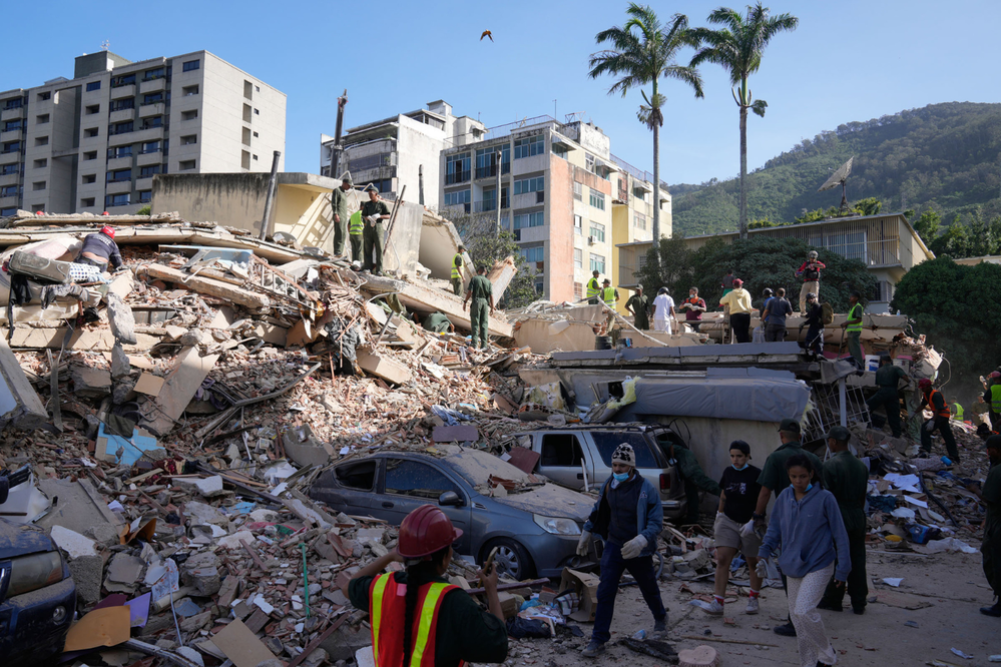
Rescue workers and local residents are clearing debris and searching for survivors in various areas of the hardest-hit state of La Guaira.
We use Google Cloud Translation Services. Google requires we provide the following disclaimer relating to use of this service:
This service may contain translations powered by Google. Google disclaims all warranties related to the translations, expressed or implied, including any warranties of accuracy, reliability, and any implied warranties of merchantability, fitness for a particular purpose, and noninfringement.
Two powerful earthquakes struck northern Venezuela less than a minute apart on Wednesday night, causing widespread damage. At least 235 people have been killed and nearly 4,300 injured. Rescue efforts are being stepped up as more people are feared trapped under rubble.
Two earthquakes measuring 7.2 and 7.5 on the Richter scale have caused buildings to collapse, crack and collapse in northern Venezuela, according to the United States Geological Survey. Strong aftershocks were still being felt on Thursday.
Health Minister Carlos Alvarado said the death toll had risen to 235. The number of injured is rising, with some in critical condition.
Rescue workers and residents are searching for survivors in various parts of the hardest-hit state of La Guaira. In many places, there is a lack of adequate equipment and skilled manpower.
A young woman waited for hours in a slum north of Caracas, screaming for help. Local resident Dani Rijo said rescue teams and security personnel were urgently needed. Locals reported that the young woman died a short time later.
People's voices were also heard from under the rubble in other areas of La Guaira. Local resident Antonio Bermudez said they were helpless due to the lack of necessary equipment and rescue materials.
A doctor at Domingo Luciani Hospital, who asked not to be named, said many children were arriving at the hospital without their parents. Some children were able to identify themselves, while others were brought in by ambulance with identification bands on their hands.
A rescue worker said the lack of trained manpower and modern equipment had hampered the rescue operation. Interim President Delcy Rodriguez visited La Guaira after the affected area was declared a disaster area.
Meanwhile, looting of food and daily necessities stores has also occurred in some places, AFP journalists reported. Nicole Cast, director of the International Rescue Committee in Venezuela, described the situation as "extremely catastrophic."
Countries around the world have pledged support after the earthquake. Switzerland, Spain, France, Portugal and Mexico have announced they will send experts and rescue teams.
The United States has said it will deploy two warships, transport aircraft and helicopters, as well as provide $150 million in aid. US Secretary of State Marco Rubio said his country's response would be swift, effective and comprehensive.
Washington's influence in Venezuela has grown since the US military ousted and arrested President Nicolas Maduro in January.
China, India, Brazil and war-torn Iran have also offered assistance. Pope Leo XIV has announced an initial €100,000 in aid. UN Secretary-General Antonio Guterres has expressed deep sorrow over the incident and urged the international community to help Venezuela.
UN humanitarian chief Tom Fletcher said the strongest earthquake in 126 years would require widespread international support.
The international airport in La Guaira has been closed after it was severely damaged, complicating rescue and relief efforts. The countries involved have confirmed that two Brazilians, two Chinese, one Italian and one Portuguese were among the dead.
Venezuela's northern coast, which lies on the border of the Caribbean and South American tectonic plates, is considered seismically sensitive. A 1997 earthquake killed 73 people, while a 1967 earthquake killed 236. The 7.5-magnitude quake was the strongest since a 7.7-magnitude quake in 1900.
The tremors were felt as far away as neighboring Colombia. Residents in Bogota evacuated their buildings as a precaution. Tremors were also felt in several cities in northern Brazil, the country's seismological monitoring agency said.
There was also panic in the capital, Caracas. Many people spent the night on the streets and in their cars. Rita Gomez, 60, rushed to the capital after learning on social media that her daughter's building had collapsed.
She said heavy equipment was being used for the rescue and that local residents were providing significant assistance, adding that she still hoped her daughter would be found alive.