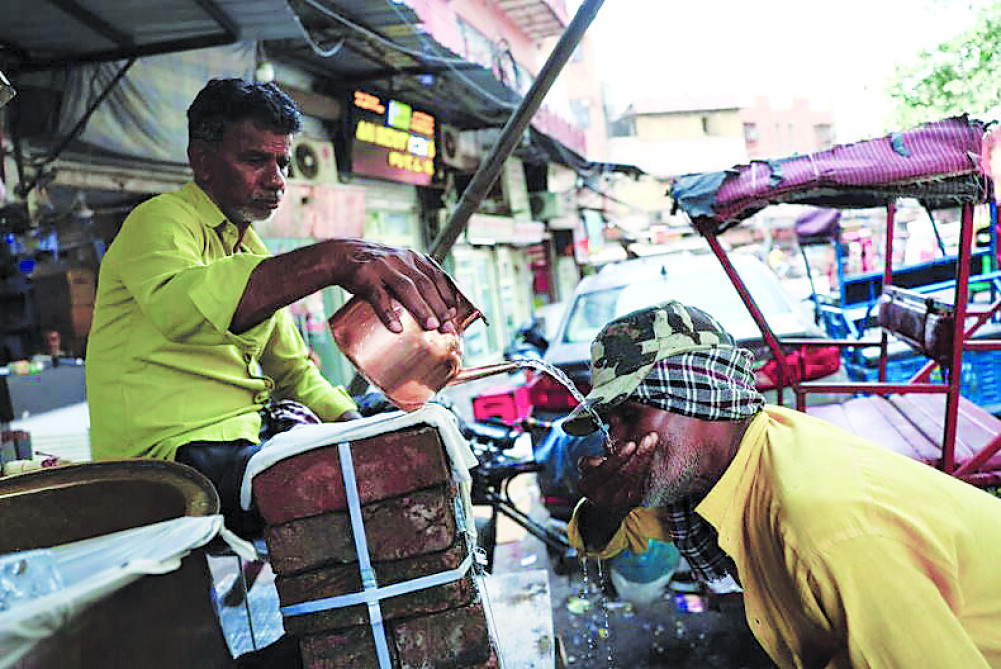
Informal sector workers and women are most affected, with schools closed in 28 Indian states, including Delhi, from May 15 to the end of June.
We use Google Cloud Translation Services. Google requires we provide the following disclaimer relating to use of this service:
This service may contain translations powered by Google. Google disclaims all warranties related to the translations, expressed or implied, including any warranties of accuracy, reliability, and any implied warranties of merchantability, fitness for a particular purpose, and noninfringement.
In Madhya Pradesh, India, the temperature often reaches 45 degrees Celsius during the day. For Anami Pooja Sahu, who works in Shamshedwad, it is becoming difficult to even do her regular work. “I have to spend most of my time outside. It is very challenging to reach people’s doorsteps during the summer,” she said. “That is why we start work early these days. We can get to work before the scorching sun sets in the middle of the day. But even getting out of the house is a challenge these days.”
Most community childcare centres and nutrition centres in Madhya Pradesh do not have regular electricity supply. “When the wind stops blowing, I wish I could walk after work,” Sahu said.
Sahu carries her ice and a bottle of cold water with her. She has experienced that some parents are not very keen on getting vaccinated during the summer. “Many do not want to bring their children to the vaccination centre. Some say they will come for vaccination after the heat subsides,' said Sahu, 'this has created a disruption in the vaccination program.'
Health workers like Sahu carry vaccination details, details of children and pregnant women, vaccination cards, daily diaries, water bottles, medicines and other materials in their bags. They have to carry a bag weighing about 12 to 13 kg. In addition, they also have to carry a cooler box to protect the vaccines from the heat.
The Bijukhedi Health Center in Loteri block provides health services to about 9,345 people in 11 villages. Anami Sumitra Deshmukh, who works here, will have to vaccinate about 950 children. However, the extreme heat has not only made it difficult for her to go out, but has also affected her work. 'People do not want to go out at noon. They do not want to bring their children to the vaccination center,' she said, 'They have to walk a lot to reach each house. It is very difficult.'
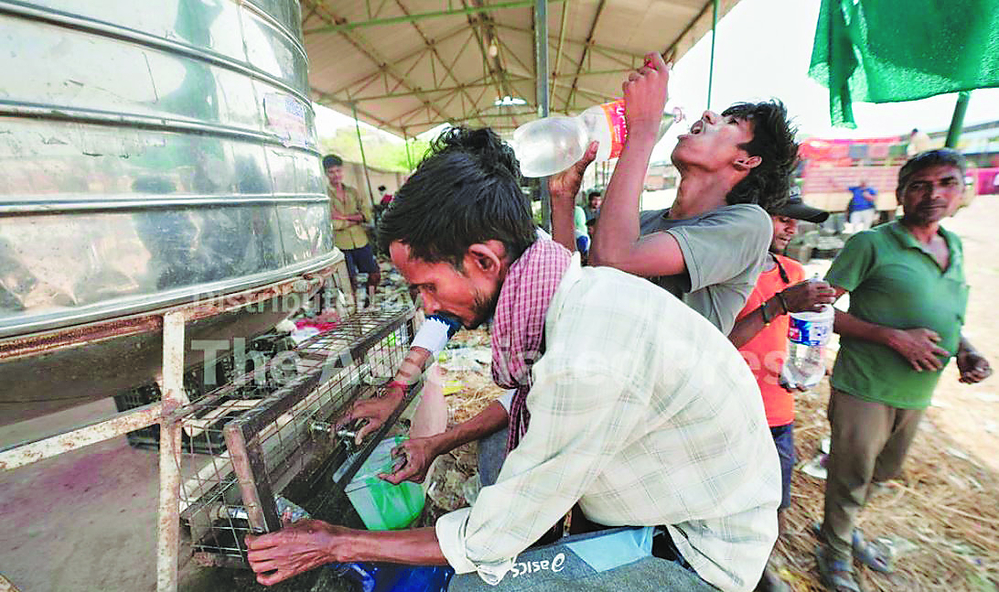
The Indian research organization Hitwatch had studied the condition of public health workers in Haryana. During that time, most public health workers said they had to spend 6 to 10 hours outdoors. Of these, 83.7 percent said they had worked outdoors during extreme heat. Of these, only 37.2 percent said they had access to water regularly. They reported experiencing heat-related problems including fatigue, dehydration, headaches, and ringworm. “The government needs to train public health workers and paramedics on heat stress and safe working practices. They need to be provided with a good income. Work hours should be reduced during extreme heat. Water, umbrellas, cooling stations, and safe transportation should be provided at all places,” said Heatwatch founder and researcher Akitap Varshney. The heat has been intense in most parts of India for the past few days. The temperature in the capital, New Delhi, has been above 41 degrees for the past few days. Schools in 28 states of India, including Delhi, have been closed due to extreme heat from May 15 to the end of June. The heat has affected the education of children on one hand, and on the other hand, it has created obstacles in the employment of women.
Sakshi Katyal has been living with her family in an apartment in Noida, the capital of Delhi, since December last year. Sakshi's family moved here in search of a place closer to her daughter's school. 'Last year, everything seemed to be going well. But suddenly, my daughter's school closed. Then, I had to quit my job in the corporate sector to take care of her.' Sakshi said that she has to pay for her child's education, additional expenses, and a hefty apartment installment on her husband's income.
Similarly, 24-year-old Zeenat Khatun has been living with her two children in a rented room in Nai Basti, 15 kilometers from Noida, a city in Uttar Pradesh. She is forced to cook and hang clothes in this room. The atmosphere is even hotter when she has to light the stove to cook at night.
'I don't have a separate kitchen,' she said. Khatun works as a domestic worker in two houses in Shaheen Bagh and earns Rs 8,000 per month. About Rs 5,000 goes towards paying rent. Her 7-year-old daughter studies in a nearby government school. She plans to enroll her son there from next year. However, her daughter is at home now because the school is closed.
She said that her daughter has been at home for about seven months this year due to pollution and high heat. “Due to the heat, classes are online. But I don’t know if my daughter is studying well,” she said. “I can’t even monitor her from home. If I stop working, who will pay for the school fees, food and rent?”
She has entrusted a local woman to look after her daughter when the school is closed. That costs about Rs 600 per month. “To make this money, I have to cut down on vegetables,” she said. “I don’t want my children to spend their lives washing dishes or sweeping floors like I did.”
Surbi Devi, 42, lives in Delhi’s Saket with her disabled child. She said she lost almost a month’s salary when schools were closed last year. “What kind of policy is this?” she said.
Urvashi Prasad, former director of India’s government think tank Niti Aayog, said India’s climate adaptation policy has failed to address women’s concerns. “In India, gender is rarely considered when planning responses to extreme heat. We haven’t analysed the data disaggregated by gender, and how climate policies are affecting women differently.”
She said informal sector workers have been hit hard by the heat and government policies related to it. “We know that heat and pollution will come every year. But why do we close schools at the last minute?” she said. She said that such decisions have left domestic workers, street vendors, agricultural workers and their children the most affected.
A senior official from India's education ministry said that past experience has shown that online classes are not effective. However, he said that since most schools in India do not have heat-resistant infrastructure, they are forced to connect students to online classes.