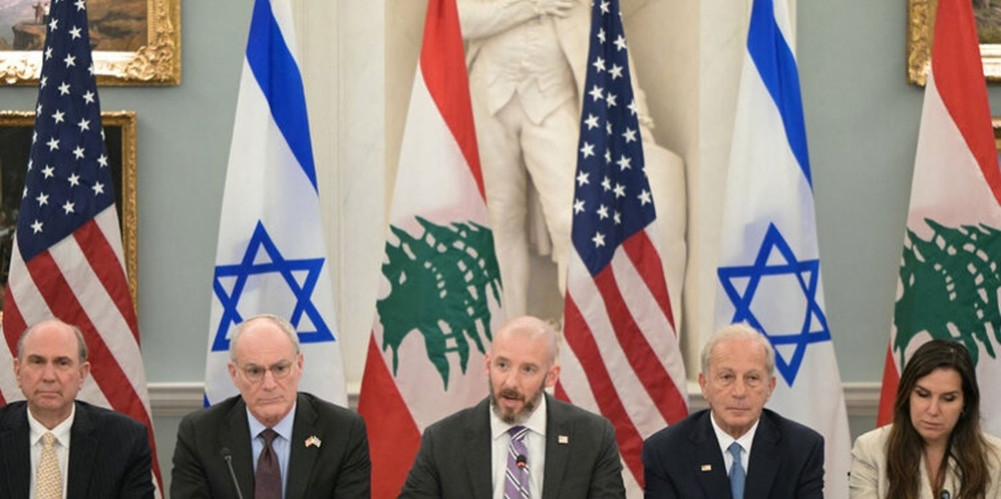
Although the two sides do not have formal diplomatic relations, the joint statement states that they have agreed to establish a 'pilot zone'.
We use Google Cloud Translation Services. Google requires we provide the following disclaimer relating to use of this service:
This service may contain translations powered by Google. Google disclaims all warranties related to the translations, expressed or implied, including any warranties of accuracy, reliability, and any implied warranties of merchantability, fitness for a particular purpose, and noninfringement.
Israel and Lebanon agreed on Wednesday to implement a ceasefire after high-level talks led by the US in Washington. But Iran-backed Hezbollah has made it clear that any agreement will not be implemented without a “complete cessation” of fire, leaving the agreement uncertain.
The two sides have no formal diplomatic relations, but a joint statement said they had agreed to establish a “pilot zone.” The area would be under special control by the Lebanese Armed Forces, which would remove non-state armed groups.
Despite the ceasefire announcement, clashes and attacks have continued along the border before and after the ceasefire. Hezbollah has claimed that it has targeted Israeli forces, and that at least 10 people have been killed in Israeli strikes in southern Lebanon. Hours after the agreement was announced, an airstrike alert was issued after “suspicious aerial targets” were spotted in northern Israel, although no casualties were confirmed.
The joint statement also includes conditions for a ceasefire to take effect, including a complete cessation of Hezbollah fire and the withdrawal of its fighters from southern Lebanon. The talks in Washington are the fourth round of direct talks between Lebanese and Israeli representatives. The talks have been ongoing since the conflict began on March 2. Hezbollah resumed attacks on Israel with Iranian backing.
The two sides have agreed to resume talks the week of June 22, with the aim of reaching a comprehensive peace agreement.
Meanwhile, US President Donald Trump has said the conflict in Lebanon and related tensions with Iran should be addressed separately. But Tehran has said the incidents are linked, with Iranian Foreign Minister Abbas Araghchi warning that any attack on Beirut could lead to a full-scale war.
The Israeli military said it intercepted a “hostile aircraft” and two projectiles that entered Israeli territory from Lebanon on Wednesday. In response, Hezbollah claimed that the Israeli army had violated the ceasefire and fired rockets at military targets in northern Israel.
On Thursday morning, Hezbollah said it had fired rockets targeting Israeli soldiers and vehicles in the southern Lebanese town of al-Qantara and had carried out two drone attacks on an Israeli command post near Chakif Castle.
Although a ceasefire proposed to halt the fighting was supposed to take effect on April 17, both sides have continued to attack each other, accusing each other of violations. Senior Hezbollah official Mahmoud Komati made it clear that the group “will not accept a partial ceasefire.”
Meanwhile, the death toll has been rising. Lebanon's state-run National News Agency (NNA) said an Israeli strike targeted a car on a main highway outside the capital. More than 20 attacks were reported in the south after the Israeli army warned several villages to evacuate.
Lebanon's health ministry said four Syrians and two Palestinians were killed in an Israeli strike in the al-Hawas area near the city of Tyre. But an Israeli military spokesman told AFP in Jerusalem that there was no information about any attacks in the area.
The health ministry said two paramedics from the Risala Scouts Association, a branch of the Hezbollah-affiliated Amal movement, were also killed in other strikes in the south. The ministry released photos of the damaged ambulances, showing medical supplies scattered across the road.
Another paramedic was killed in another attack on an ambulance team belonging to the Hezbollah-affiliated Islamic Health Committee in the town of Zibdin, the NNA said. At least 130 emergency and health workers have been killed since the conflict began.
The Lebanese army also said one soldier was killed in the Israeli attack and an officer and a soldier were wounded in a separate incident. The army strongly condemned Israel for its "systematic targeting" of soldiers, vehicles and military positions.