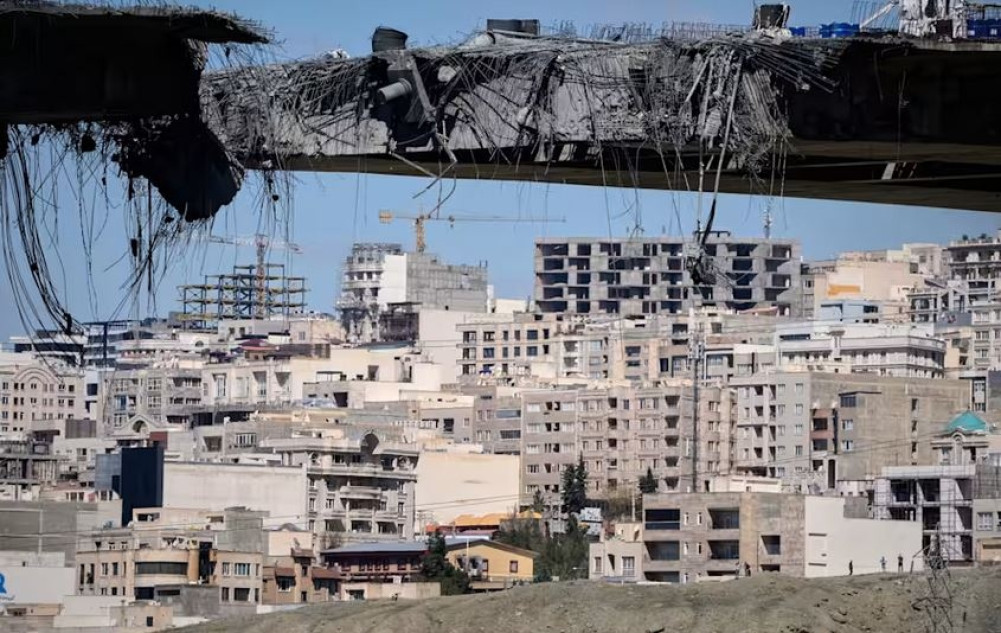
The ceasefire has once again become uncertain after the United States launched strikes against Iran near the Strait of Hormuz and the port of Bandar Abbas on Thursday.
We use Google Cloud Translation Services. Google requires we provide the following disclaimer relating to use of this service:
This service may contain translations powered by Google. Google disclaims all warranties related to the translations, expressed or implied, including any warranties of accuracy, reliability, and any implied warranties of merchantability, fitness for a particular purpose, and noninfringement.
The Iran-Iraq war has been going on for 90 days since Thursday. Efforts to end the war over the past month have not yielded results. Hopes for an end to the war had risen after the two warring parties participated in direct talks in Islamabad on April 11 and 12, mediated by Pakistan.
But the talks failed to succeed. Despite that, both sides did not launch major attacks on each other and continued their efforts to negotiate indirectly, mediated by Pakistan and West Asian countries. Just a few days ago, US President Donald Trump had said that an agreement had been reached with Iran on the main points of the dispute and that only signing was required. However, the next day, he said that the US was in no hurry to negotiate.
Meanwhile, the ceasefire has once again become uncertain after the United States attacked Iran near the Strait of Hormuz and the port of Bandar Abbas on Thursday. The US claims that the attacks targeted Iranian military bases in the Strait of Hormuz that are considered a threat to its troops and maritime transport. Iranian media reported that there was no damage to human or physical structures from the explosion.
The Islamic Revolutionary Guard Corps (IRGC) also launched a missile attack on a US air base in the Gulf on Thursday. The IRGC said the attack was in response to a US attack on southern Iran. However, it did not disclose which military base was attacked in which country. However, Kuwaiti officials said that some missile and drone attacks had been launched in their country and that they had been intercepted and neutralized.
As the atmosphere for talks was building, the series of recent attacks and counterattacks has raised fears of a new outbreak of war. Iran has been blocking the Strait of Hormuz since the Israeli-American attack on Iran on March 28. The blockade, which is responsible for 20 percent of the world's crude oil and natural gas, has deepened the energy crisis.
According to human rights organizations, at least 3,500 people have been killed in Iran and at least 3,000 in Lebanon since the war began. Similarly, 13 American soldiers have been killed, and many civilians have been killed in Israel and West Asian countries. The number of injured and displaced is very high. On February 28, the first target of the US-Israeli attack was the death of dozens of senior military officials, including Iran's Supreme Leader Ali Khamenei.
Trump had claimed in early March that Iran's regime would collapse within the next three weeks. However, even after three months, the US has not achieved its goal. White House spokeswoman Olivia Wells claimed that the US military campaign has achieved all its objectives and that Trump has the upper hand in the negotiations. However, the situation does not seem to be that way. "This war that Trump designed to win in the short term is turning into a long-term failure for him," Aaron David Miller, who previously served as the US mediator in West Asia, told Reuters.
Trump had declared during his election campaign after running for a second term that he would not intervene militarily in foreign countries unnecessarily. However, he has now brought the United States to a point where American foreign policy and credibility are in crisis. The rise in gasoline prices in the United States is fueling opposition to a war with Iran. This will likely pose a serious challenge to his party in the upcoming November parliamentary elections.
According to some analysts, Trump now has limited and difficult options. First, accept the agreement put forward by Iran or escalate the attack and cause an even bigger crisis. Second, if diplomacy fails, launch a final, short-term attack on Iran, then declare himself victorious and leave Iran.
Analysts also believe that Trump could take action against Cuba to divert attention from the Iran war. This would divert attention from the Iran issue. Some of Trump's aides have accepted that he will easily take power in Iran, just as he invaded Venezuela and took over its President Nicolas Maduro on January 3. However, not all of Trump's aides are ready to accept this. Alexander Gray, CEO of the American Global Strategies Consultancy, claims that Trump's Iran campaign has not failed. He was a senior adviser to Trump during his first term. “Deeply damaging Iran’s military might is a strategic success in itself. This war has brought the Gulf states away from China and closer to the United States. Similarly, the fate of Iran’s nuclear program remains to be determined,” he said.
Initially, the US carried out a series of airstrikes on Iran’s ballistic missile arsenal. Similarly, the US sank several Iranian naval vessels and killed high-ranking leaders. In response, Tehran blocked the Strait of Hormuz, which caused global energy prices to soar. Similarly, Iran has repeatedly attacked Israel and the Gulf states. The US has also blockaded Iranian ports in return, but Trump’s goal of subduing Iran has not been achieved.
Trump has said that the main goal of the war is to prevent Iran from developing nuclear weapons. He claims that this will eliminate Iran’s ability to act against West Asia and American interests and that the Iranian people will easily remove the government there. But none of his goals seem to have been achieved. Analysts say they are unlikely to be achieved.
Jonathan Penicoff, a former US deputy national intelligence officer for West Asia (now at the Atlantic Council think tank), says, “No matter how much damage Iran has suffered in this attack, the Iranian regime considers it a success. They have also gained experience from the war in terms of how much control they can exert over shipping in the Gulf.” Iran has even started to levy tolls on ships passing through the Strait of Hormuz to take advantage of its strategic advantage.
Trump’s goal of halting Iran’s nuclear weapons program also seems unlikely. Iran is suspected of hiding a large stockpile of enriched uranium underground after the US and Israel carried out airstrikes in July. The US has been saying that Iran should recognize its right to enrich uranium for peaceful purposes.
Two senior Iranian officials told Reuters that Supreme Leader Mojtaba Khamenei has ordered that the stockpile of enriched uranium needed to make a nuclear bomb cannot be transferred elsewhere. This has further complicated the situation. Some analysts say that this is a sign that Iran, like North Korea, is determined to become a nuclear weapons state.
Trump’s plan to cut off Iran’s support for armed groups in West Asia also does not seem to be working. Robert Kagan, a senior fellow at the Brookings Institution, a Washington think tank, said that a defeat against Iran would be more painful for the United States than in Vietnam and Afghanistan. “Because those countries were not at the center of global competition,” he wrote on the Atlantic magazine website. “There is no way to go back to the way things were. No American victory can undo or reverse the damage that has been done.”