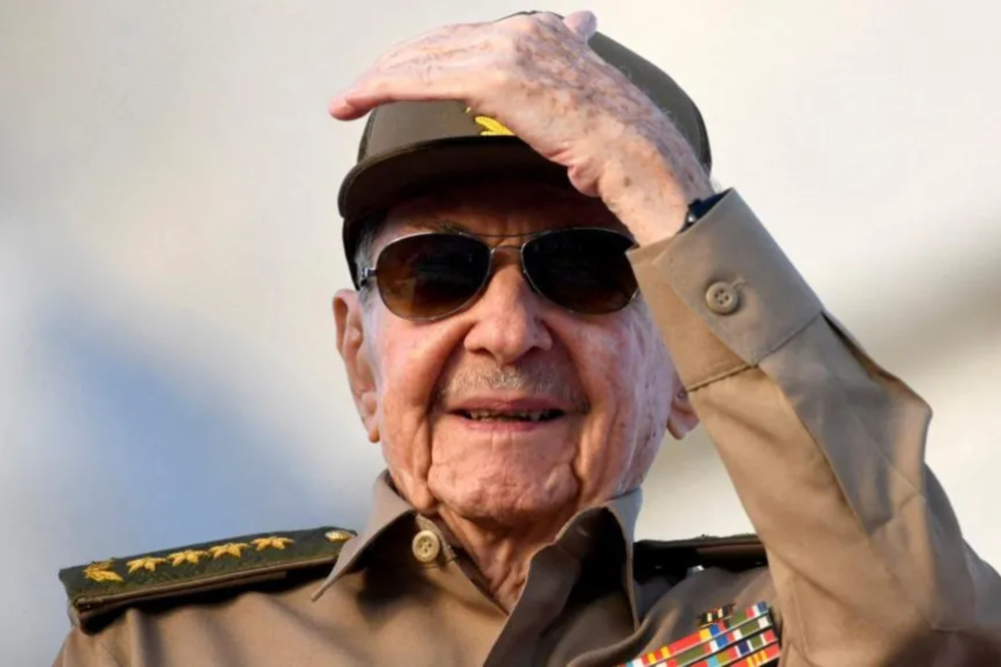
Castro is the brother of the late Cuban leader Fidel Castro and is still known in Cuba as the ”living leader of the revolution.”
We use Google Cloud Translation Services. Google requires we provide the following disclaimer relating to use of this service:
This service may contain translations powered by Google. Google disclaims all warranties related to the translations, expressed or implied, including any warranties of accuracy, reliability, and any implied warranties of merchantability, fitness for a particular purpose, and noninfringement.
The United States has charged Cuban leader and former President Raul Castro with conspiracy to murder American citizens and other crimes. The indictment, released Wednesday, charges Castro and five others with the shooting down of two airliners flying between Cuba and Florida in 1996, killing four people, including three Americans. Castro, 94, was head of Cuba’s armed forces at the time. Cuban President Miguel Diaz-Canel has called the charges “a political ploy with no legal basis.” Acting U.S. Attorney General Todd Blanche said Castro was also charged with the shooting down of the plane and four separate counts of murder. The dead include Armando Alexandre Jr., Carlos Alberto Costa, Mario Manuel de la Pena and Pablo Morales. “The United States and President Trump will never forget our citizens,” Blanche said.
The charges must be proven in a US court. The murder charge could carry the death penalty or life in prison. The new charges are seen as an attempt to increase US pressure on Cuba's communist leadership. "The strategy is to gradually increase the pressure and force the Cuban government to come to the negotiating table," said William Leogrand, a Latin American political expert at American University. The US has imposed sanctions on Cuba, cutting off oil supplies, causing power cuts and food shortages in the country.
Meanwhile, US Secretary of State Marco Rubio issued a message to the Cuban people on the occasion of Cuba's Independence Day. "President Trump has proposed a new path between the US and a new Cuba," Rubio said.
Rubio accused the Cuban military-controlled business group (GAESA) of being the main cause of the country's power shortages and food crisis. GAESA controls everything from ports to gas stations and five-star hotels.
Responding to Rubio’s message, Díaz-Canel accused the US of spreading lies and imposing collective punishment on the Cuban people.
He said the charges against Castro were “used to create a pretext for a military attack on Cuba” and that the details of the incident were also misrepresented. According to him, Cuba acted in “legitimate self-defense” within its jurisdiction.
When asked by reporters about the possibility of bringing Castro to the US, Blanche said an arrest warrant had been issued. He did not say whether the US would try to capture Castro, saying “he is expected to come here voluntarily or by other means.”
Leogrande said he believed the US could arrest him unless Cuba surrenders in talks.
In January, the US arrested former Venezuelan President Nicolas Maduro. But Leogrande said the situation in Cuba is different, as Castro left power almost a decade ago.
Castro, the brother of the late Cuban leader Fidel Castro, is still known in Cuba as the “living leader of the revolution.”
Although he has retired from active government and party roles, he worked with Barack Obama to bring about a brief improvement in U.S.-Cuba relations during his 2008-2018 presidency.