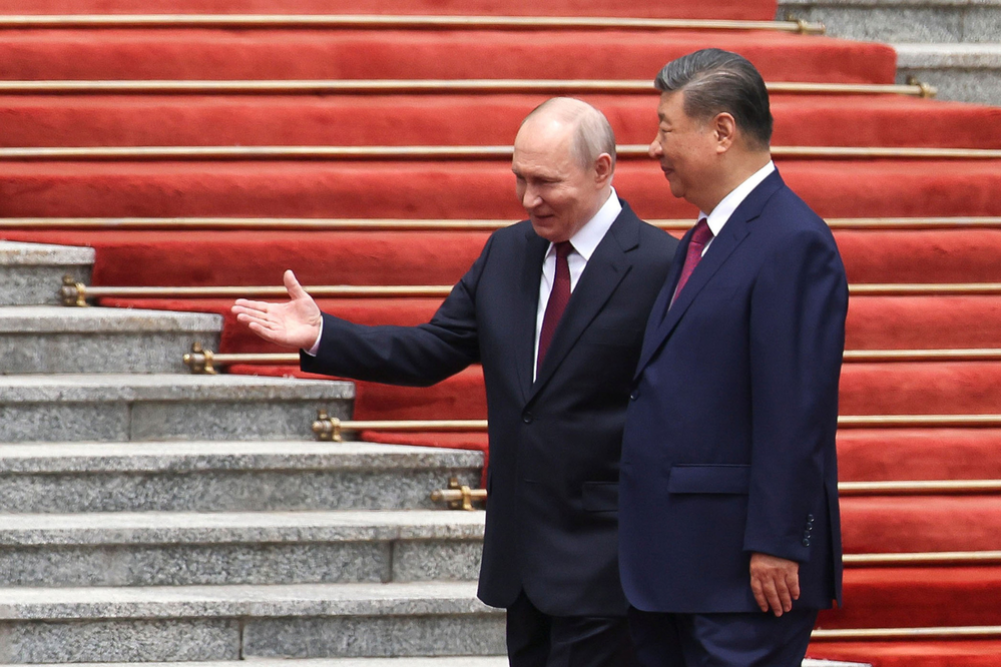
During the talks, Xi indirectly criticized the US, warning that ”unilateral and hegemonic tendencies are spreading uncontrollably.”
We use Google Cloud Translation Services. Google requires we provide the following disclaimer relating to use of this service:
This service may contain translations powered by Google. Google disclaims all warranties related to the translations, expressed or implied, including any warranties of accuracy, reliability, and any implied warranties of merchantability, fitness for a particular purpose, and noninfringement.
Chinese President Xi Jinping and Russian President Vladimir Putin met in Beijing, days after US President Donald Trump's visit to China, describing the Sino-Russian relationship as "solid" and "strategically strong." The two leaders signaled their intent to deepen their partnership as global politics becomes increasingly polarized.
Trump was given a grand welcome in Beijing last week when he visited China. But the visit was seen as a mixed bag after it failed to produce tangible results on key economic and security issues, including helping to reopen the Strait of Hormuz. Putin's visit to China, which followed shortly after, has been seen as an attempt to expand practical cooperation between the two countries.
Russia, which has been under pressure from Western sanctions, particularly over the Ukraine war, is increasingly dependent on China for energy exports. Moscow sees its relationship with Beijing as crucial to both its economic and strategic security as Western sanctions hit Russia's energy revenues.
Meanwhile, Russia is seeking to position itself as an alternative energy supplier after the US-Israeli war with Iran disrupted oil and gas supplies from the Middle East. Analysts say Putin is likely to push ahead with the proposed Power of Siberia-2 natural gas pipeline project to China via Mongolia during his visit. The project is seen as a land-based alternative to energy flowing through the Middle East via sea routes.
At the opening session of the talks at the Great Hall of the People in Beijing, the two leaders pledged to expand their "friendly cooperation" treaty, stressing the importance of their relationship. Xi said with Putin that "political mutual trust and strategic coordination have been continuously deepened."
Meanwhile, according to footage released by Russian media, Putin also mentioned that despite “adverse external circumstances”, Sino-Russian relations have “reached an unprecedented high level”. Although he did not name any country, this comment is seen as an allusion to the US.
Xi had indirectly criticized the US during the talks, warning that “unilateral and hegemonic tendencies are spreading uncontrollably”. In recent months, Beijing has intensified its series of receptions for world leaders as many countries have begun to move closer to China due to the uncertain policies of the Trump-led US.
Sino-Russian relations have become closer since Russia launched its invasion of Ukraine in 2022. Putin has been visiting China every year as the distance with Western countries has increased. In this context, Patricia Kim, an analyst at the Brookings Institution in Washington, has described the Xi-Putin relationship as a “relationship that does not require demonstrative assurances.” According to her, Putin’s visit is less glamorous than Trump’s, but its strategic importance is greater.
Xi had warmly welcomed Putin in September 2025, calling him an “old friend.” According to analysts, both China and Russia consider their relationship to be “structurally more stable and stronger” than the Sino-US relationship.
Beijing has been supporting negotiations to end the war in Ukraine. But despite presenting itself as a neutral party, China has not openly criticized Russia’s military actions. On the other hand, Russia seems to be heavily dependent on trade and energy transactions with China to maintain the necessary economic basis for the war. According to Lyle Morris of the Asia Society, Putin does not want to lose China’s support.
However, there are some differences in the priorities of China and Russia regarding the Middle East war. Russia is seen as seeking to profit from the closure of the Strait of Hormuz, which has sent oil prices soaring. Russian Foreign Minister Sergei Lavrov said after meeting Xi in April that Russia could fill China's energy gap if the Middle East crisis affected global energy supplies.
But China has been in favor of an early end to the Middle East war. In talks with Putin, Xi said further hostilities in the Middle East were "unacceptable" and stressed the need for a "comprehensive ceasefire."
According to James Char of Nanyang Technological University in Singapore, China depends on the smooth operation of the world's major sea lanes to maintain its economic activity. Therefore, Beijing wants the tension in the Strait of Hormuz to end as soon as possible, he said.