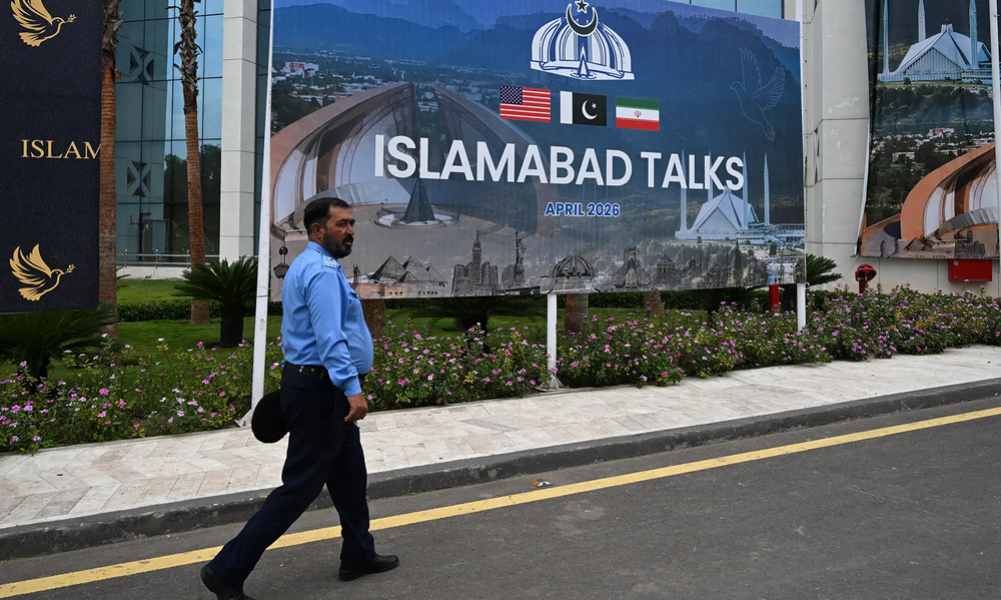
Iran has said that while the two countries have reached an understanding on many issues, differences remain on two or three important issues.
We use Google Cloud Translation Services. Google requires we provide the following disclaimer relating to use of this service:
This service may contain translations powered by Google. Google disclaims all warranties related to the translations, expressed or implied, including any warranties of accuracy, reliability, and any implied warranties of merchantability, fitness for a particular purpose, and noninfringement.
The US and Iran held direct talks in Islamabad, Pakistan, for 21 hours, but no solution was reached. In the end, representatives from both countries returned to their respective countries without any concrete results, thanking Pakistan for mediating the talks. US Vice President JD Vance said that the US had failed to get Iran to agree to its terms.
‘We had made our point clear. But we could not get them to agree,’ he said. Iranian Foreign Ministry spokesman Esmail Baghai said that although the two countries had reached an understanding on many issues, differences remained on two or three important issues. He said that the talks, which were held in an atmosphere of distrust and suspicion after a 40-day war, could not be expected to yield immediate concrete results.
But he also indicated that dialogue would remain open in the future. The Iranian side raised issues such as a permanent end to the war, the issue of nuclear proliferation, control of the Strait of Hormuz, and compensation for the destruction caused by the war during the talks. The Fars News Agency reported that the talks could not take place due to differences on these issues.
This is the first time that an Iranian delegation has held direct talks with the US since the Islamic Revolution in 1979. All previous talks were indirect. That is why the rest of the world was hoping that these talks would convey some positive message. The main reason why the rest of the world is as interested in these talks as Iran and the US is because of the global energy crisis and price hike it has caused.
After the US and Israel attacked it on February 28, Iran has blocked the Strait of Hormuz. About 20 percent of the world's crude oil and natural gas are exported to the rest of the world through this strait in the Persian Gulf region. After Yemen's Houthi rebels announced their support for Iran in the war and blocked the Red Sea, fuel and essential supplies have not been supplied to North Africa from Saudi Arabia. This has caused a fuel crisis in Asian and African countries.

The impact of this war has been seen even in Nepali kitchens. There is a shortage of cooking gas (LPG) in the market. Petrol and diesel prices have been rising steadily since the war began. Nepal has been given two public holidays a week to reduce fuel consumption. Iran's attack has damaged energy centers in Qatar, one of the largest exporters of natural gas, and other Gulf countries. Due to this, even if the Strait of Hormuz is opened, there is a risk that the fuel and fertilizer problem will not be solved immediately. Because raw materials for fertilizers come from Qatar to India. And, India processes and exports fertilizers to Nepal. Farmers in other South Asian countries like Nepal and India are also very worried.
There is a rise in diesel and petrol prices and a shortage of LPG gas in all South Asian countries, including India, Pakistan, and Sri Lanka. Pakistan, which has been mediating the talks, is forced to implement a rule that markets and shopping malls must close by 8 pm due to fuel shortage. Almost half of the government employees have been forced to work from home since the war began. Sri Lanka has declared three public holidays a week. Earlier, Saturdays and Sundays were public holidays in Sri Lanka. Now, Wednesdays have also been declared holidays.
Japan and South Korea, which used to import crude oil from West Asia, are also facing fuel shortages. These countries, which had been reducing their use of coal in their industrial operations, have now returned to the situation of increasing their use of coal. The increase in prices has had a major impact on the United States. There are problems in the supply of materials such as plastics, medicines and electronics. China, the world's largest producer, used to purchase large quantities of crude oil from Iran. China is also Iran's largest trading partner. The blockage in the Strait of Hormuz has also not been able to supply China with sufficient supplies.
This has also affected European countries. European countries that have imposed an embargo on Russian oil are facing problems due to the lack of crude oil from West Asia. US President Donald Trump has claimed on the social network Truth that tankers of empty oil from Europe are coming to the United States. He also accused China and European countries of not having the courage to open the Strait of Hormuz. He has claimed that the United States alone will open this strait. The US Central Command in West Asia claimed that two US destroyers had passed through the Strait of Hormuz on Saturday while talks were ongoing. However, this was denied by Iran's Revolutionary Guard Corps. A standoff here could further strain the already troubled economy. That is why European countries had been in favor of opening the Strait of Hormuz through dialogue. But the attempt failed in Sunday's talks.
The war in Iran and Lebanon has displaced as many as 3.2 million people, according to the United Nations High Commissioner for Refugees (UNHCR). Human rights activists are facing difficulties in delivering humanitarian relief and rescue supplies to Lebanon and Gaza. Both Israel-US and Iran are continuously attacking energy centers and public infrastructure. Attacks on water treatment plants in Arab countries facing acute water shortages are putting lives at risk.
Nearly 3,000 people have been killed in Iran and 2,000 in Lebanon. A large number have been injured. The death toll in Israel and the Arab world is also high. A report by the United Nations Development Programme (UNDP) has projected that the war could cost Arab countries between 3.78 and 6 percent of their gross domestic product (GDP). This translates into losses of between $120 billion and $194 billion.
In North Africa, already fragile countries such as Sudan have been hit hard by the war. According to the World Food Programme, 41 percent of the population in Sudan is food insecure due to the civil war. At least one in five families are facing starvation. Aid supplies prepared by various donors for these countries have been forced to travel around the Cape of Good Hope and the Mediterranean Sea due to the Iran war, which has delayed and increased the cost of relief efforts.
Food prices in Somalia have risen by 20 percent. The country used to import a third of its fertilizer from the Gulf. However, the war in West Asia during the harvest season is set to affect grain production here. This seems to be worsening the problem. According to Doctors Without Borders, almost a third of the population here is now facing food insecurity.
In Southeast Asia, the price of diesel has increased by 81.6 percent since the war began in the Philippines. The government has already declared an energy emergency. Private hospitals are preparing to increase prices by 5 percent because the process of operating diesel-powered generators and supplying medicines is expensive. It has also created a global problem in the operation of health equipment and the supply of medicines.
Kristalina Georgieva, Managing Director of the International Monetary Fund (IMF), has said that the situation after the war is not as easy as it was before. ‘Even if everything goes well, it is difficult to return to the previous situation. "The sharp rise in energy prices, damage to infrastructure such as roads and industries, disruptions to supply chains and loss of confidence in markets have had a major impact on global economic growth. All of this will take time to recover," she said. Stating that the IMF's previous global economic growth forecast would not be achieved, she said that $42.9 billion has been set aside for emergency assistance.
Similarly, she warned that an additional 45 million people would face food insecurity this year. In such a situation, the number of people suffering from hunger and poverty in the world would exceed 360 million. She said that poor and energy-importing countries would be the most affected by this crisis. Meanwhile, World Bank President Ajay Wanga has said that up to $25 billion in short-term assistance can be provided to developing countries. He said that the World Bank plans to provide up to $60 billion in long-term assistance.
(with the support of the agency)