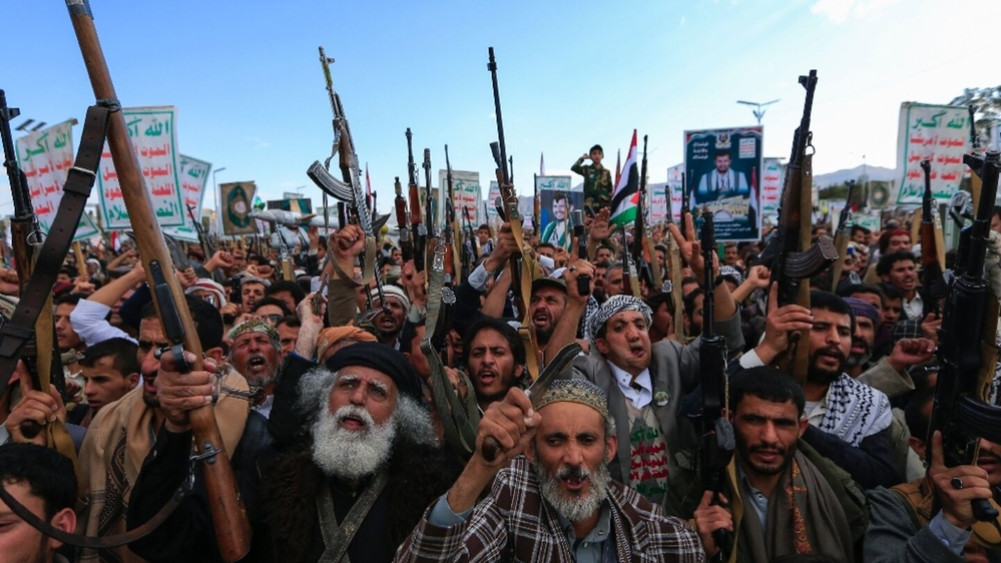
The Houthi entry into the war is considered meaningful because of its ability to control the Red Border.
We use Google Cloud Translation Services. Google requires we provide the following disclaimer relating to use of this service:
This service may contain translations powered by Google. Google disclaims all warranties related to the translations, expressed or implied, including any warranties of accuracy, reliability, and any implied warranties of merchantability, fitness for a particular purpose, and noninfringement.
Agency — Yemen's Houthi rebels have also been involved in the ongoing war between the US-Israel and Iran. The Houthis have fired missiles at Israel in support of Iran.
Houthi Brigadier General Yaya Sare said that they will participate in this war until their goal is achieved. He said that sensitive Israeli military infrastructure was targeted.
The Israeli army said that the missile fired by the Houthis was intercepted. Sirens sounded as a warning on Friday night after the Houthis attacked around Beer Sheba and near Israel's main nuclear research center.
Israel and West Asian countries have been accusing Iran of spreading regional instability by supporting rebel organizations.
Iran's ally Hezbollah has been fighting Israel in Lebanon since March 2. In response, Israel has been attacking Hezbollah-dominated southern Lebanon. More than 1,100 people have died in Lebanon so far.
The Houthis are a major organization close to Iran. Iran has been accused of providing training, weapons and financial support to the Houthis, a radical Shiite Islamic organization founded in Yemen in 1994.
Like the Iranian regime, this organization is anti-Israel and anti-American and promotes Islam.
Yemen's civil war erupted in September 2014 when the Houthis captured the capital Sanaa. The Houthis have so far established themselves as the main force in the civil war by taking control of large parts of the country.
In the process, the group's fighters have been accused of serious human rights violations such as killings, looting, robbery and rape. The group denies this.
The US designated the group a Specially Designated Foreign Terrorist Organization from January 10 to February 16, 2021. However, the Biden administration temporarily removed the Houthis from the list after it became apparent that humanitarian aid supplies would be difficult to deliver to Yemen.
Donald Trump signed an executive order on January 22, 2025, two days after taking office as acting president for the second time, to designate the Houthis as Specially Designated Foreign Terrorist Organizations. The order, which went into effect on March 4, remains in effect.
The Houthis adopted a “wait and see” policy for a while after the US-Israeli attack on Iran on February 28. However, the Houthis have stated that they are forced to participate in the war as it has disrupted the regional and global economies.
‘This operation is being carried out in conjunction with the operations carried out by our brothers, the militants in Iran and Hezbollah in Lebanon,’ the Houthis said, ‘This operation has successfully achieved our goal.’
At risk of a Red Sea blockade
Saudi Arabia currently sends a limited amount of fuel to the outside world via a pipeline through the Red Sea.
The Houthis’ control of Yemen’s maritime territory has made the Houthi entry into the conflict a significant one. It could pose a major challenge to major oil exporter Saudi Arabia.
The Red Sea is considered a vital trade corridor between Asia and Europe. $1 trillion worth of goods pass through the strait annually.
Ten percent of all crude oil traded by sea passes through the Bab el-Mandeb strait. The chokepoint is very narrow. It is only 16 miles wide and separates the Arabian Peninsula from the Horn of Africa. The Houthis previously attacked commercial ships passing through the Red Sea in October 2023 in response to the Israeli-Hamas war in Gaza. The United Nations Agency for Trade and Development estimates that by mid-2024, shipping through the Red Sea, the Suez Canal and the Mediterranean would have fallen by 70 percent. The U.S. Energy Information Administration estimates that crude oil shipments through the Bab el-Mandeb Strait had fallen by half. The Houthis could create a similar obstacle this time, Fawaz Georges, a professor at the London School of Economics, told NBC News. The Houthis are not a limited war. This is a conflict that spans the entire region,” he said. “My concern is that it is no longer just a military conflict but an economic war that involves supply chains. The global energy system and sea lanes are interconnected.”
“With Saturday’s attack, the Houthis have sent a message to the Americans and the Israelis about what can happen next,” he added.
In March last year, US President Donald Trump launched a massive bombing campaign against the Houthis. The nearly six-week war before the ceasefire ended cost US$1 billion in bombs and missiles.
The US has carried out air and sea strikes on more than 1,000 targets. On May 6, 2025, US President Donald Trump announced a ceasefire, saying the Houthis had accepted defeat.
After the ceasefire brokered by Oman, the Houthi group did not attack the American ship, but continued to attack Israeli ships. The region, which has been affected by the war for a long time, only began to return to its original number in December.
Iran has also indicated that it may attack this waterway. Until recently, the American warship Gerald Ford was stationed in the region. But after a fire incident on the warship, the warship went to the coast of the Greek island of Crete for repairs.
Iran warned on Monday that it would target infrastructure supporting groups associated with this warship.
Although Trump said that he would stop attacking Iranian energy infrastructure for a few days, both sides in the war have not stopped attacking each other.
Earlier, Trump claimed that talks with Iran were in the final stages. But Iran has denied this claim.
Some US troops were injured in an Iranian missile attack on Saudi Arabia's Prince Sultan Air Base on Friday, a US military source said.
However, none of the soldiers were in serious condition, the source told NBC News. At least one aircraft was damaged in the attack.
At least 303 US troops have been injured in the war with Iran so far. 10 of them are in critical condition. As of Thursday, at least 1,937 people had been killed and more than 25,000 wounded in Iran, Iran's Deputy Health Minister Ali Zafarin told Al Jazeera.
Pakistan to host regional talks
Pakistan is set to hold two-day talks between Saudi Arabia, Turkey and Egypt on the Iran-Iran war starting Sunday. The foreign ministers of the four countries are expected to hold in-depth discussions on reducing regional tensions, Islamabad's foreign ministry said.
Islamabad has sought to present itself as a potential venue for US-Iran talks.
Turkish Foreign Minister Hakan Fidan said the meeting would explore ways to prevent war.
“Where is the agreement on this war? How have the four countries handled the situation? We will discuss what can be done,” Fidan said.
Earlier, Pakistan had sent Iran a 15-point ceasefire proposal on behalf of the US. Iranian officials have been indicating that any agreement could be reached in Pakistan or Turkey.