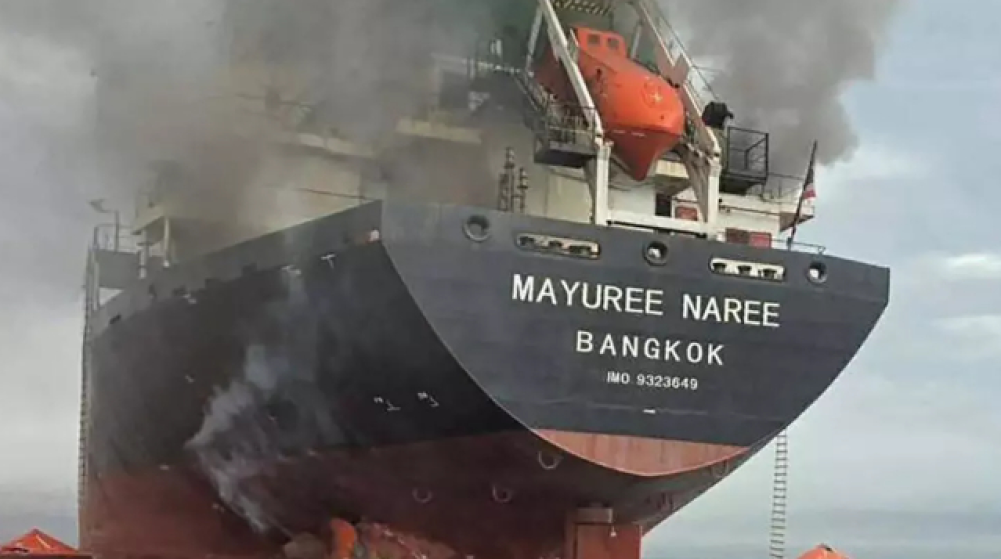
The US has accused Iran of laying sea mines around the Strait of Hormuz.
We use Google Cloud Translation Services. Google requires we provide the following disclaimer relating to use of this service:
This service may contain translations powered by Google. Google disclaims all warranties related to the translations, expressed or implied, including any warranties of accuracy, reliability, and any implied warranties of merchantability, fitness for a particular purpose, and noninfringement.
A Thai ship heading to India through the Strait of Hormuz has been attacked. The ship had left the UAE's Khalifa Port. The 20 crew members on board have been rescued by the Omani Navy. The ship has been brought to an Omani port. Earlier on Wednesday, a Japanese-flagged ship was also attacked in the Hormuz area. The Japanese company said that no one on board was injured and there was no damage to the ship. A ship was also attacked about 50 miles northwest of Dubai. All three ships were hit by missiles. But no one has claimed responsibility for the attack. Iran had earlier said that it would target ships of the US, Israel and their allies traveling through the Strait of Hormuz. ‘Ships belonging to America, the Jewish state or their despicable allies will be targeted,’ the Iranian military’s central command had said. The military had reiterated its claim that not a single liter of oil would be allowed to escape from the Strait of Hormuz.’ Meanwhile, the US has accused Iran of laying sea mines (underwater bombs) around the Strait of Hormuz. Among the ships destroyed in the US attack on Tuesday, 16 were minelayers, according to the US Central Command (Centcom), the US military command responsible for the Middle East. Earlier on Tuesday, US President Donald Trump had said on the social media platform Truth Social that if any attempt was made to lay a bomb, it would be removed immediately.
On Monday, he had warned that Iran would increase its attacks by 20 times if any attempt was made to block the Strait of Hormuz. About 20 percent of the world's crude oil and natural gas used to exit the Middle East through this waterway.
Before the war, Saudi Arabia, Iraq, the UAE, Kuwait, Qatar and Bahrain used to send their oil and gas to the world market through the huge Strait of Hormuz.
'The work of planting bombs has not been done in detail yet. In the last few days, only a few dozen places have been planted.' However, even now, 80 to 90 percent of the small boats and ships in the area are Iranian,' CNN wrote, citing a source, 'that is why this unit can plant hundreds of bombs underwater.'
Iran's conventional navy and the paramilitary Islamic Revolutionary Guard Corps are currently maintaining control of the Strait of Hormuz.
They have said that they will attack ships passing through here. The closure of the Strait of Hormuz has led to a fuel crisis in the world market. Due to this, there has been a fluctuation in fuel trade.
There is a shortage of cooking gas and fuel in South Asian countries. The hotel and tourism sector has come to a standstill in Mumbai, Bangalore, Delhi, Goa, Punjab and other areas of India.
After oil supplies from West Asia have stopped, India is going to import oil from Russia again. The US, which had previously been pressuring India not to buy Russian oil, has given it a waiver to buy oil from Russia as long as the Middle East crisis persists.
Pakistan, which is highly dependent on UAE and Saudi oil, is facing a crisis of both gas and oil. The price of petrol and diesel here has increased by 55 Pakistani rupees. People have also had to stand in long lines to fill up with expensive oil.
Pakistan's Prime Minister Shehbaz Sharif on Monday announced a series of measures to reduce fuel consumption. These include school holidays and reduced working hours for government employees.
Primary and secondary schools across Pakistan are scheduled to be closed for two weeks from Monday. The government has said that colleges and universities will operate online.
Government offices, except for banks and essential services, will operate only four days a week. Half of the employees will work from home. According to Radio Pakistan, government vehicles, except ambulances and public buses, will be allowed to refuel at half the rate they used to.
The rule will be in effect for two months. Prime Minister Sharif also said that cabinet ministers and advisers will forgo their salaries and allowances. The purchase of new vehicles has also been banned before June 2026.
In Bangladesh, universities and schools have also been given long holidays. The government has said that this decision has been taken for fuel security. Nearly 95 percent of Bangladesh's oil and gas comes from abroad. There is also a shortage of electricity here. People have been urged to consume electricity and fuel economically.
Major attack in Iran
The most serious attack since the war began in Iran on Tuesday evening. The US and Israel had deployed a large number of fighter jets. Locals said that they felt a threat that shook the ground.
The public said that they were terrified by the continuous explosions. Cities including Isfahan and Karaj have also been targeted.
Al Jazeera wrote about the horrific situation on Tuesday night, quoting residents of west Tehran, 'For the first 15 minutes, it seemed like dozens of fighter jets were flying directly overhead. After a few minutes, it was quiet.' A new round of attacks would have started again.'
A local resident, who asked not to be named, said, 'The ground, the glass and even our hearts were shaking. But we took shelter in the bathroom and spent the night there.'
Some locals also filmed the attack from their rooftops and balconies. Videos posted online show a bright blue light at night, which is believed to have been caused by damage to power generation infrastructure.
Since the war began, the US and Israel have accused each other of attacking more than 10,000 civilian areas in their country.
Schools, hospitals, power plants, residential areas and other areas in Iran have been damaged by bombs. More than 1,200 people have been killed. Israel is also continuing its attacks on Beirut in southern Lebanon.