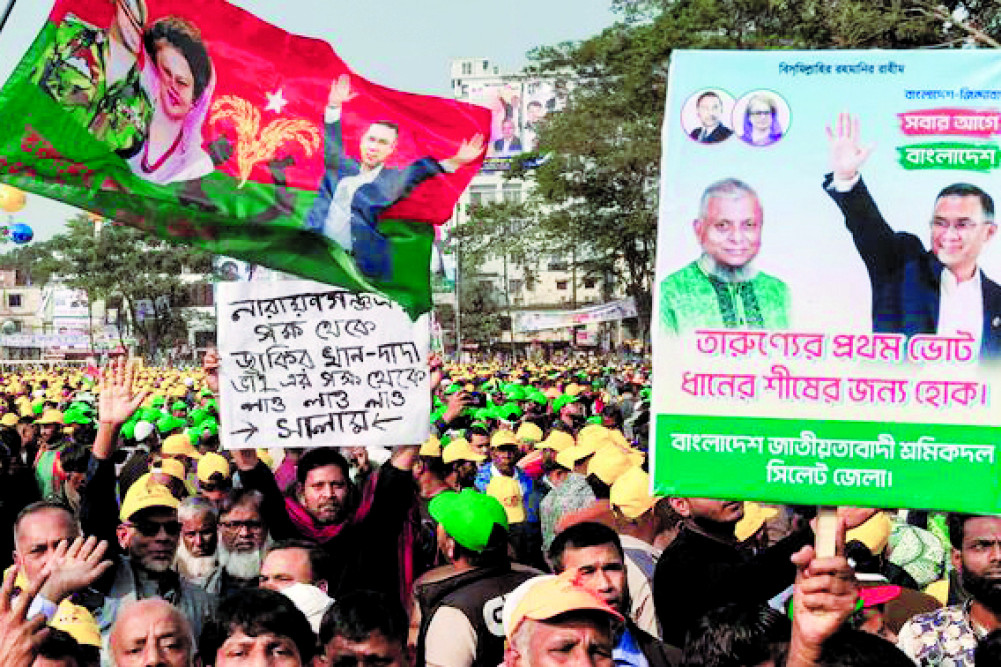
The upcoming elections in two years are being viewed with expectations that they will determine the political future of the country in Bangladesh and the proposed political reforms demanded by the July Movement.
We use Google Cloud Translation Services. Google requires we provide the following disclaimer relating to use of this service:
This service may contain translations powered by Google. Google disclaims all warranties related to the translations, expressed or implied, including any warranties of accuracy, reliability, and any implied warranties of merchantability, fitness for a particular purpose, and noninfringement.
In the next 9 days, i.e. on 29 Magh, voting will be held in 42,000 centers for 350 seats in Bangladesh. In Nepal, new elections are being held on 21 Falgun after the Gen-G uprising, while in Bangladesh, elections are being held a year and a half after the Sheikh Hasina government was ousted by the youth student movement in August 2024. The interim government led by Nobel laureate Mohammad Yunus is going to hold the elections.
Bangladesh is going to hold elections after a decade and a half in the absence of Hasina, who has ruled Bangladesh for more than a decade. According to Bangladesh Election Commission officials, 120 million voters are eligible to vote in this election. This election is being seen in Bangladesh with the expectation that it will determine the political future of the country on the one hand and the proposed political reforms on the other. And, it is also being considered as the world's biggest election to be held in 2026.
Gen-G voters are decisive
Hasina-led rule was removed by the movement led by young students there. And in the upcoming elections, the same young students will be decisive in who will be brought to the top of politics. According to Bangladesh Election Commission data, 43.56 percent of the voters are young people aged 18 to 37, most of whom are voting for the first time.
This election is also being seen as a referendum on the 'July Charter'. A 'blueprint for political reforms' was prepared in July 2025 after the student movement. The draft includes issues such as curtailing the powers of the executive, increasing the independence of the judiciary, strengthening the Election Commission and preventing political abuse of law enforcement agencies. The charter will also be voted on at polling stations. Young voters are expected to be decisive in this. The charter has been signed by 25 of the 52 registered parties in Bangladesh. However, its supporters have stressed the need for a referendum to implement it. According to the Bangladesh Telecommunications Regulatory Authority, 130 million of the 170 million population use the internet. Many of these are young people.
The two main parties have given importance to ‘digital campaigning’ to influence their voters online. The Bangladesh Nationalist Party (BNP) has launched a website called ‘Match My Policy.com’, where voters can express their agreement and disagreement with its policy proposals.
If the party wins the election, it will implement the revised policy with the expressed opinions there.
Another party, Jamaat-e-Islami, has also launched a website called 'Jantaristehar.org'. It had sought suggestions from voters from here to prepare its election manifesto. According to Mubashar Hassan, a fellow at Western Sydney University, these two parties have adopted different election strategies. According to him, the BNP's online materials, short videos, videos and cards promote its party policies.
On the other hand, Jamaat-e-Islami is also creating digital materials against the BNP, saying that it is no different from the Awami League, and is placing special emphasis on materials with anti-India sentiments to lure voters.
Due to the ban on the general election to be held after a decade and a half, Hasina and her party, the Awami League, will not be seen in the election field. In fact, Hasina, who fled the country to India, has been sentenced to death. After the ban on the party that has ruled Bangladesh continuously for more than a decade, there will be only a two-polar competition in the elections here. On one side will be a BNP-led alliance, and on the other side, a Jamaat-e-Islami-led alliance.
Who are the prime ministerial contenders?
Tariq Rahman, son of the late former Prime Minister of Bangladesh Khaleda Zia and BNP chairman, is seen as the main contender for the prime minister's post. BNP supporters have been campaigning for him as the main contender for the prime minister's post at election rallies. Similarly, Jamaat-e-Islami, which is leading a coalition of 10 parties, has made a strategy to expand its influence in this election. If this party, which has faced widespread repression during Hasina's 15-year rule, wins, it will be considered a dramatic development.
This party is considered to be conservative towards secularism. Secularists in Bangladesh, which has one of the largest Muslim populations in the world, will criticize this party. (With the help of the agency)