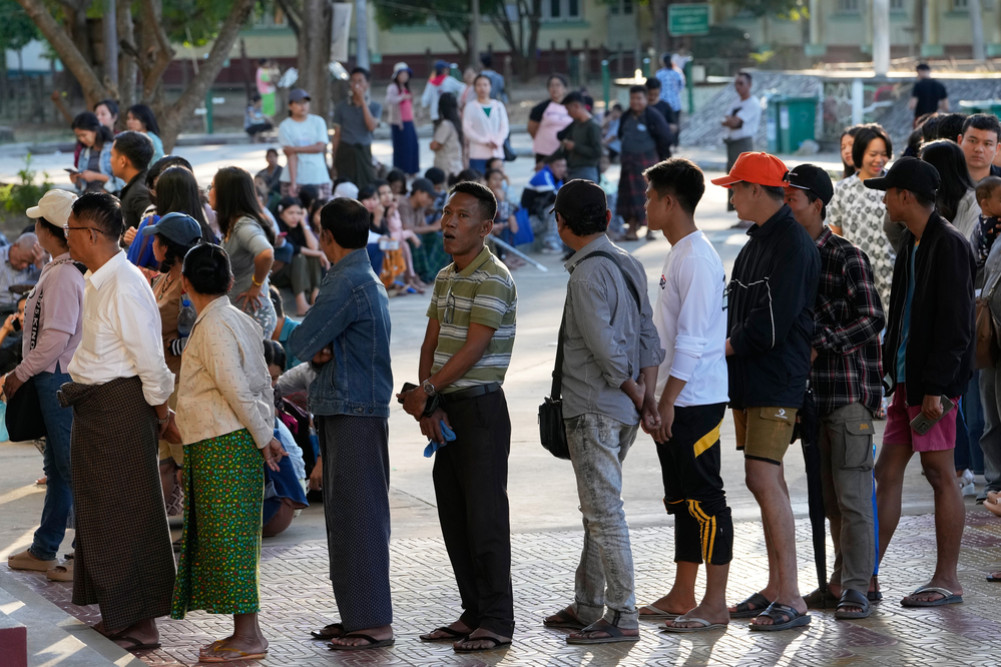
Voting will be held in 102 of the 330 constituencies in the first phase on Sunday, with the rest taking place in the second and third phases. Voting will not be held in 65 rebel-held constituencies.
We use Google Cloud Translation Services. Google requires we provide the following disclaimer relating to use of this service:
This service may contain translations powered by Google. Google disclaims all warranties related to the translations, expressed or implied, including any warranties of accuracy, reliability, and any implied warranties of merchantability, fitness for a particular purpose, and noninfringement.
Myanmar held its first round of general elections on Sunday, five years after the military seized power. The second round is scheduled for January 11 and the third round for January 25. Analysts have described the election as a “showdown.”
Richard Hersey, a Myanmar analyst at the International Crisis Group, said the military will remain in power because the same group that staged the coup five years ago is holding the election. “This election is not credible,” he told the Associated Press. “They have not included any political party that has done well in previous elections.”
Myanmar’s military government is directly supported by China and Thailand, and indirectly by India. Independent observers say the government is trying to maintain support by holding a sham election to give it a democratic and legitimate look. “Many fear that this election will install those responsible for years of extrajudicial killings,” said Joy Freeman, a researcher at Amnesty International.
Western countries have imposed sanctions on Myanmar due to its harsh repression of the opposition and undemocratic measures. There is even a travel ban on the ruling generals. Western countries have not sent observers to the election. Observers have come from China, India, Russia, Kazakhstan, Belarus, Cambodia, Vietnam and Nicaragua.
The military previously took power on 1 February 2021. The military claimed that the 2020 election results were invalid because Aung San Suu Kyi's National League for Democracy party rigged the voter registration process. The mastermind of the plot and military leader Min Aung Hlaing has called the election an opportunity for national reconciliation.
Voting under the shadow of civil war
Explosions and airstrikes were reported in several parts of the country as voting was underway on Sunday, according to the BBC. Three people were taken to hospital after a rocket attack on a house in Mandalay region on Sunday morning, the region's chief minister told the BBC. Earlier, a series of explosions damaged more than 10 houses in Myawaddy township, near the Thai border, late on Saturday night.
Voting is underway in 102 of the 330 townships on Sunday. The remaining townships will vote in the second and third phases. Voting will not take place in 65 townships held by the rebels. This has formally excluded at least 20 percent of the population from the electoral process. Since the military ruler will come to power, there is no incentive for the large population to vote. A total of 57 parties, including six national parties, have fielded candidates in this election. Most of the candidates are former soldiers or close to the military. The United Solidarity and Development Party, led by former soldiers, is expected to win the most seats.
A total of 1,100 seats are being contested in three phases, including the two chambers of the National Assembly, state and regional assemblies. About 5,000 candidates have filed for this. Myanmar's 80-year-old leader Aung San Suu Kyi and her party are not participating in this election. She is serving a 27-year prison sentence. The National League party she leads was dissolved after it refused to register under new military rules. Other parties have also boycotted the election. Alem Bir, an analyst with the Asian Network for Free Elections, said that the major parties of 2020 are no longer in existence. Many leaders of major political parties are in prison.
5 years of military rule
Repression and resistance: The military has been repressing democratic views for a long time since it seized power in February 2021. Since October 2023, opposition groups have been organizing a joint resistance against the military. Since then, the death toll has been high. According to the Independent Support for Political Prisoners, more than 22,000 people are being held for political crimes. More than 7,600 civilians have been killed by security forces since they seized power.
The United Nations office has stated that civilians in conflict-affected areas have had to live in fear of security forces and opposition groups. The military has also carried out airstrikes on schools, hospitals, religious sites and camps for displaced people.
Refugee: More than 5 million people have been displaced within the country since the military took power, according to a recent UN report. Internally displaced people lack critical assistance and protection. Public services have been severely affected, with more than half of the country without access to electricity and hospitals out of service in conflict-affected areas. According to the latest UN report, 1.5 million of the displaced have fled the country, while 3.5 million have been internally displaced. The worst hit is in Rakhine state, where nearly 1.7 million Rohingya have been displaced.
Economic growth stalled: Myanmar's gross domestic product has been in a steady decline since 2020. The size of GDP has shrunk by 23.3 percent in the last 5 years, and international organizations estimate that it will shrink by 25 percent by 2026. This has reversed the economic progress of the previous decade. Inflation is high. Various countries have imposed economic sanctions. The illegal economy is thriving. That has made the Buddhist-majority country one of the world’s leading producers of opium, heroin and methamphetamine.
Illegal casino operations and human trafficking are flourishing across the country’s open borders. Hunger is rampant. Agricultural productivity has fallen by 16 percent since 2021. Both conflict and climate-related disasters have hit the agricultural sector. Fertilizer shortages, soaring fuel prices and trade barriers have caused rice prices to soar in some areas. The western state of Rakhine is particularly vulnerable to famine.
Outmigration: The economic and security situation is causing Myanmar’s youth to flee the country in droves. Many are heading to Thailand. The number of school and college dropouts is also rising. The government is at risk of forcibly conscripting young people into the military, according to a United Nations report.
(with agency support)