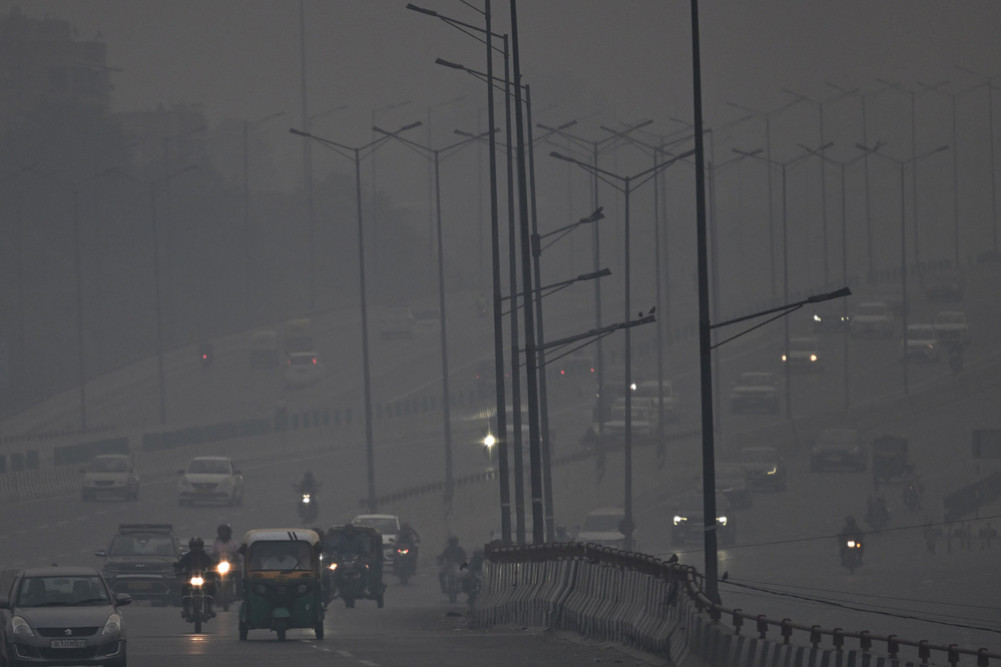
The aim of this campaign is to remove harmful smog and particles from the atmosphere through artificial rain and bring urban pollution under control.
We use Google Cloud Translation Services. Google requires we provide the following disclaimer relating to use of this service:
This service may contain translations powered by Google. Google disclaims all warranties related to the translations, expressed or implied, including any warranties of accuracy, reliability, and any implied warranties of merchantability, fitness for a particular purpose, and noninfringement.
India on Thursday conducted its first cloud seeding experiment in the capital New Delhi. The mission aims to remove harmful smog and particles from the atmosphere through rain and bring down pollution in the city.
Cloud seeding is the process of firing salt or other chemicals into clouds from aircraft to induce rain. This technique is already being used by some countries around the world to reduce atmospheric pollution by artificially causing rain.
New Delhi authorities, in collaboration with the Indian Institute of Technology (IIT) Kanpur, began testing the aircraft using a Cessna light aircraft in Burari, a northern area of the city, on Thursday afternoon.
Delhi Minister Manjinder Singh Sirsa said in a statement, "Today, a test flight of cloud seeding was completed, in which chemical particles were fired into the clouds using flares." According to him, the flight evaluated the capabilities of the aircraft, the endurance of the equipment, the coordination mechanism and the necessary preparations for cloud seeding.
Delhi Chief Minister Rekha Gupta said, "If the weather remains favourable, Delhi will experience its first artificial rain on October 29." She called the project "an important step towards bringing back clean air" for Delhiites.
However, the details of the chemicals used in the test were not immediately made public.
New Delhi, with a population of over 30 million, is considered one of the most polluted capitals in the world. Every winter, the city is blanketed in thick smog. Cold air traps pollutants close to the ground, which mixes with crop burning, industrial fumes and traffic emissions to create a deadly mix of pollution.
Fine particles called A: 2.5, which are small enough to enter the bloodstream and can even cause cancer, are sometimes found in concentrations up to 60 times the UN's daily health limit.
Pollution levels have risen further this week after fireworks during the Diwali festival. The level of A: 2.5 has reached 56 times the limit, according to the monitoring organization 'IQAir'. The increase comes after the Supreme Court had already lifted the complete ban and allowed 'green crackers', i.e., less polluting fireworks.
On Thursday morning alone, the level of A: 2.5 had reached 154 micrograms per cubic meter in some areas of New Delhi. This is 10 times higher than the World Health Organization's recommendation.
A study conducted in September concluded that even the historic Red Fort in Delhi is turning black due to pollution. A joint team of Indian and Italian scientists, in a study published in the Heritage journal, has warned that the Red Fort, a UNESCO World Heritage site, is continuously covered with a black crust and is deteriorating.
Cloud seeding technology, developed in the 1940s, has been used by various countries for decades to reduce drought, control forest fires and remove fog in air transport. China used this technology to stop rain in Beijing during the 2008 Olympics.
But scientists are divided on the effectiveness of this technology. Some research has shown that cloud seeding does not produce the expected results and has unintended effects in areas other than the targeted area. Therefore, scientific evaluation is still pending on whether Delhi's effort will be successful.