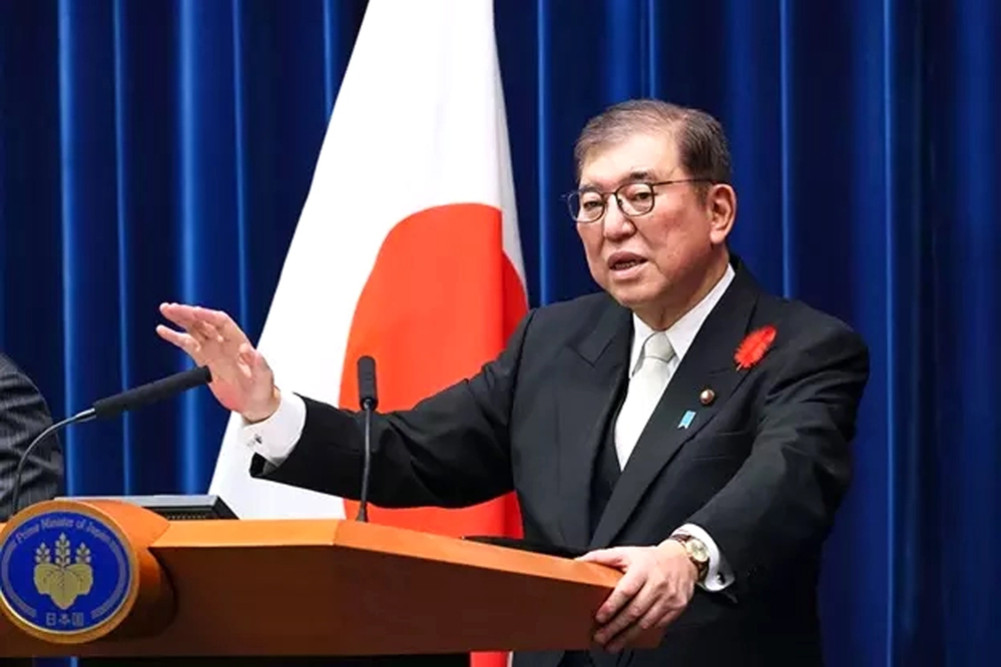
Senior LDP leader Sanai Takaichi and Agriculture Minister Shinjiro Koizumi are seen as competitors for the future leadership.
We use Google Cloud Translation Services. Google requires we provide the following disclaimer relating to use of this service:
This service may contain translations powered by Google. Google disclaims all warranties related to the translations, expressed or implied, including any warranties of accuracy, reliability, and any implied warranties of merchantability, fitness for a particular purpose, and noninfringement.
Japanese Prime Minister Shigeru Isiba has resigned as the chairman of the ruling Liberal Democratic Party (LDP). It has been analyzed that Isiba's resignation will prolong the political transition that has been going on for a few months in Japan, which is the fourth largest economy in the world.
The 68-year-old Isiba also asked his party LDP to start the process of selecting the future leadership while holding a press conference on Sunday. The LDP has been leading the government for most of the time since World War II. It is said that with Isiba's decision to resign from the post of party chairman, the leadership of the government will also change.
Isiba, who has been leading the government for about a year, had to face the defeat of the ruling coalition in the parliamentary elections during this period. After the defeat in the parliamentary elections, there was intense pressure on him to leave the leadership of the party. However, until a few days ago, he was insisting that he would not resign and that he was focusing on a new trade agreement after resolving the dispute with the US. The American decision to increase the 'tariff' on products including Japanese cars has caused a great stir in the Japanese car industry. This is projected to have a negative impact on Japan's economy.
"Since Japan has signed a trade agreement and the president has signed an executive order, we have crossed an important hurdle," Isiba said at a press conference, "I want to hand over power to the next generation." Due to political uncertainty, the value of the Japanese currency yen fell sharply last week. It was widely believed that Isiba would be out of power after the LDP scheduled voting for the leadership election on Monday.
The senior leader of LDP, Sanai Takaiji, is seen as Isiba's successor, according to the Japanese media. She is considered to be a supporter of loose financial and monetary policy. Takaiji also criticized the Bank of Japan's decision to increase interest rates. Isiba defeated Takaichi by a narrow margin in the LDP leadership race last year. Similarly, Agriculture Minister Shinjiro Koizumi is also seen as a competitor for the Prime Minister. "There was a lot of pressure on Isiba to resign after LDP's repeated election defeats, so his resignation is natural," said Kazutaka Maeda, an economist at the Meiji Yasuda Research Institute.
Since there is no majority of any party in the parliament, there is no guarantee that the LDP president will become the prime minister. Some analysts have also speculated that the future leadership may call for elections for a fresh mandate. However, in a survey published by the Kyodo news agency on Sunday, about 55 percent said there was no need for early elections. Isiba's final task as Prime Minister will be to finalize the trade agreement signed with the US last week. According to the agreement, Japan will invest 550 billion dollars in the US in return for reducing customs duties.