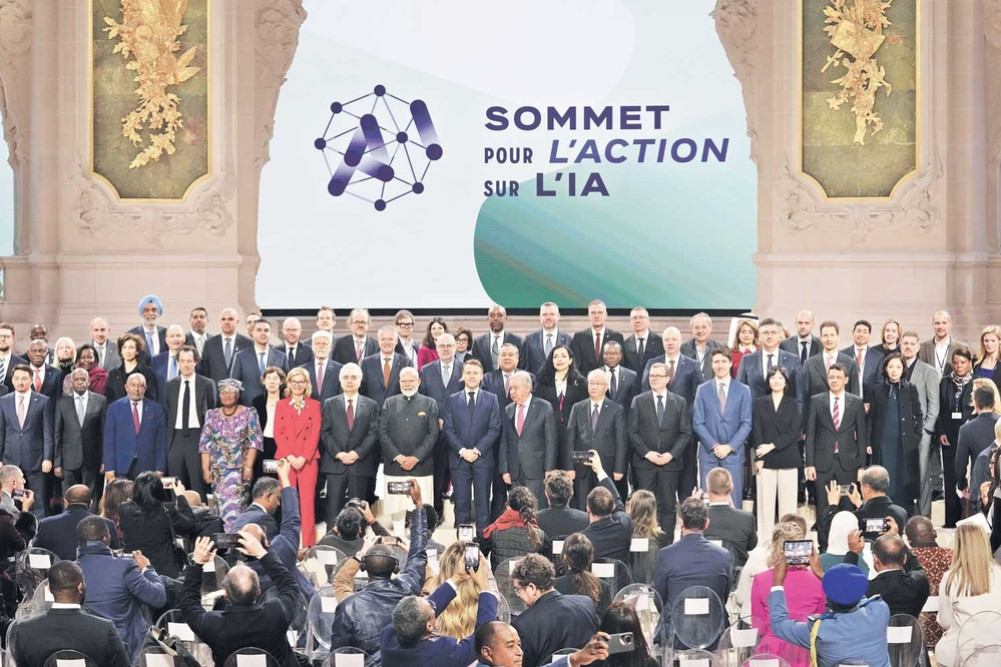
US Vice President Vance has criticized efforts to over-regulate the AI sector, refusing to sign the resolution saying it could hinder the development of AI.
We use Google Cloud Translation Services. Google requires we provide the following disclaimer relating to use of this service:
This service may contain translations powered by Google. Google disclaims all warranties related to the translations, expressed or implied, including any warranties of accuracy, reliability, and any implied warranties of merchantability, fitness for a particular purpose, and noninfringement.
The 'World AI Conference' in Paris, the capital of France, was held on Tuesday with the participation of the top leaders of America, India, European Union, France, China and other countries. The two-day conference was attended by government representatives from 80 countries, leading companies, developers and experts in the field of AI. The United States and Britain refused to sign a joint communique preamble to the conference, while the European Union signaled that it would be somewhat lenient on AI regulation.
Indian Prime Minister Narendra Modi was present as co-chairman in the conference chaired by French President Emmanuel Macron. US Vice President JD Vance, Chinese Vice Premier Zhang Jiaoqing, European Commission President Ursula von der Leyen and others participated as speakers. US Vice President Vance and UK Secretary of State for Science and Technology Peter Kyle did not sign the declaration on promoting inclusive and sustainable AI development at the
conference. Vance also stated that the European Union is tough on AI regulation and that this will affect innovation.
The Paris AI Conference held on February 10 and 11 brought together the world's political, business and technological leaders. Aimed at establishing a global standard for AI regulation, the conference emphasized ethical, sustainable and inclusive approaches to the use and development of AI. One of the main highlights of the conference was a speech by the President of the European Commission, Ursula von der Leyen. She pointed out the need for Europe to be at the forefront of the latest developments in AI.
"We want Europe to advance in the field of AI," she said, "so that we can make AI an integral part of our daily life and use." She also announced plans to mobilize 200 billion euros for AI investment in Europe. He said that this investment will be used to establish four AI Gigafactories similar to the European Nuclear Agency called 'CERN'.
US Vice President Vance criticized efforts to over-regulate the AI sector. He was of the opinion that it could hinder the development of AI. Emphasizing that AI systems should be kept free from ideological bias, Vance said, "The current development in the field of AI is as important a time as the industrial revolution or the development of the steam engine." Our efforts will focus on keeping the AI technologies and platforms developed in America free from any ideological bias. Indian Prime Minister Modi, who actively participated in the
program, discussed the transformative potential and potential risks of AI. "We are at the beginning of the AI era, where technology is redefining our economy and society," he said. The
conference also featured in-depth discussions on the impact of AI on jobs, privacy and social security. Issues such as widespread surveillance of AI and potential abuses such as algorithmic bias were discussed. At the same time, Amnesty International emphasized the need for commitment to protect fundamental rights and highlighted the risks of abuse of algorithms. At the conference, there was considerable debate not only on the negatives but also on the positives of AI.
Experts spoke about AI's potential to add to economic growth and cutting-edge thinking. At the same time, France, the host of the conference, announced a private investment of 109 billion euros in the AI sector. It has prioritized investing in data center and AI technology infrastructure development. The investment was expected by French leaders to create jobs and establish France as a major player in the global AI sector. The
conference was also found to expose geopolitical tensions. In particular, signs of the effects of the strained political relations between the US, China and Europe were seen at the conference. The fact that the US did not sign the joint statement containing the preambles of the conference has been interpreted as different countries' views on AI regulation and disagreements over it. As the attraction of the
conference, the well-known Chinese technology company Deepsik gave a presentation about its AI technology advancements. Dipsic signaled that the growing competition in the AI sector is further intensifying and challenging the monopolistic influence of American companies. The French have also criticized the closure of metro stations for the conference and the monitoring of traffic to ensure security. French President Macron, who presided over the
conference, reaffirmed France's commitment to the development and expansion of AI and announced that France is back in the race for AI development. He claimed that the green and renewable energy sources he has will facilitate AI development. "As we advance the development of AI, it is important to ensure that it serves the human world and respects our values," Macron said. He emphasized that global cooperation, including the US and China, is necessary for the development and regulation of AI.
Previously, the first AI conference was held in the UK in 2023 and last year in Seoul, South Korea. This time, with the widespread popularity of the Chinese AI model Dipsik, this conference was held amid major changes in the information technology sector, so many people were interested in it. Indian Prime Minister Modi, who participated in the AI conference for the first time, has proposed to hold the next conference in India. Addressing the conference, Modi also welcomed the establishment of AI Foundation and Sustainable AI Council.
The Paris AI Conference aimed to provide free, safe and reliable access to AI for the general public, develop environmentally friendly AI and emphasize its global regulatory efforts while ensuring effective and inclusive AI. According to AFP, the conference held at the 125-year-old opulent Grand Palace in Paris discussed the current state of the AI field and future goals.
with the help of