In general, the lack of proper management of damaged and unusable electronic equipment and the careless disposal of such waste are also creating serious risks to the environment and human health.
We use Google Cloud Translation Services. Google requires we provide the following disclaimer relating to use of this service:
This service may contain translations powered by Google. Google disclaims all warranties related to the translations, expressed or implied, including any warranties of accuracy, reliability, and any implied warranties of merchantability, fitness for a particular purpose, and noninfringement.
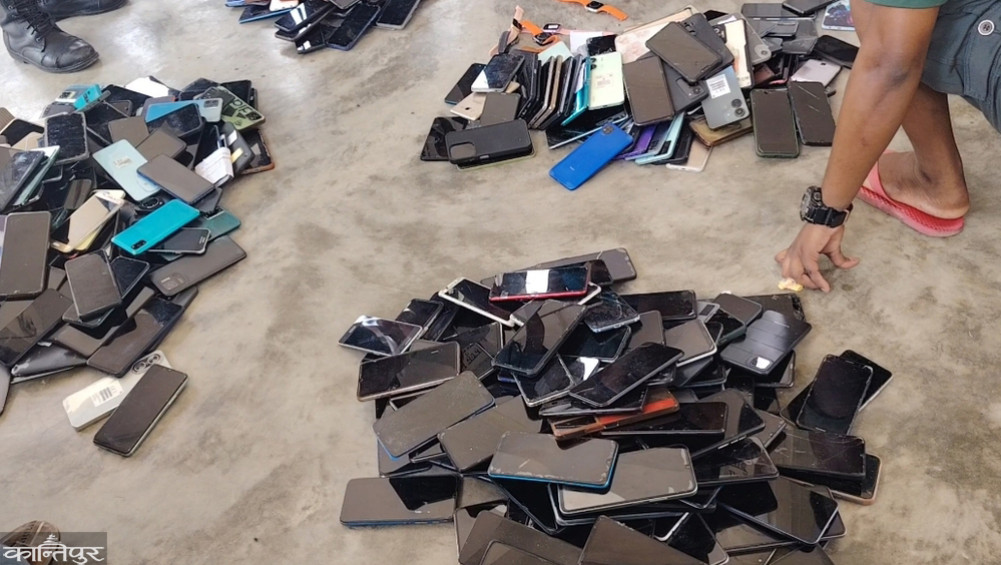
Police destroyed mobile phones and smart watches used during the SEE exam in Siraha by submerging them in water and breaking them.
There is widespread criticism of the police on social media regarding this issue. The way the police destroyed these digital gadgets has raised a different question. Is this the way to destroy electronic materials? Of course, those materials of students are not old and damaged goods. However, there is no method in Nepal to destroy or manage such damaged and useless electronic materials.
Generally speaking, the lack of proper management of damaged and useless electronic materials and the careless disposal of such waste are also creating serious risks to the environment and human health. But, ironically, we have neither a policy nor the infrastructure for managing such electronic waste.
Be it a mobile phone or a television, a washing machine or a refrigerator or any other electronic material that we use daily, what do you do when they break? People usually throw it away like normal waste or sell it as garbage. But, did you know?
The electronic devices that you and I throw away or sell in this way, i.e. e-waste, are causing serious environmental and health problems. The United Nations Global E-Waste Report 2024 showed that about 42,000 metric tons of electronic waste were being generated annually in Nepal from 2021 to 2023. And, Pratidev pointed out that this rate is increasing by 18 percent.
This report is now coming out in 2027 and it is projected to increase further from 2023 to 2026. Despite such a large amount of waste being generated, Nepal does not have any reliable government mechanism or plant to collect and manage it. Currently, the management of the entire electronic waste in the country is completely dependent on the informal sector, i.e. the local garbage collectors.
Scrap collectors collect old items from homes and only remove metals such as plastic, copper and aluminum that they can sell. In the process, old wires are burned openly to extract the copper, which directly increases air pollution.
Even more dangerously, the remaining parts that are no longer useful, such as TV picture tubes, mobile phone batteries and lead-acid batteries from vehicles, are dumped directly on river banks or in major landfill sites. When these materials are dumped in this way, the harmful chemicals such as lead or mercury and cadmium in these materials are mixed with the soil and groundwater, causing irreparable damage to human health and the ecosystem.
How are the lithium battery cells used in electric vehicles managed once they become useless? There is no work for that in Nepal. What is more serious is that despite the large amount of e-waste being produced in Nepal, we do not have any concrete law to control it.
The Waste Management Act, 2068 BS does not have any provisions related to e-waste, electrical and electronic waste. Similarly, the Environmental Protection Act, 2076 BS, although it covers environmental protection issues, has not provided a clear and concrete strategy for e-waste management.
Even after such a major crisis, there is no legal clarity in Nepal. Companies that produce or import goods internationally are required to manage old goods under Extended Producer Responsibility (EPR). Despite such provisions, since this policy is not implemented in Nepal, manufacturers and importers can easily get away with selling their goods and the country has to bear the long-term burden of waste.
Experts claim that if e-waste recycling plants and strict policies are not introduced in time for their management, our landfill sites will become toxic. Now let's think about it, where and how should we dispose of our useless phones, TVs, cars, or other electronic devices?