The first image, titled 'Hello, World', shows the vast Atlantic Ocean spread out in blue. The image also captures the glow in the atmosphere as the Earth blocks the sun and green auroras at both poles.
We use Google Cloud Translation Services. Google requires we provide the following disclaimer relating to use of this service:
This service may contain translations powered by Google. Google disclaims all warranties related to the translations, expressed or implied, including any warranties of accuracy, reliability, and any implied warranties of merchantability, fitness for a particular purpose, and noninfringement.
The US space agency (NASA) has released the first high-resolution images of Earth taken by astronauts on the Artemis 2 mission as they passed halfway between Earth and the moon.
The images were taken by mission commander Reed Wiseman. NASA said the images were taken after the final engine burn to push the spacecraft into lunar orbit. According to NASA's online dashboard, the Orion spacecraft is now about 228,500 kilometers from Earth and about 132,000 miles from the moon.
Astronaut Christina Koch said the crew was delighted to pass it 2 days, 5 hours and 24 minutes after launch.
A bird's-eye view of Earth
The first image, titled 'Hello, World,' shows the vast Atlantic Ocean spread out in blue. The image also shows the glow in the atmosphere as the Earth blocks the sun and green auroras at both poles.
The image shows the Earth upside down, with the Western Sahara and Iberian Peninsula on the left and eastern South America on the right. NASA has confirmed that the bright planet in the lower right of the image is Venus.
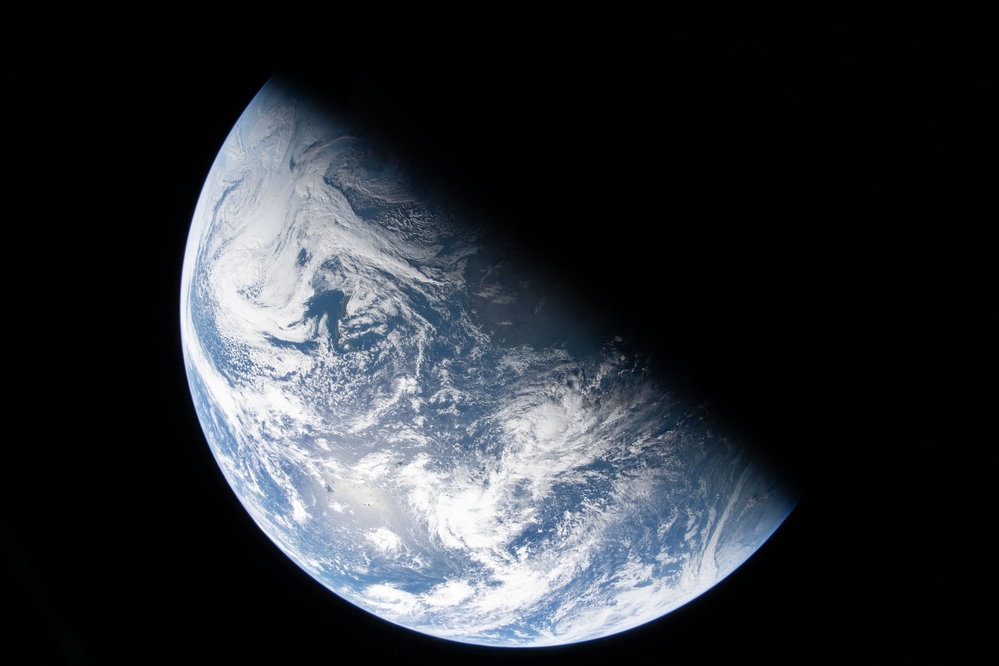 The images were taken after the successful completion of a 'trans-lunar injection burn' on Friday morning, according to the BBC. This lifted the Orion spacecraft out of Earth's orbit, carrying four astronauts on a journey of more than 320,000 kilometres (200,000 miles) to the moon.
Artemis 2 is now on its way back to Earth after passing behind the moon. This is the first time humans have gone beyond Earth's orbit since 1972.
The spacecraft, launched from the Kennedy Space Center in Florida, will reach the far side of the moon on April 6 and splashdown in the Pacific Ocean on April 10.
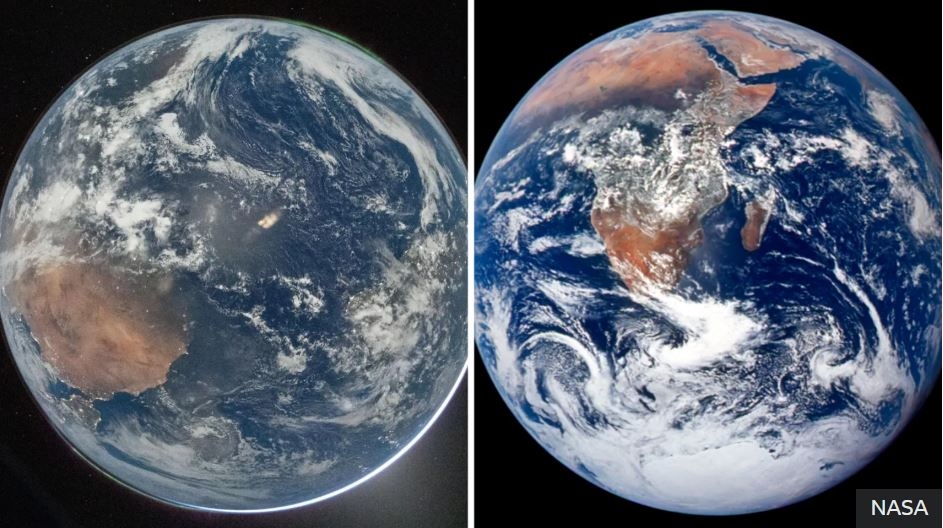 Two images of Earth: now (left) and 54 years ago (right)
NASA has also compared the image of Earth taken by the Apollo 17 team in 1972 (the last time humans set foot on the moon) and the current image from 2026.
NASA wrote, 'We've come a long way in the last 54 years, but one thing hasn't changed: Our home looks amazing from space!'

