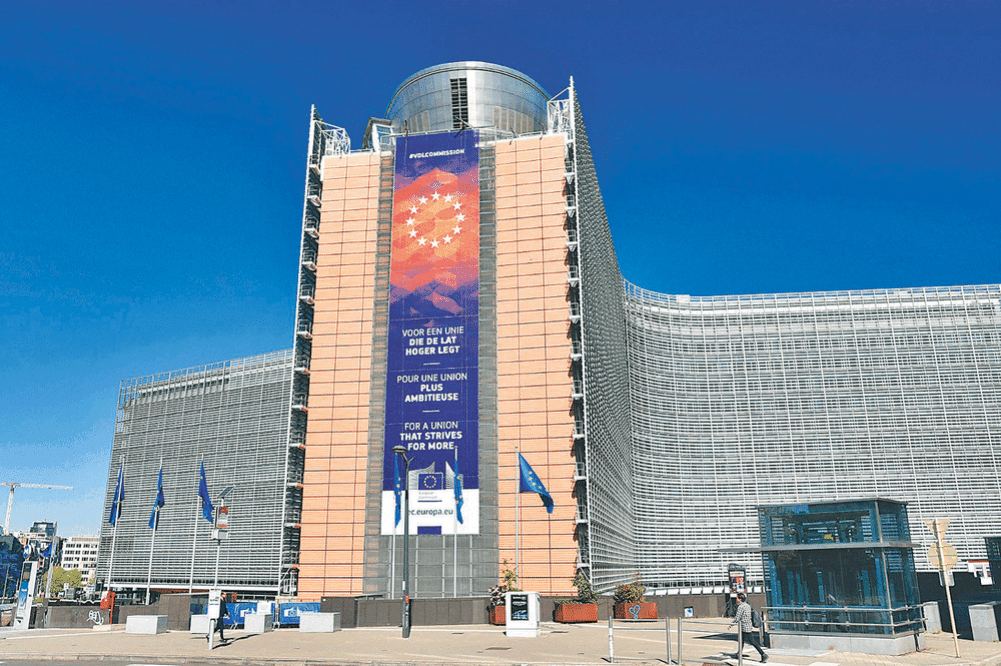
Europe raises $20 billion to build gigafactories to follow US and China in AI technology, experts question the purpose of large structures
We use Google Cloud Translation Services. Google requires we provide the following disclaimer relating to use of this service:
This service may contain translations powered by Google. Google disclaims all warranties related to the translations, expressed or implied, including any warranties of accuracy, reliability, and any implied warranties of merchantability, fitness for a particular purpose, and noninfringement.
Huge artificial intelligence (AI) factories are going to be built in various European countries. According to Reuters, Europe is going to raise 20 billion dollars to build such gigafactories in order to follow the US and China in AI technology. The work of setting up the factory is being started from next year. But experts have raised questions about the purpose of such gigafactories.
According to the information placed on the website of the European Commission, for this project, through the partnership of 'The European High Performance Computing Joint Undertaking' (Euro HPC JU), first 7 and then 6 AI Gigafactories are going to be established at 13 locations.
According to Euro HPC JU, AI factories will be established in different places in Finland, Germany, Greece, Italy, Luxembourg, Spain, Sweden, Austria, Bulgaria, France, Poland and Slovenia.
Euro HPC is set to host new AI-optimized supercomputers at five of the sites selected for AI factories (Finland, Germany, Italy, Luxembourg and Sweden). The 'Maronostrum-5' supercomputer launched a year ago by Euro HPC will be upgraded and operated at the AI factory in Spain. Currently, this supercomputer is housed in the Barcelona Supercomputing Center.
In Greece, an AI factory will be established and operated as an upgrade of the currently operating "Daedalus" supercomputer. According to the European Commission, there will also be an experimental platform in the AI factories in Finland and Spain, and it will develop and test the latest AI models, as well as work on expanding the state-of-the-art infrastructure to promote cooperation across Europe.
"In the first phase, these seven AI factories are being established through a combination of local resources from the European Union and Member States," the Commission's website said, adding that the project represents a collaboration between 17 European countries. Under this, various consortia will move forward through multinational partnerships.
AI factories, especially AI hubs, have been moved with the aim of building a network, according to the Commission. The hub will provide AI startups, small and medium-sized businesses and researchers with cutting-edge AI-based high-performance computing resources, training and technical expertise, according to the website.
AI factories in France and Germany will operate Europe's first exascale supercomputers named Alice Raycock and Jupiter. The European Commission expects that Austria, Bulgaria, Poland and Slovenia will also establish new AI-optimized systems and further expand Europe's AI infrastructure through AI factories.
New AI models and technologies will be developed and tested in the AI factory to be built in Ulisse, Germany. It is announced that these 13 AI factories will form an interconnected network to promote AI innovation across Europe. Each factory will act as a 'one-stop shop' in itself and will serve AI startups, small
and providing support to medium-sized enterprises and researchers for their dataset development, according to the commission's website. Just last month, European Commission President Ursula von der Leyen announced plans to build large data centers for AI infrastructure development. At the "World AI Conference" held in Paris, the capital of France, Commission President Von der Leyen pointed out the need to make Europe a leader in the latest developments in AI.
"We want Europe to move forward in the field of AI," she said, "so that we can make AI an integral part of our daily lives and use." She announced at the same time the plan to mobilize 200 billion euros for AI investment in Europe.
He said the investment would be used to establish an AI gigafactory similar to the European nuclear agency CERN. Europe's AI Gigafactory project faces several challenges, according to a Reuters analysis. According to Reuters, obtaining semiconductor chips and ensuring power supply will be major challenges.
"Even if we build such a large computing factory in Europe and prepare an AI model in that infrastructure, then what do we do with that model?" Bertin Martens of think tank Bruegel told Reuters.
The project is expected to help startup companies like France's Mistral expand. This startup is supported by American chip maker Nvidia. The Commission expects Mistral to create a local AI model in the future that is compatible with European AI laws and data protection policies.
But in the absence of large cloud service providers in Europe such as Google and Amazon or companies with millions of customers such as ChatGPT maker OpenAI, building such a large hardware for AI is a risky move, according to Reuters' Tubby Stirling. Europe is investing heavily in AI factories to establish itself as equal to the US and China in AI. These factories are said to be Europe's strategic initiative for innovation, collaboration and reliable AI model development.
The European Commission and Member States have allocated funds for this project. The AI factories in the first phase will receive about 1.63 billion US dollars and in the second phase, six AI factories in Austria, Bulgaria, France, Germany, Poland and Slovenia will receive an investment of about 528.65 million dollars.
From a geopolitical point of view, this initiative is expected to strengthen Europe to maintain sovereignty in technology. It is expected to reduce Europe's dependence on AI technologies, especially from the US and China. After China has developed advanced generative and agentic AI technology such as Dipsic and Manus at a low cost, it seems that other organizations and countries including Europe have been encouraged to develop AI infrastructure.
Along with this, the European Commission also aims to set global standards for ethical and reliable AI by building a strong AI ecosystem. (with the help of the agency)