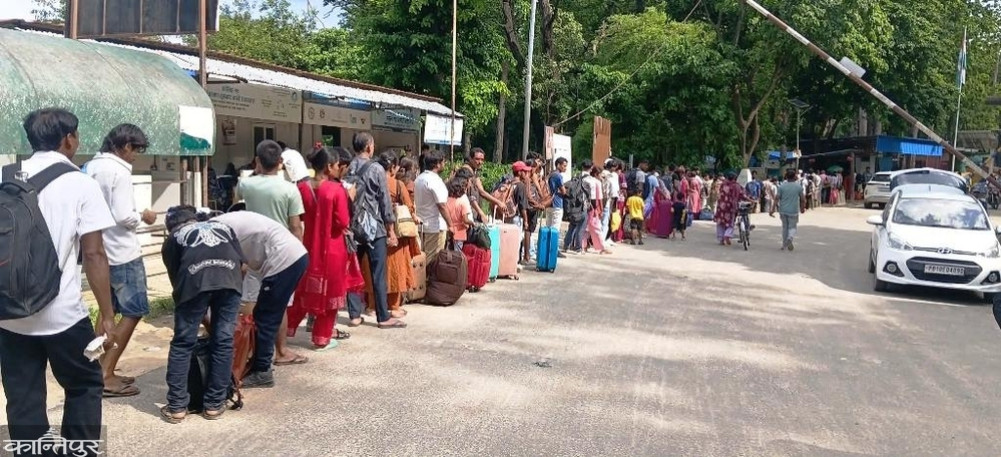
Hundreds of Nepalis have begun crossing into India daily in search of work during the monsoon season through the border points of Kailali and Kanchanpur.
We use Google Cloud Translation Services. Google requires we provide the following disclaimer relating to use of this service:
This service may contain translations powered by Google. Google disclaims all warranties related to the translations, expressed or implied, including any warranties of accuracy, reliability, and any implied warranties of merchantability, fitness for a particular purpose, and noninfringement.
In recent days, there has been a steady stream of people entering various cities in India through the Trinagar border in Kailali and the Gaddachauki border in Kanchanpur in search of work. Every day, from around 2 or 3 in the afternoon until late evening, people from various districts of Sudurpaschim and Karnali Provinces are crossing into India in search of employment.
Those unable to find work in their villages have been going to India for employment throughout the year. However, at this time of year, after the rice planting is finished, there is a large crowd of workers from both the hills and the plains crossing the border into India.
Punarama Chaudhary of Sukkhad, Ward 8, Ghodaghodi Municipality, Kailali, works as a house-building mason in his village. Having started masonry work from a young age, employment in India has also become a lifeline for him to support his family. But since there is no masonry work during the monsoon, he heads to India and takes up other jobs.
This year as well, on Wednesday, he set out for Almora in Uttarakhand with seven neighbors. With plans to work in India throughout the monsoon, he crossed into India via the Gaddachauki border. “There’s no work here during the monsoon. How can I support my family for three or four months?” Chaudhary said. “I have relatives and acquaintances working in Almora. The work is good, and they’ve asked me to come. That’s why I’m going with my friends.”
He set out for Almora with his neighbors Bhukhali Chaudhary, Santosh Chaudhary, and five others. Hoping to find work in house construction, road building, and similar jobs in Almora, they decided to head to India after finishing their agricultural work.
On Tuesday, at the Trinagar border in Dhangadhi, Ramesh Nepali of the remote Sigash Rural Municipality-3 in Baitadi was found drenched in sweat from the heat while waiting in the SSB inspection line, accompanied by his elderly mother and young children as they crossed into India. They were in a hurry to reach Pune in Maharashtra, India. Having worked in India for several years, Ramesh decided to take his family for a long stay after securing work there.
In recent years, Nepali workers have started going to India not just for short-term jobs but also to stay for extended periods. Most of those who travel to remote areas of India during the monsoon in search of work share the same plight: “There’s no work in the village, it’s hard to make ends meet. No matter what kind of job we find, we have no choice but to go to India.” They say that in the hills, monkeys, wild boars, and porcupines don’t even let them harvest their crops.
The number of women relatives going to India in search of work along with the men has also started to increase. In the past, most people from the hills and plains of Sudurpaschim who went to India for work headed to border areas like Himachal, Uttarakhand, Delhi, and Punjab. But in recent years, employment destinations have expanded to include Mumbai and Pune in Maharashtra, Bengaluru in Karnataka, Chennai, and Ahmedabad and Surat in Gujarat.
Workers from the Tharu community in the western Terai are also employed in hotels, restaurants, and construction sectors in large cities. Ramsingh Badayak of Laljhadi-2, Kanchanpur, and Shilpi Rana of Punarbas Municipality-1 are both carpenters. They reached Trinagar in Kailali on Tuesday to go to Pune, India. Nepali workers also go to places like Shimla in Himachal to pick apples and for development and construction work, as well as to the hilly regions of Uttarakhand for similar jobs.
During the monsoon, the risk of floods and landslides is high in the high hill regions of Uttarakhand and Himachal. Every year, Nepali workers lose their lives in floods and landslides. Last year too, many Nepalis lost their lives in floods and landslides in the Dhauli area of Pauri Garhwal and Dharali in Uttarkashi. Five people died in Pauri Garhwal, but there are no statistics on how many Nepalis died in Dharali. Nor has any Nepali government agency investigated the matter.
Currently, around 500 to 700 Nepali workers are crossing into India daily through the Gaddachauki border in search of work. Most of them go as seasonal workers. It is customary for them to go to India after planting rice and return home for Dashain and Tihar festivals.
The number of people crossing into India through the Trinagar border in Kailali is similar to that at Gaddachauki. At the Nepal Police checkpoint near the Gauriphanta border, records are kept of Nepali citizens going to India in search of work. On Tuesday alone, by 3 p.m., about 500 Nepalis had crossed into India. “The border remains open until 8 p.m. This number could increase further,” said a police security officer who keeps records of those crossing into India. “Since the last week of Asar, the number of people going to India for work has been increasing daily. It will continue to rise throughout Shrawan. During Dashain, Tihar, and other festivals, however, the number of people returning to Nepal is higher.”
Most of those crossing into India through the Gaddachauki border in Kanchanpur are headed to Shimla in Himachal and Almora, Garhwal, and other areas in Uttarakhand. Every year, a large number of Nepalis go there hoping to find work in agriculture and development sectors. “For the past ten or twelve years, I’ve been going to India during the monsoon and returning home for Dashain and Tihar,” said Punarama. “I’ve been to Nainital, Dehradun, Garhwal, and other places. This is my first time going to Almora.” As in previous years, this time too he will return home only for Dashain. After harvesting the crops, he said he would find work in the village during the winter.
In previous years, most of those going to India for work due to lack of employment in the villages were young men. Now, those seeking work include women and even children. Some are going with their parents, while others are going specifically to work. After the monsoon break in schools, children also go to India with their parents and now return only for Dashain.