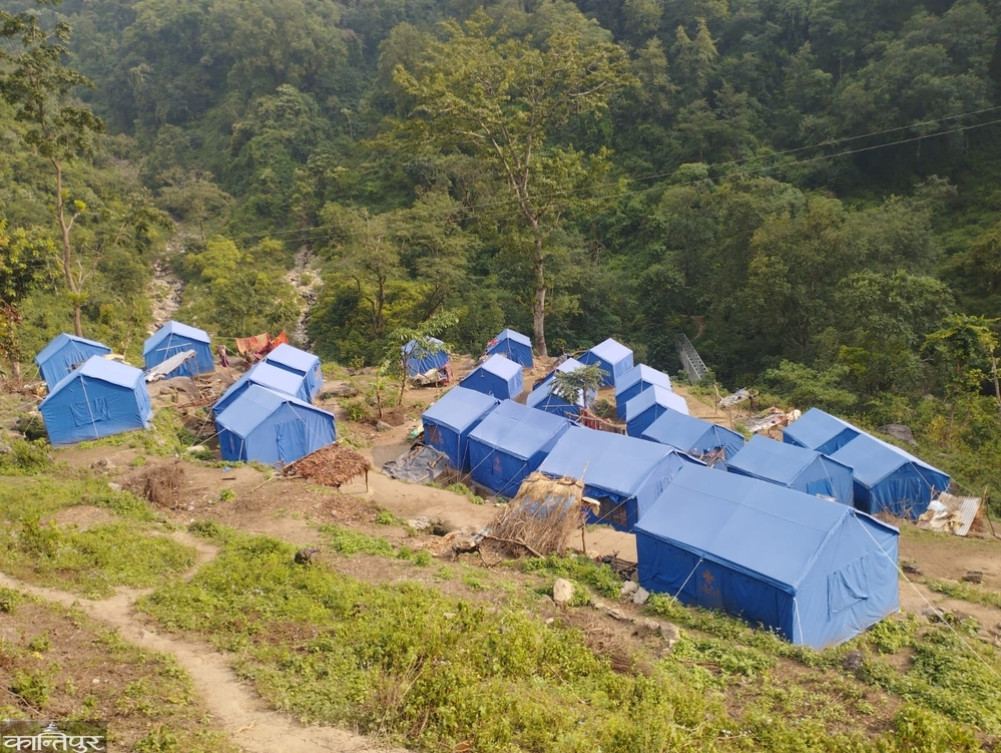
After their settlement was put at risk by a landslide, residents of Malagaun who were displaced during the monsoon of 2022 have been spending their nights in tents for four years, hoping for resettlement.
We use Google Cloud Translation Services. Google requires we provide the following disclaimer relating to use of this service:
This service may contain translations powered by Google. Google disclaims all warranties related to the translations, expressed or implied, including any warranties of accuracy, reliability, and any implied warranties of merchantability, fitness for a particular purpose, and noninfringement.
As soon as the monsoon begins, fear grows in the hearts of the residents of Malagaun in Alital Rural Municipality–1. Four years ago, after a landslide put the entire settlement at risk, 24 families who were forced to leave their homes are still waiting for permanent resettlement.
Years have passed since the National Disaster Risk Reduction and Management Authority concluded that the settlement needed to be relocated, but as the resettlement process has yet to be completed, they continue to endure a difficult life in temporary tents.
During the monsoon of 2079 BS, cracks appeared in the land of Malagaun due to a landslide, making it impossible to live in the settlement. After the landslide put the village houses at high risk, technical experts concluded that the entire settlement needed to be relocated. Since then, the 24 families have been living under tarpaulins in a place called ‘Basti’ across from the village. However, even after four years in tents set up for temporary shelter, their situation has not been managed.
Family members living in tents still return to the village during the day to work in their fields and on their land. After evening falls, they return to the tents to spend the night. They say that when it rains, they have to stay in the tents even during the day. Every monsoon, they are forced to spend their nights in fear of landslides and falling rocks.
Dan Bahadur Aauji of Malagaun complained that although the government has promised resettlement, there has been no progress in four years. “The tarpaulin provided earlier has now started to rot. Water leaks in. We have to cross the river to go to the village. When the river swells during the monsoon, the problem gets worse,” he said. “There is no drinking water supply. Pipes have not been brought to the settlement. It is difficult even to buy food. There is no work, and it has become very hard to support the family.”
According to him, since there is a river between the tents and the old settlement, travel becomes risky during the rainy season. He said that it is difficult to carry daily necessities and to take sick people to the hospital.
Another local, Sunita Aauji, said that her family of six has been living in a tent for four years. “We have been waiting for a safe house since the day of the landslide. But we still have to live in a tent,” she said. “The tent has rotted. There is fear of rocks falling from above. When it rains, it is even scarier.” According to her, they are forced to carry small children on their backs while crossing the river. She said that the risk increases even more when the river swells during the monsoon.
After the landslide, various government agencies and non-governmental organizations such as the Multipurpose Development Society (MPDS) and the Rural Women Development and Unity Center (RUDUC) provided tarpaulins and relief materials to the residents of Malagaun. Although this relief solved the immediate problem to some extent, the lack of long-term management has forced them to live in temporary tents for four years.
According to locals, it is not even possible to live safely in the tents. The tarpaulins are old and leak. Basic facilities such as drinking water, toilets, electricity, and health services are insufficient. They complain that the lack of food and employment has made daily life even more difficult.
Yagyabahadur Deuba, Ward Chair of Alital Rural Municipality–1, said that in previous years, the rural municipality allocated a budget of 100,000 to 200,000 rupees for the management and food support of displaced families. However, he said that after the expenditure was shown as unsettled in last year’s report of the Office of the Auditor General, they were unable to allocate a budget for food support.
He said that the rural municipality has been providing tents, tarpaulins, and other necessary materials as needed. According to Deuba, the technical assessment of the proposed resettlement site called ‘Basti’ has also been completed. He said that the study concluded that the site is suitable for settlement. “We have been continuously working for the resettlement of the 24 families from the beginning,” he said. “A letter has come from the Authority to initiate the process of relocating Malagaun to another place. Now, we expect the resettlement process to move forward at the site called ‘Basti’.”
According to Tek Rana, sub-engineer at Alital Rural Municipality, the National Disaster Risk Reduction and Management Authority has already corresponded regarding resettlement. He said that the details of the affected households must be entered by the municipality and sent to the relevant agencies through the District Administration Office. “The municipality enters the details of the affected households and sends them to the district. After that, the resettlement process moves forward from the relevant agencies,” he said.
He said that the process has been slower than expected due to geological studies, budget management, and the large number of affected settlements. He added that not only Malagaun, but many other settlements in the rural municipality also need to be relocated.
Amar Bahadur Wali, Chief District Officer of Dadeldhura and Coordinator of the District Disaster Management Committee, said that the issue of Malagaun’s resettlement is under the process of the National Disaster Risk Reduction and Management Authority. Wali said that the process of relocating Malagaun’s settlement has been ongoing from the beginning. According to him, the Authority’s technical team recently conducted a field study. He said that the report of that study was received by the District Administration Office on the 30th of Ashar.
The report states that the resettlement process should be advanced in accordance with Section 13 of the Disaster-Affected Private Housing Strengthening, Reconstruction, and Resettlement Grant Procedure, 2081. He said that the necessary process will be advanced in coordination with the local level as per that procedure.
According to Alital Rural Municipality, not only Malagaun but also settlements such as Balocha, Obha, Dhupkheda, Khinnebhadi, Koirali, and Ghogala are at high risk of landslides. The rural municipality has stated that the relocation of those settlements is also necessary.