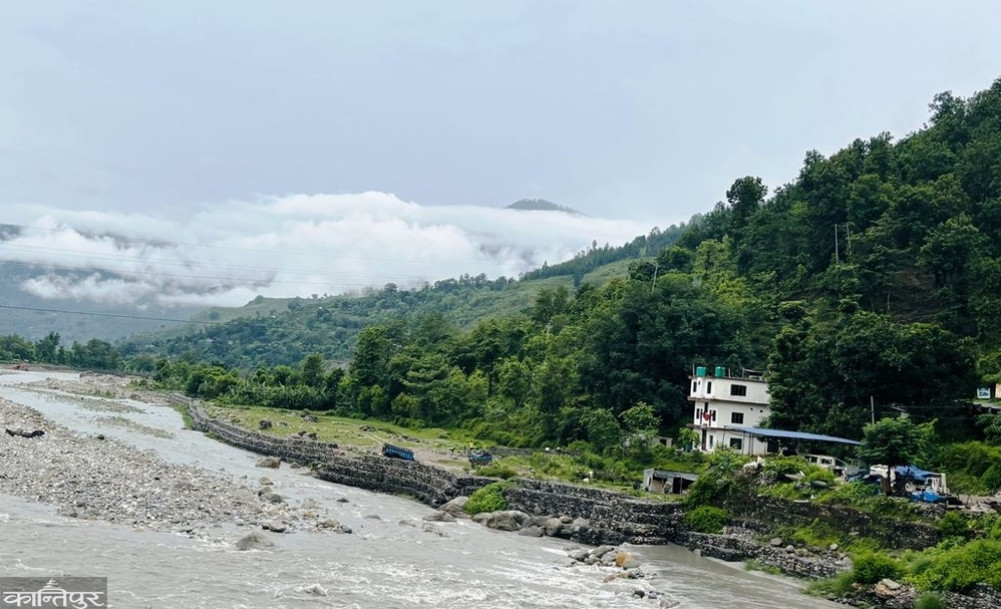
The district response plan states that nine out of 10 local levels in Achham are at high risk of floods and landslides due to steep terrain and weak soil structure.
We use Google Cloud Translation Services. Google requires we provide the following disclaimer relating to use of this service:
This service may contain translations powered by Google. Google disclaims all warranties related to the translations, expressed or implied, including any warranties of accuracy, reliability, and any implied warranties of merchantability, fitness for a particular purpose, and noninfringement.
Due to steep and weak terrain, 9 out of 10 local levels in Achham are at high risk of floods and landslides. According to the ‘Disaster Response Plan 2083’ recently approved by the District Disaster Management Committee, only Bannigadhi Jayagarh Rural Municipality is at medium risk of disasters. The remaining 9 local levels are in the high-risk list.
In the stratification (pairwise ranking) conducted by the District Disaster Management Committee based on disaster risk and vulnerability, landslides have been given first priority (weight 7) and floods have been given fourth priority (weight 4). This shows that landslides and floods are the most challenging monsoon-related disasters in Achham.
Mithu Badi, 49, of Pul Bazaar, Sanfebagar Municipality-4, has spent most of her nights sleeping during the rainy season for years. According to her, the nearby Budhi Ganga has been flooding the Pul Bazaar along with the houses. Mithu says that three other 10 families from the Badi community have been suffering every year in this Pul Bazaar, which is the old market of Sanfebagar. ‘Every rainy season, the Budhi Ganga rises.’ The house nearby is flooded. ‘There is nowhere to move to. When it rains, we have to stay outside all night.’ She said, ‘Last year, the entire market was flooded.’ Even then, we begged everyone to move our house. Now, no one cares.’
Ramesh Badi said that although people from other communities have land and can move during the rainy season, the Badi community has nowhere to go. ‘We don’t even have land to move from the place where we are currently living.’ Every year, floods enter the house,' he said, 'Even now, the Badi community has to work all day to make ends meet. On top of that, they have to run away when it rains.'
After the Budhi Ganga started eroding every year, not only the residents of Pulbazar but also the Sanfebagar Municipality are at risk. Ram Bahadur Kunwar of Sanfebagar Municipality-4 said that the Baidyanath Dham to Sanfebagar area has to bear losses worth crores of rupees due to inundation and erosion every year. 'I have 5 plots of 12 ropanis of land in my Lalpurja. But, all of that has been eroded by Budhi Ganga. Many of the fields here have already been eroded,' he said, 'Baidyanath Dham, one of the four Dhams of Nepal, has also been shrinking in terms of area due to inundation every year. If we do not think in the long term, the risk of not being able to save Sanfebagar is increasing.'
Sanfebagar area is at risk due to the Budhiganga River and Sanfebagar Municipality itself is at risk, said Mayor Rajendra Kuwar. He said that the population of about 15,000 in the Sanfebagar area is still at high risk. 'The entire market area of Sanfebagar is at risk. We are also making many plans to see how it can be managed.' But the budget coming from the government itself does not seem to be utilized properly,' he said. 'It seems that individuals are working on the embankment in their own way with their own plans. There is no cooperation and coordination with the municipality.'
Some settlements in Achham are also at the same risk of landslides. Last year, 48 people from 9 houses in Seripakha, Chaurpati Rural Municipality-6, had to be displaced for weeks in the building of the community health unit due to the risk of landslides. After the ground cracked and large rocks got stuck and threatened to wash away the settlement, Chaurpati Rural Municipality Chairman Bhim Bahadur Saund had pointed out that about 25 houses in the settlement had to be relocated. At that time, Chairman Saund said that the District Disaster Management Committee had not been able to proceed with the technical examination and long-term relocation process.
Despite efforts to gather the necessary materials for disaster preparedness in the district, the lack of skilled manpower has emerged as the main problem. Panchadeval Binayak Municipality Mayor Ambika Chalaune said that despite having the necessary resources, the materials have been stagnant due to the lack of manpower. ‘We have brought the necessary materials from the Disaster Management Authority. They have been stagnant because there is no manpower to use them. Now, the materials will be used with the help of the Nepali Army,’ she said.
According to the data of the Disaster Response Plan 2083, 186 people have lost their lives due to landslides in Achham in the past 9 decades alone. Similarly, 22 people died and 1 person went missing in the floods and landslides that occurred in Kamalbazar Municipality, Dhakari Rural Municipality and Turmakhand Rural Municipality due to heavy rains from Bhadra 28 to 31, 2079. The action plan states that 35 houses were completely destroyed during that time, while 125 houses were partially damaged. Due to limited resources and means, this plan can only provide immediate emergency assistance to a total of 500 households across the district.
Achham Chief District Officer Yagya Bahadur Budha said that to make the disaster response plan more effective, all municipalities in the district should be active and the understanding of the local level should be revised. ‘There is a disaster management committee at the local level, but it has not worked as expected.’ The understanding that all disaster work is the responsibility of the federal government was seen at the local level, said Pradya Budha, ‘We have suggested that the budget be managed in the disaster area.’ We have requested a list of which local levels have what disaster supplies. There is a risk of landslides in Achham due to the steep terrain. We are seeking the help of the local level to identify vulnerable settlements.'
He said that since the exact details of the disasters that occurred in the past years were not fully available, some flexibility had to be adopted in determining the level of disaster severity and that most of the preparedness activities still had to be implemented by external sources.