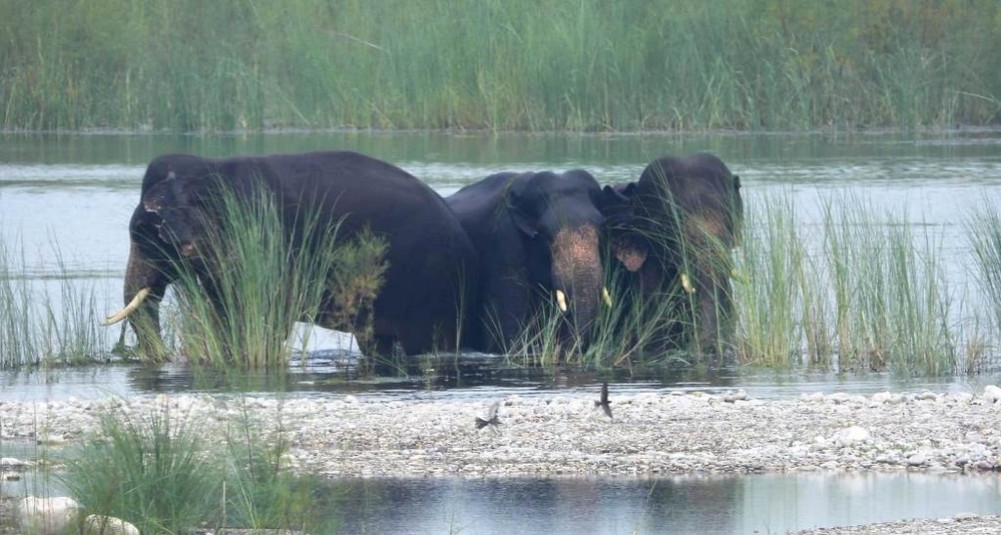
On Saturday night, drones were flown, sirens were sounded, and even gunfire was fired to try to drive back the elephants that had crossed the suspension bridge. At midnight, the elephants returned the way they had come.
We use Google Cloud Translation Services. Google requires we provide the following disclaimer relating to use of this service:
This service may contain translations powered by Google. Google disclaims all warranties related to the translations, expressed or implied, including any warranties of accuracy, reliability, and any implied warranties of merchantability, fitness for a particular purpose, and noninfringement.
Three elephants, which were seen in a pond near a four-lane concrete bridge built on the Mahakali River, entered the Shuklaphanta National Park only at midnight on Sunday morning. The elephants that came through the suspension bridge on Saturday night returned via the same route.
Despite various efforts by the park administration and police, the elephants could not be returned. They had been flying drones, blaring sirens and firing throughout the day. But in the middle of the night, the elephants returned the way they came.
Locals were panicked after three wild elephants reached the settlement. There was a risk of them entering the settlement at night after they could not be returned to the park despite various efforts throughout the day. The park staff and security personnel had guarded the area for this.
This is not the first time that elephants have entered the settlement from the park. Sometimes elephants enter settlements in herds or in single or double numbers. Sometimes, there is also damage to agriculture and humans. Residents around the park have been facing such problems every year.
Purushottam Wagle, Conservation Officer of Shuklaphanta National Park, says that elephants enter settlements mainly for two reasons. ‘First, if a settlement is settled in the traditional way, it follows the path of its ancestors.’ In this, it usually moves with a herd.
Second, elephants that have been separated from the group or have been ostracized enter settlements. Such elephants are found in single or double numbers or in small groups. They can even cause trouble in the settlement,' he said, 'The elephants seen in the pond may have separated from the group, but their movements are yet to be monitored.' He said they may have felt safe as there is plenty of water and grass to graze in the pond.
Elephants are matriarchal creatures that usually move in herds. The female elephant leads the herd. Even though the males are adults, they are ostracized if they do wrong things in the group. Wagle says that those ostracized wander around and sometimes enter the settlement and cause trouble. The elephant that killed a woman near the park last year was also a tailless male. It is estimated that that elephant may also have been ostracized. He said that elephants follow the path of their ancestors, and since many places along the traditional route have become densely populated, there is conflict between elephants and humans.
‘Elephants are animals that travel long distances, sometimes they even enter settlements in search of tasty food,’ said Laxmiraj Joshi, head of the Shuklaphanta Conservation Program of the National Trust for Nature Conservation. ‘Now that paddy has been planted, there is also sugarcane in some places, they come out in search of tasty food.’ According to him, the elephants seen on the banks of the Mahakali may have come from Shuklaphanta and crossed the Mahakali via Dodhara Chandani to reach the Nandhaur Wildlife Sanctuary in India.
Joshi says that since there is grass and water in the pond, they may have been coming and going in search of good food. The number of elephants has also increased in Shuklaphanta in recent times. Joshi says that a large number of elephants are seen throughout the twelve months. He said that this is why the elephants may have come out in search of food. According to him, since elephants walk long distances, they also need more food. He said that since they have to graze for 18-20 hours a day, elephants that come out during the farming season regularly enter the settlements to eat rice and sugarcane. Conservation Officer Wagle said that the issue of whether the elephants seen in the pond are native to Shuklaphanta National Park or not will be studied. Some of the elephants from the park also reach here on their migration.