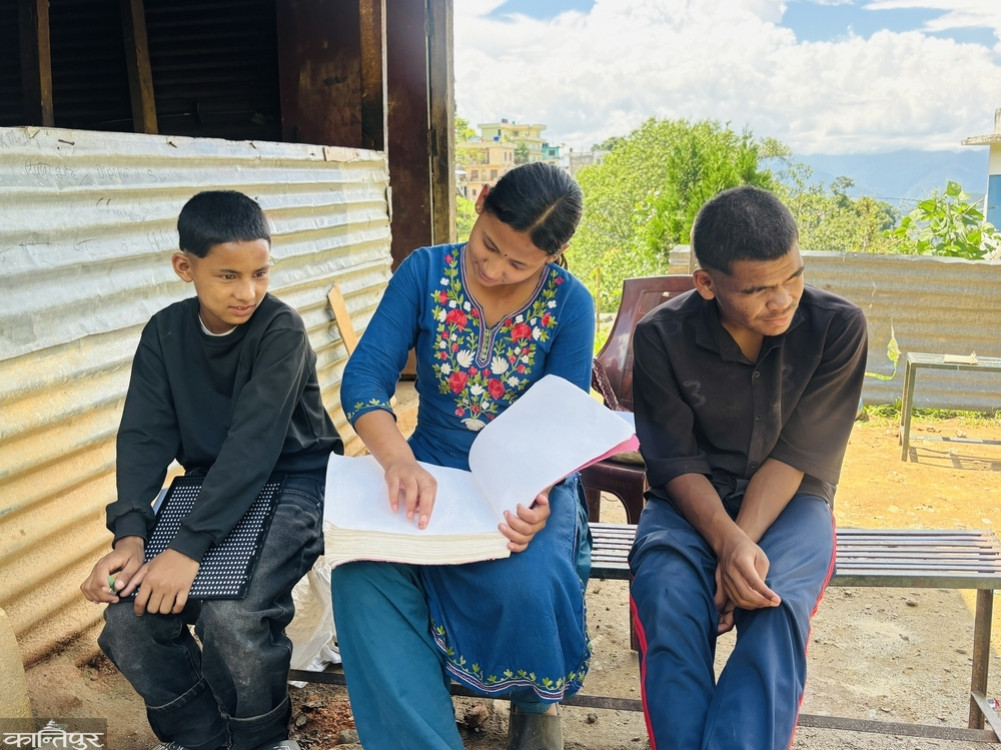
Due to geographical remoteness, economic hardship, and a lack of disability-friendly infrastructure, visually impaired children in the district are still deprived of education.
We use Google Cloud Translation Services. Google requires we provide the following disclaimer relating to use of this service:
This service may contain translations powered by Google. Google disclaims all warranties related to the translations, expressed or implied, including any warranties of accuracy, reliability, and any implied warranties of merchantability, fitness for a particular purpose, and noninfringement.
Lal Bahadur BK of Rahaf, Turmakhand Rural Municipality–1, a remote area of the district, is 14 years old. Born blind, he remained out of reach of education for a long time, even after reaching adolescence.
His family, living in a village far from the district headquarters Mangalsen, had no information about where and how blind children could study. Only seven years ago did they learn that Shodasha Secondary School in the district headquarters had provisions for teaching blind children, after which he came to Mangalsen with his family's support.
However, between receiving this information and attending school regularly, his economic and geographical situation became obstacles. The family's poor financial condition and the fact that his father is also blind added to the difficulties. Reaching the school in the district headquarters, about two hundred kilometers from home, became his biggest challenge. Initially, Lal Bahadur came to Mangalsen once and enrolled, but after the school holidays, he returned home. After that, he could not return to school on time. “Even now, there are no vehicles to the village. My father is also blind. To reach the place where vehicles come, someone else has to carry me, and it costs four or five thousand rupees, so I couldn’t come back to study,” says Lal Bahadur. “When the school saw that I was enrolled but not attending regularly, they started looking for me. After a year, I somehow managed to gather the expenses and reached Mangalsen. Again, after the holidays, I went home. That time too, I couldn’t come to school for six months because I couldn’t pay the person to carry me on the way.”
Lal Bahadur is currently studying in grade 3 at the age of 14. According to the school, it takes a long time for blind children to recognize letters in the initial phase. To get their fingers accustomed, they are first made to distinguish large beads, then small beads, and only then taught Braille. It took him about five years to complete this process. Now, he sits in the classroom like other students, but the learning process is still not easy. “After learning Braille, it has become somewhat easier. But it’s still not as easy as it is for other students in the classroom,” he said.
For 14-year-old Deepa Budha, a grade 7 student at the same school, the classroom environment is also not as comfortable as she had imagined. Deepa, from Ramaroshan Rural Municipality–5, studied up to grade 2 at her village school. However, as she could not recognize letters and had problems with her eyes in sunlight, she left school. Even after learning that there were special classes for the blind in Mangalsen, it took her a long time to get there, mainly due to poor financial conditions.
After leaving school, Deepa also came to Mangalsen with her family’s support, learned Braille like Lal Bahadur, and now sits in the classroom like a regular student. However, she says that having many students in the same class and the teacher having to pay equal attention to everyone has affected her. “I can’t understand what’s written on the whiteboard. I have to study with the help of friends. There are 71 students in the class. It’s hard for the teacher to teach just one student in the classroom,” says Deepa. “If I keep asking questions in class, it disturbs others too. At times like this, I feel there should be a separate classroom and teacher for students like me.”
For Deepa, not only the internal environment for studying but also the school’s physical infrastructure has created another uncomfortable situation. As the school’s toilets and classrooms are not disability-friendly, they face daily difficulties. “I have to go to the toilet with the help of friends. We have to use the same toilets as other students. It’s even harder during menstruation.”
Thirteen-year-old Bhupendra Budha of Turmakhand Rural Municipality–4 is also blind from birth. Initially, he was enrolled in the local Kalikeswari Secondary School. However, due to the lack of appropriate learning materials and Braille, he could not recognize letters and left school. Only after many years did his family learn that such education was available in Mangalsen, and seven months ago, he was brought to Shodasha Secondary School. He is currently in the initial phase of learning Braille. So far, he has not been able to formally enroll in any class. The compulsion to study in a lower grade as he grows older has made him uncomfortable. “I haven’t even enrolled in grade 1. All my classmates are much younger. I regret not being able to study on time.”
According to Principal Brikesh Bogati, the government has allocated a quota of 10 students for blind students at Shodasha Secondary School. Currently, 7 students are enrolled. The school has arranged for two blind teachers to teach Braille to blind students in the initial phase. However, Principal Bogati says that due to a lack of awareness and access, children arrive at school at an older age, and by the time they are taught and formally enrolled in a class, they are already much older.
Currently, the school is teaching them in the classroom alongside regular students. However, due to a lack of necessary infrastructure and budget, the school administration has not been able to create a disability-friendly environment, even if it wants to, says Principal Bogati. “The school does not have a blind-friendly structure. The state has only focused on residential and teaching arrangements, not on infrastructure,” says Principal Bogati. “The lack of a blind-friendly structure has made things difficult for them.”
Principal Bogati says the experiences of blind children have exposed the state of implementation of the inclusive education policy and the reality faced by blind students in remote areas. He said that although the state has provided scholarships, accommodation, and teachers, the targeted group still does not have a comfortable environment due to geographical remoteness, poor economic conditions, and lack of physical infrastructure.