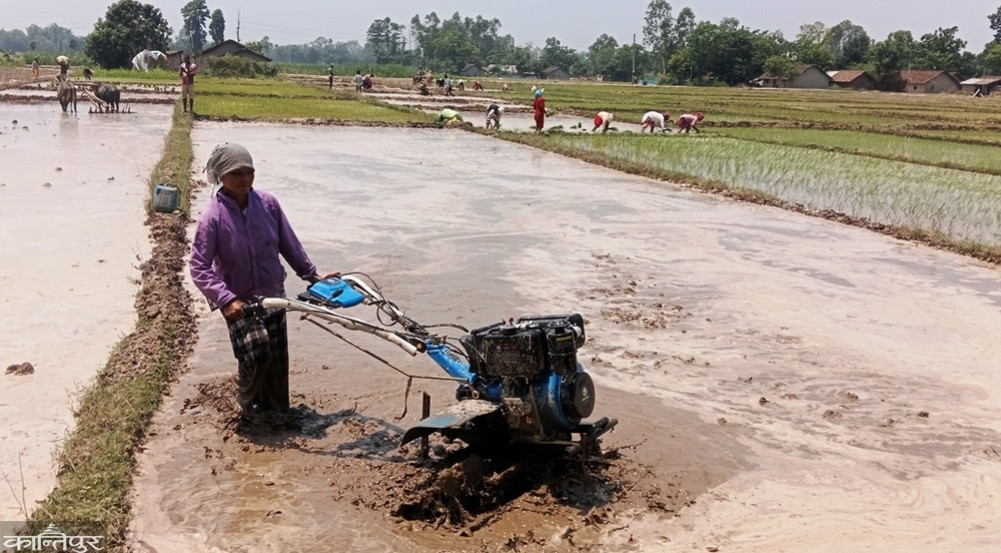
Farmers in Singhapur have simplified farming through the use of machinery and the enduring tradition of mutual cooperation.
We use Google Cloud Translation Services. Google requires we provide the following disclaimer relating to use of this service:
This service may contain translations powered by Google. Google disclaims all warranties related to the translations, expressed or implied, including any warranties of accuracy, reliability, and any implied warranties of merchantability, fitness for a particular purpose, and noninfringement.
Some are making mud in the fields with hand tractors, others are plowing with oxen. Women are planting rice in the same fields. This is the scene of rice planting in Singhpur, Belauri Municipality-5, Kanchanpur at the moment. But the specialty here is not just planting, but the tradition of alternating tillage. Farmers in the village are taking turns working in each other's fields to complete the planting.
It is difficult to find agricultural laborers in the village now. There are no large joint families like in the past. As the youth have left for employment, there is a shortage of laborers for farming. As a solution to this problem, farmers here are still preserving the old practice of alternating tillage. 'You cannot plant alone,' says local farmer Pushpa Chaudhary, 'A lot of manpower is required from plowing to planting. That is why four to five families work in everyone's fields in turn.'
The practice of alternating tillage is disappearing in many villages in Nepal. But the Tharu community of Singhapur has kept it alive. Along with farming, it has also strengthened mutual cooperation, trust and harmony between the communities.
According to local Nayan Chaudhary, the shortage of laborers has now made arram-parma a necessity. 'There are no workers during farming,' he said, 'Farming is not possible without arram-parma.'
When the planting is done collectively, the planting is completed quickly. After that, many farmers go out for wages. 'After planting, some work in the village, some go to work in India,' Nayan said, 'Working together also saves time.'
Selling a bull and buying a hand tractor
Shivraj Chaudhary, a farmer from Singhapur, has sold a plow bull this year and bought a hand tractor. He has been plowing with bulls for years, and after selling the bull for five thousand rupees, he raised an additional loan and bought a hand tractor for 90 thousand rupees. 'Raising cows has become expensive, and ploughing is difficult,' he said. 'With the hand tractor, anyone in the family can operate it.'
His wife Pushpa Chaudhary can also use a hand tractor to make mud in the fields. They say that this has not only saved labor but also time. Many farmers in the village are now attracted to agricultural equipment including hand tractors and power tillers. Many farmers have purchased large tractors, while small farmers have started using small equipment according to their needs. They have experienced that this has reduced both the cost and labor of farming.
The attraction of farmers has increased even more after the local level and the Agricultural Knowledge Center started providing subsidies for the purchase of agricultural equipment. According to the farmers, purchasing agricultural equipment once is now more economical than raising cows throughout the year. However, farming is still carried out based on the mutual cooperation and goodwill of the villagers.